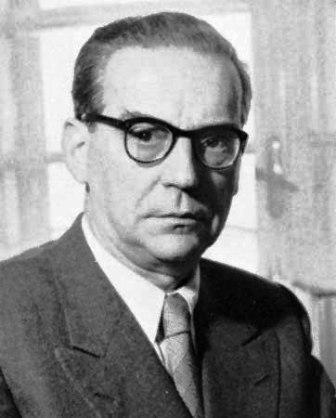
Ivo
Andrić ( Dolac , municipality of Travnik Bosnia , October 9 of 1892 - Belgrade ,
March 13 of 1975 ) was a writer Yugoslav who received the Nobel Prize for
Literature in 1961 "for the epic force with which reflected issues and described
human destinies of their country's history. "
Ivo Andrić was born on October 9, 1892 in Lašvi na Dolac near Travnik in
Bosnia-Herzegovina , then part of the Ottoman Empire . His parents, Antun and
Katarina Andrić Andrić (nee Pejic), were Catholics and residing in Sarajevo :
the birth of his son was in Dolac because they were visiting relatives. Andrić
was baptized with the name of Ivan, whose diminutive Ivo be known. His father
died when the future author was only two years old and her mother lacked the
resources to maintain it, was brought up by his mother's family in Višegrad ,
along the river Drina , where they will find the famous Ottoman bridge Mehmed
Pasa Sokolovic then would give title to one of his most famous novels, a bridge
over the Drina .
He did his secondary studies in Sarajevo. He started writing poetry during his
high school senior season: his first poem, "U Sumrak" ("In the twilight")
appeared in 1911 in the journal Bosanska vila . Also from this period, Andrić,
advocate of independence from Yugoslavia, became a member of the progressive
nationalist movement "Mlada Bosna" ("Young Bosnia"). He studied at the
universities of Zagreb , Vienna and Krakow .
During the First World War he was arrested by the Austrian authorities because
of his political activities revolutionary Šibenik first, and then in Maribor ,
where he remained until March 1915. After his release, he was confined in
Ovčarevo and Zenica. He remained there until the summer of 1917, when it had to
be admitted to the Hospital of the Sisters of Charity of Zagreb because of a
lung disease. When proclaiming a general amnesty, actively participated in the
preparation of the journal Književni jug ("Southern Literary") and published his
book of prose poems Ex-ponto , describing life as a big prison dominated by
fear, suffering and loneliness.
Following the creation in 1918 of the Kingdom of Serbs, Croats and Slovenes ,
Andrić became a civil servant. In 1919 he started working at the Ministry of
Religion in Belgrade , actively participating in the literary life of the city,
meeting with writers like Crnjanski , Vinaver , Pandurović and Sibe Milicic
Moskva in the cafeteria. In 1920 he began a successful diplomatic career. He was
sent on to the Yugoslav diplomatic missions in the Vatican (1921), Bucharest
(1921), Trieste (1922) and Graz (1923). Why not neglected literature: in 1920
saw the birth of a new book of prose poems, entitled Nemiri ("Problems") and a
story, Allie Djerzeleza Put ("The Journey of Ali Djerzelez"). In 1922 published
in journals other short stories, including "Za logorovanja" ("In the camp") and
"Zena od Kosti slonove" ("Women ivory").
During his diplomatic mission in Graz, he completed his studies, he had not
reached a conclusion because of the war, in June 1924 and a Ph.D. in philosophy
with a thesis on "The Development of Spiritual Life in Bosnia under the
influence of Ottoman government. " Then he was sent to Belgrade, and that same
year he published his first volume of short stories.
In 1926 he joined the Serbian Academy of Sciences and Arts, on the
recommendation of Bogdan Popović and Slobodan Jovanović . His next destinations
were diplomats Marseille (in 1926), Paris , Madrid (1928) and Geneva (1930).
Andrić
entered the diplomatic service of Yugoslavia , where he held various positions,
including ambassador to Germany . At the outbreak of World War II , in 1941,
resigned and returned to Belgrade permanently.
During
World War II he wrote three novels: The Chronicle of Travnik , The young lady
and a bridge over the Drina , which chronicles the life, customs and deeds of
his native Bosnia and its people. In them, Andrić describes the history of
Bosnia since its conquest by the Turks in 1389 , to the creation of the Yugoslav
state , after 1919.
Although he lived in Rome , Bucharest , Madrid , Geneva and Berlin , was his
home province, Bosnia , with its history, folklore and ethnic diversity,
cultural and religious, which provided him with the themes found in his works.
However, he considered himself a Yugoslav writer. Retreated from all public
activity at the end of his life. He died on March 13 of 1975 in Belgrade , then
capital of the Federal Republic of Yugoslavia (now the capital of the Republic
of Serbia ).
When he was awarded the Nobel Prize for Literature in 1961 , the committee
praised in particular "the epic force" with which human destinies described
affected by the history of his country, especially in his work A bridge over the
Drina . To Magris, Andrić's narrative is rooted in a choral epic, but rescues
individual life over time, which always deepens. His work, perhaps the best of
Yugoslavia, expresses anonymous wisdom that mixes humor and tragedy fable. His
posthumous Omer-paša Cans is an unfinished novel, about a renegade, who warns of
the specter hovers fratricidal country.
Works
Put Allie Đerzeleza 1920 . Tr. Djerlez Alija's journey .
Na Drini Ćuprija 1945 . Tr. A bridge over the Drina , Pocket Ed, 2000, The pont
on the Drina , Edicions 62, 1999, "A Bridge over the Drina" Rhino Publishing,
2007.
Gospođica 1945 . Tr. Mademoiselle , Pocket Ed, 2003.
Hronika Trávníčka 1945 . Tr. Chronicle of Travnik , Pocket Ed, 2003.
Prica or vezirovom slonu 1948 . Tr. Vizier's Elephant .
Avlija Prokleta 1954 . Tr. The damn place , Caralt, 1975.
Titanic Bife i Druge price . Tr. Titanic Café and Other Stories , The Cliff,
2008.
Omer-paša Latas , released in 1977 .