Appleton's Cyclopedia of American Biography, edited by James
Grant Wilson, John Fiske and Stanley L. Klos. Six volumes, New York: D. Appleton
and Company, 1887-1889 and 1999. Virtualology.com warns that these 19th Century
biographies contain errors and bias. We rely on volunteers to edit the historic
biographies on a continual basis. If you would like to edit this biographyplease
submit a rewritten biography in text form.
If acceptable, the new biography will be published above the 19th Century
Appleton's Cyclopedia Biography citing the volunteer editor
Virtual American Biographies
Over 30,000 personalities
with thousands of 19th Century illustrations, signatures, and exceptional life
stories. Virtualology.com
welcomes editing and additions to the
biographies. To become this site's editor or a contributor
Click Here
or e-mail Virtualology here.
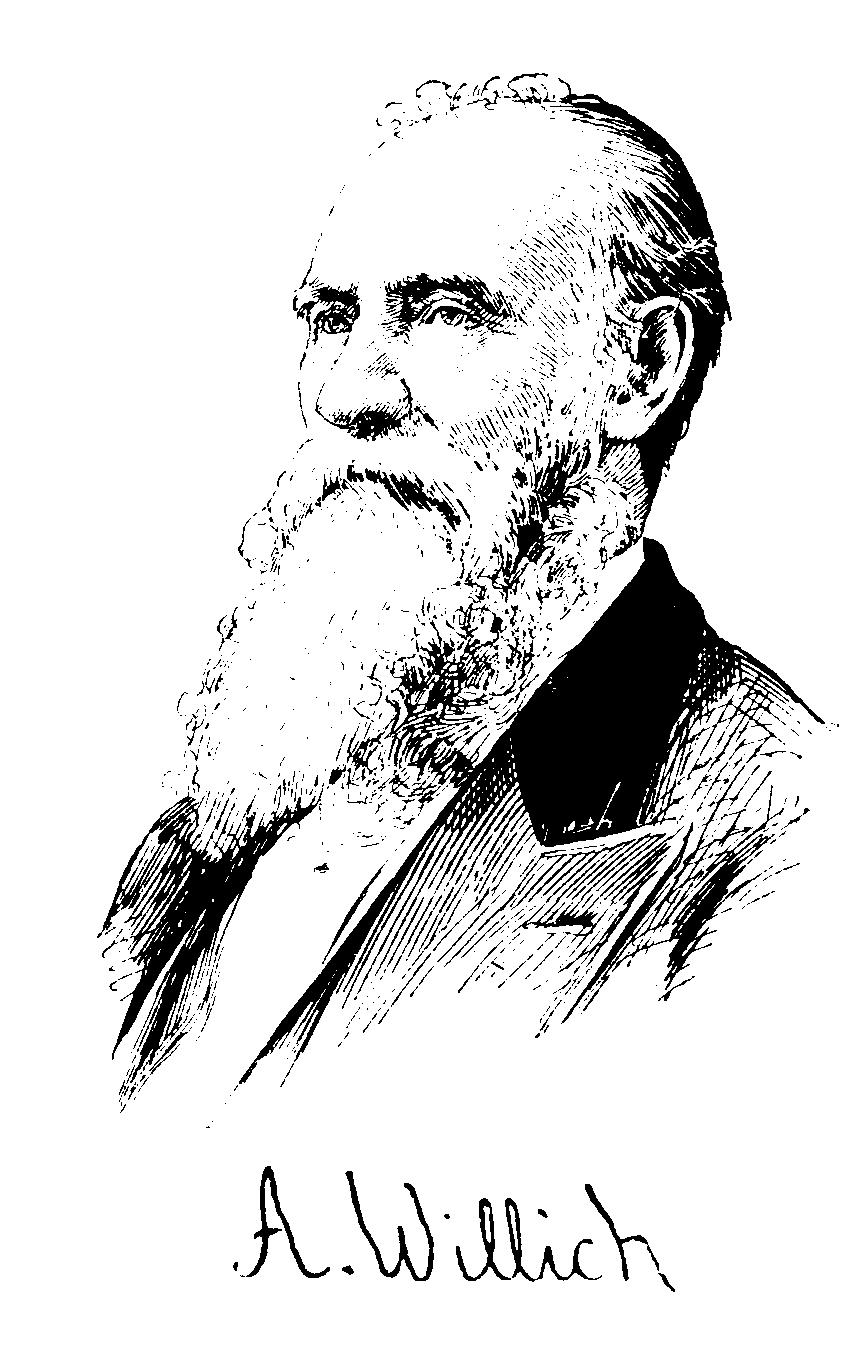
WlLLICH, August, born in Gorzyn, in the Prussian province of Posen, in 1810; died in St. Mary's, Mercer County, Ohio, 23 January, 1878. His father, a captain of hussars during the Napoleonic wars, died when August was three years old. With an elder brother, the boy found a home in the family of Frieda rich Schleiermacher, the famous theologian, whose wife was a distant relative. He received a military education at Potsdam and Berlin, and at eighteen years of age was commissioned 2d lieutenant of artillery in the Prussian army, becoming a captain in 1841. In 1846, in company with a number of the younger and more ardent officers of his brigade, he became so imbued with republican ideas that he tendered his resignation from the army in a letter written in such terms that, instead of its being accepted, he was arrested and tried by a court-martial. By some means he was acquitted, and afterward was permitted to resign. When the great revolution of 1848 threatened the overthrow of all European monarchies, Willich, with several former army friends, among whom were Franz Sigel, Friederich K. P. Hecker, Louis Blenkel, and Carl Schurz, went to Baden and took an active part in the armed attempt to revolutionize Germany. After its failure, Willich and many of his con patriots became exiles, he escaped to Switzerland, but afterward made his way to England, where several of his fellow-exiles had also found refuge. Here he remained till 1853, devoting much of his time and labor to aid in his distressed countrymen to reach the United States. He had learned the trade of a carpenter while in England, and so earned a livelihood. Coming to the United States in 1855, he first found employment at his trade in the navy-yard at Brooklyn. Here his attainments in mathematics and other scientific studies were soon discovered, and he found more congenial work in the coast survey. In 1858 he was induced to go to Cincinnati as editor of the "German Republican," in which work he continued till the opening of the civil war in 1861. He enlisted, at the first call to arms, in the 1st German (afterward 9th Ohio) regiment, which within three days mustered about 1,500 men. He was at once appointed adjutant, and, on 28 May, commissioned major. This regiment afterward became one of the best in the service. In the autumn of 1861 Governor Oliver P. Morton, of Indiana, who was raising a German regiment in that state, commissioned him as its colonel. This was the 32d Indiana infantry, famous in the Army of the Cumberland for its drill and discipline, as well as for its gallantry in action. Willich devoted himself to this regiment, and with such good results that, on 26 November, 1861, three companies, deployed as skirmishers, repelled in confusion a regiment of Texan rangers. This affair gave it a prestige that it retained to the end of the war. On 17 July, 1862, he was appointed brigadier-general of volunteers. At the battle of Stone River, 31 December, 1862, he was captured almost before the action began, and was held a prisoner for several months. He was exchanged in season to take part, at the head of his brigade, in the battle of Chickamauga, 19 and 20 September, 1863, and from that time on he shared in all the movements and battles of the army, including the Atlanta campaign and the march to the sea and through the Carolinas. He was made brevet major-general, 21 October, 1865, and was mustered out of service, 15 January, 1866. On his return to Cincinnati he was chosen county auditor, which post he held for three years. He was visiting his old home in Germany at the beginning of the Franco-Prussian war, and at once offered his services to the king, whom he had before attempted to dethrone. His offer was gratefully acknowledged, but, on account of his advanced age, it was not accepted. He found consolation, if not more congenial occupation, in attending lectures on philosophy at Berlin. Returning to the United States, he chose St. Mary's, Ohio, as his residence.
Unauthorized Site:
This site and its contents are not affiliated, connected,
associated with or authorized by the individual, family,
friends, or trademarked entities utilizing any part or
the subject's entire name. Any official or affiliated
sites that are related to this subject will be hyper
linked below upon submission
and Evisum, Inc. review.
Please join us in our mission to incorporate The Congressional Evolution of the United States of America discovery-based curriculum into the classroom of every primary and secondary school in the United States of America by July 2, 2026, the nation’s 250th birthday. , the United States of America: We The
People. Click Here