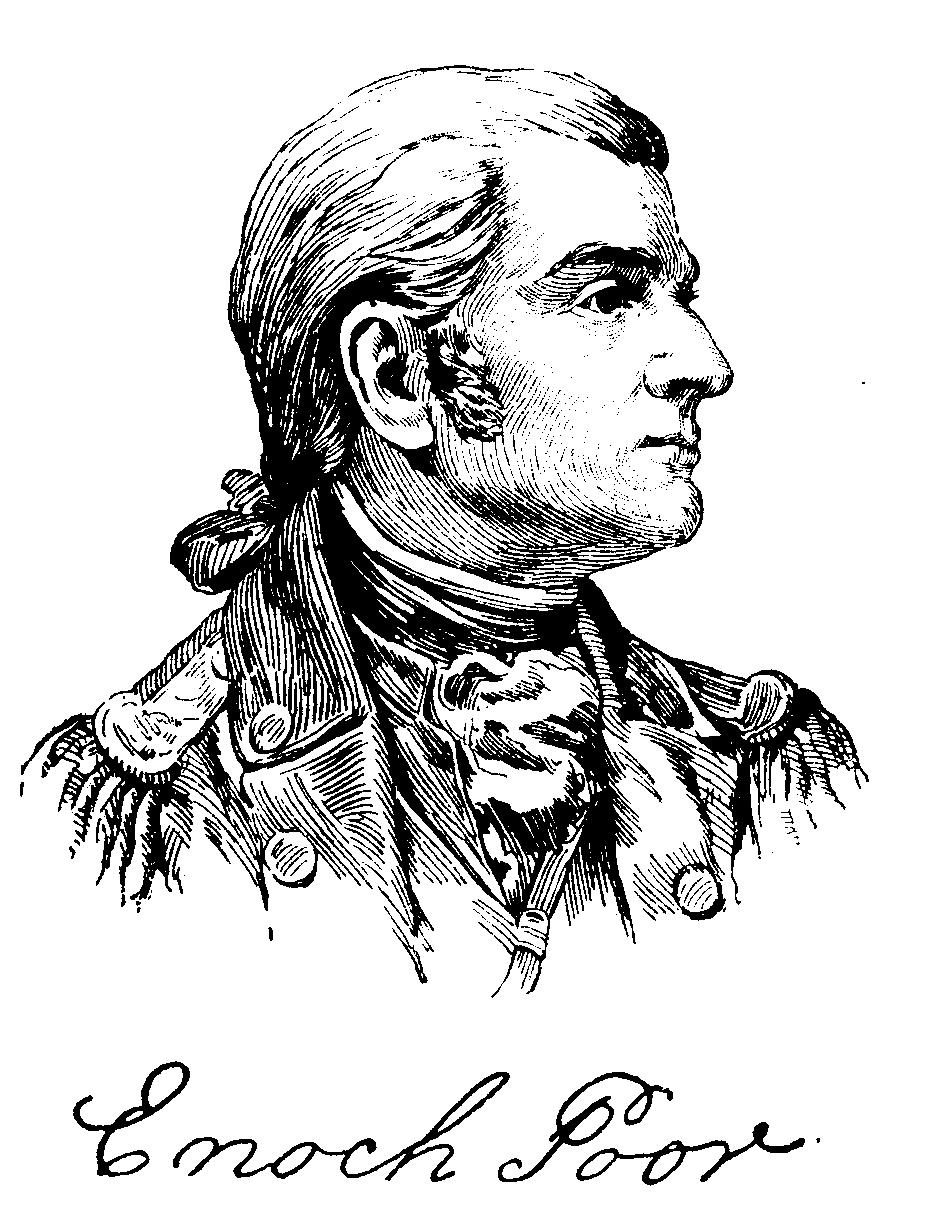
Enoch Poor - A Klos Family Project - Revolutionary War General
Click on an image to view full-sized
Enoch Poor
POOR, Enoch, soldier, born in
Andover, Massachusetts, 21 June, 1736; died near Hackensack, New Jersey, 8
September, 1780. He was educated in his native place, and removing to Exeter,
New Hampshire, engaged in business there until the battle
of Lexington, when the New Hampshire assembly resolved to raise 2,000 men.
Three regiments were formed, and the command of one of them was given to Poor.
After the evacuation of Boston he was sent to New York, and was afterward
ordered to join the disastrous Canadian expedition with his regiment. On the
retreat from Canada the Americans concentrated near Crown Point, and Colonel
Poor was actively occupied in strengthening the defenses of that post until a
council of general officers advised its evacuation, which was accordingly
ordered by General Philip Schuyler. Against this step twenty-one of the
field-officers, headed by Poor, John Stark, and William Maxwell, sent in a
written remonstrance General Washington, on
being appealed to, while refusing to overrule General
Schuyler's action, concurred distinctly in the views of the remonstrant as
to the impolicy of the measure.
On 21 February, 1777, Poor was commissioned brigadier-general, and he held
a command in the campaign against Burgoyne. In
the hard-fought but indecisive engagement at Stillwater, General Poor's brigade
sustained more than two thirds of the whole American loss in killed, wounded,
and missing. At the battle of Saratoga, Poor
led the attack. The vigor and gallantry of the charge, supported by an adroit
and furious onslaught from Colonel Daniel Morgan, could not be resisted, and the
British line was broken After the surrender of Burgoyne,
Poor joined Washington in Pennsylvania, and
subsequently shared in the hardships and sufferings of the army at Valley Forge.
During the dreary winter that was spent by the Revolutionary army in that
encampment, no officer exerted himself with greater earnestness to obtain
relief. He wrote urgently to the legislature of New Hampshire: "I am
every day," he said, referring to his men, "beholding their
sufferings, and am every morning awakened by the lamentable tale of their
distresses If they desert, how can I punish them, when they plead in
justification that the contract on your part is broken ?"
General Poor was among the first, to set out with his brigade in pursuit
of the British across New Jersey in the summer of 1778, and fought gallantly
under Lafayette at the battle
of Monmouth. In 1779 he commanded the second or New Hampshire brigade, in
the expedition of General John Sullivan against the Indians of the Six Nations.
When, in August, 1780, a corps of light infantry was formed composed of two
brigades, the command of one of them was given, at the request of Lafayette,
to General Poor; but he survived his appointment only a few weeks, being
stricken down by fever. In announcing his death, General Washington
declared him to be "an officer of distinguished merit, who, as a citizen
and a soldier, had every claim to the esteem of his country."
In 1824, when Lafayette visited New
Hampshire, at a banquet in his honor, he was called upon by a gray-haired
veteran for a sentiment. Lifting his glass to his lips, and after a few
explanatory words, he gave: "Light-infantry Poor and Yorktown Scammel."
He had seen the latter mortally wounded at the battle
of Yorktown. Both men were New Englanders. General Poor was buried in
Hackensack, where a fine monument marks his grave.
Edited Appletons Encyclopedia, Copyright
© 2001 VirtualologyTM