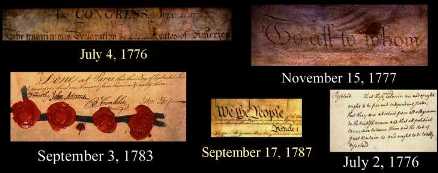
Who Was The First President
of the United States? Peyton Randolph
First President of the Continental Congress United Colonies of America John Hancock
First President of the Continental Congress United States of America Samuel Huntington
First President of the United States of America in Congress
Assembled George Washington
First President of the United States of America
The
origin of the U.S. Presidency can be traced back to the convening of the
American Colonial Congress on September 5, 1774 when the delegates elected
Peyton Randolph of Virginia as their President. Originally just called
Congress, the word Continental was added to the name on October 20, 1774 in the
Articles of Association primarily to distinguish this Congress from the many
Congresses being held throughout the Colonies at that time.
“We, his majesty's most loyal subjects, the delegates of the several colonies of
New-Hampshire, Massachusetts-Bay, Rhode-Island, Connecticut, New-York,
New-Jersey, Pennsylvania, the three lower counties of Newcastle, Kent and Sussex
on Delaware, Maryland, Virginia, North-Carolina, and South-Carolina, deputed to
represent them in a continental Congress, held in the city of
Philadelphia, on the 5th day of September, 1774” [1]
The
Articles of Association were an alliance between the Colonies, later States, and
not a Constitution per se. The Continental Congress would convene under this
agreement passing laws, enacting treaties and conducting a war.
Under
these Articles of Association the delegates of the Continental Congress began to
formulate a federal constitution under the presidencies of the well-known John
Hancock and Henry Laurens from 1775 until 1777. The first federal constitution,
known as the Articles of Confederation, was passed by the delegates in York-Town
(now York), Pennsylvania on November 15, 1777. [2]
The constitution, however, required unanimous ratification by all thirteen
States. Maryland held out until February 28th, 1781. Consequently,
for four years the Continental Congress existed in an indeterminate state that
often required a creative melding of the Articles of Association with the
Articles of Confederation meeting the needs of the ever fluid central government
in its conduction of an ongoing war for independence.
On
March 1, 1781 the Articles of Confederation were ratified. The Continental
Congress ceased to exist and the United States of America in Congress Assembled
became the federal government of a “Perpetual
Union between the states of New Hampshire, Massachusetts-bay, Rhode Island and
Providence Plantations, Connecticut, New York, New Jersey, Pennsylvania,
Delaware, Maryland, Virginia, North Carolina, South Carolina and Georgia.”
[3]
The
Articles of Confederation, although erratically enforced from 1777 to 1781, were
the true law of the land only for seven years, 1781-1788, with ten men holding
the office, President of the United States. By 1787, the founding fathers
agreed that the unicameral government formed by the Constitution of 1777 was
grossly inadequate. Former President of the Continental Congress John Jay wrote
the following as the U.S. Foreign Secretary:
“To
vest legislative, judicial, and executive powers in one and the same body of
men, and that, too, in a body daily changing its members, can never be wise. In
my opinion those three great departments of sovereignty should be forever
separated, and so distributed as to serve as checks on each other."
[4]
President Arthur St. Clair and his 1787 Congress clearly understood the severity
of these inadequacies. On February 21, 1787 they enacted legislation to “… render the federal
Constitution adequate to the exigencies of Government and the preservation of
the Union” [5]
Specifically, the United States, in Congress Assembled passed the following
resolution:
“Resolved that in the opinion of Congress it is expedient that on the second
Monday in May next a Convention of delegates who shall have been appointed by
the several States be held at Philadelphia for the sole and express purpose of
revising the Articles of Confederation and reporting to Congress and the several
legislatures such alterations and provisions therein as shall when agreed to in
Congress and confirmed by the States render the federal Constitution adequate to
the exigencies of Government and the preservation of the Union.” [6]
This
historic resolution produced the Philadelphia Convention of 1787. It resulted in
not a revision of the Constitution of 1777, but an innovative Plan of the New
Federal Government, known as the Constitution of 1787 that current governs
the United States of America. In the this constitution the office of
President of the United States was combined with Commander-in-Chief.
U.S. Founding Presidential Point One - Thenumber of unicameral
Presidents:
The Journals of the Continental
Congress and the United States, in Congress Assembled report that there were
six Presidents of the Continental Congress and ten Presidents of the United
States, in Congress Assembled serving from 1774 to 1788 before George
Washington.
Two of the Presidents, John
Hancock and Samuel Huntington, served in both offices. The total number of men
holding founding presidential offices is fourteen.
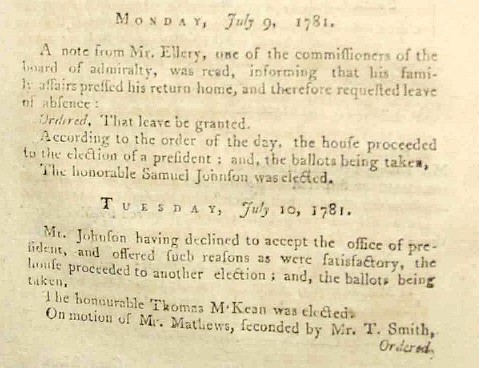
A 15th founder, Samuel Johnson
of North Carolina, was elected the President of the United States, in Congress
Assembled on July 10th, 1781 but refused to accept the office.
18th Century Journals of Congress and United States
in Congress Assembled for 1781 recording Mr. Johnson's decline of the US
Presidency - Original Manuscript – Stan Klos Collection
David Ramsay of South Carolina
served as the Chairman of the United States, in Congress Assembled for the
ailing President, John Hancock, from November 23, 1785 – May 12, 1786. Upon
Ramsay’s resignation, Nathaniel Gorham assumed the Chairmanship until John
Hancock resigned.
U.S. Founding Presidential Point
Two – Theunicameral congressDelegates’ election of the President:
Each
Colony/State elected or appointed a delegation to the Continental Congress and
the United States, in Congress Assembled.
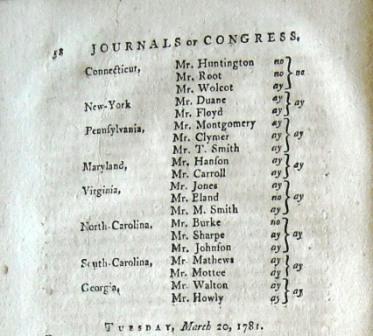
Each State, regardless of
population or delegation size, had only one vote in both the Continental
Congress and the United States, in Congress Assembled. Presidents were
elected by a simple majority of the States in attendance once a quorum was
formed.
18th Century Journals of Congress and United States
in Congress Assembled for 1781 showing no matter how many delegates a state had
they had only one vote. Original Manuscript – Stan Klos Collection
U.S. Founding Presidential Point
Three –Presidents
of the Continental Congress:
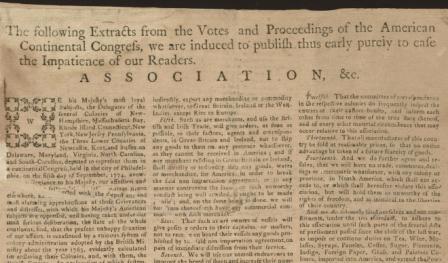
The Articles of Association was
passed October 20, 1774 and it officially named the Continental Congress.
Peyton Randolph, Henry
Middleton and John Hancock served as Presidents of the Continental Congress of
the United Colonies from September 5, 1774 to July 1, 1776.
John Hancock, Henry Laurens,
John Jay, and Samuel Huntington served as Presidents of Continental Congress
of the United States from July 2, 1776[i]
until March 1, 1781.[ii]
Articles of Association, October 20, 1774 Library of Congress
Broadside Collection[iii]
U.S. Founding Presidential Point
Four – The
Articles of Confederation:
The first
federal constitution, the Articles of Confederation, was passed on November
15, 1777 but it required ratification by all thirteen states.
Virginia was the first to
ratify the constitution on December 16, 1777.
Delaware, which claims to be
the First U.S. State, ratified the Articles of Confederation on February 9,
1779.
Maryland was the last state to
ratify delaying its approval until March 1, 1781. On March 2, 1781 the
Continental Congress was dissolved and the new constitutional government named
the United States, in Congress Assembled convened.
[iv]
Virginia, not Delaware is the
“First State” to ratify the formation of the United States of America.
US Statehood Order
Articles of Confederation – 1 to 13 States
U.S. Founding Presidential Point
Five – the
first President of the United States, in Congress Assembled:
Elected in 1779 under rules,
the Articles of Association and subsequent resolutions, Samuel Huntington
ascended to the United States Presidency on March 2, 1781. The Journals of the
United States, in Congress Assembled report: “The
ratification of the Articles of Confederation being yesterday completed by the
accession of the State of Maryland: The United States met in Congress, when
the following members appeared: His Excellency Samuel Huntington, delegate for
Connecticut, President.”
[vi]
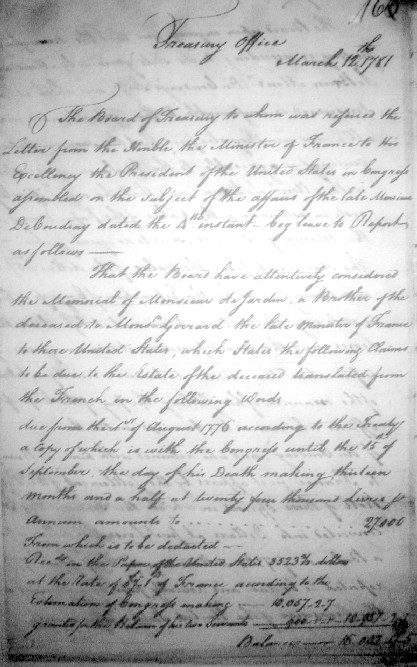
U. S. Treasury
referring to Samuel Huntington as President of the United States,
in Congress Assembled – Image Courtesy of the Library of Congress
[vii]
Unauthorized Site:
This site and its contents are not affiliated, connected,
associated with or authorized by the individual, family,
friends, or trademarked entities utilizing any part or
the subject's entire name. Any official or affiliated
sites that are related to this subject will be hyper
linked below upon submission
and Evisum, Inc. review.
Please join us in our mission to incorporate The Congressional Evolution of the United States of America discovery-based curriculum into the classroom of every primary and secondary school in the United States of America by July 2, 2026, the nation’s 250th birthday. , the United States of America: We The
People. Click Here