Appleton's Cyclopedia of American Biography, edited by James
Grant Wilson, John Fiske and Stanley L. Klos. Six volumes, New York: D. Appleton
and Company, 1887-1889 and 1999. Virtualology.com warns that these 19th Century
biographies contain errors and bias. We rely on volunteers to edit the historic
biographies on a continual basis. If you would like to edit this biographyplease
submit a rewritten biography in text form.
If acceptable, the new biography will be published above the 19th Century
Appleton's Cyclopedia Biography citing the volunteer editor
Virtual American Biographies
Over 30,000 personalities
with thousands of 19th Century illustrations, signatures, and exceptional life
stories. Virtualology.com
welcomes editing and additions to the
biographies. To become this site's editor or a contributor
Click Here
or e-mail Virtualology here.
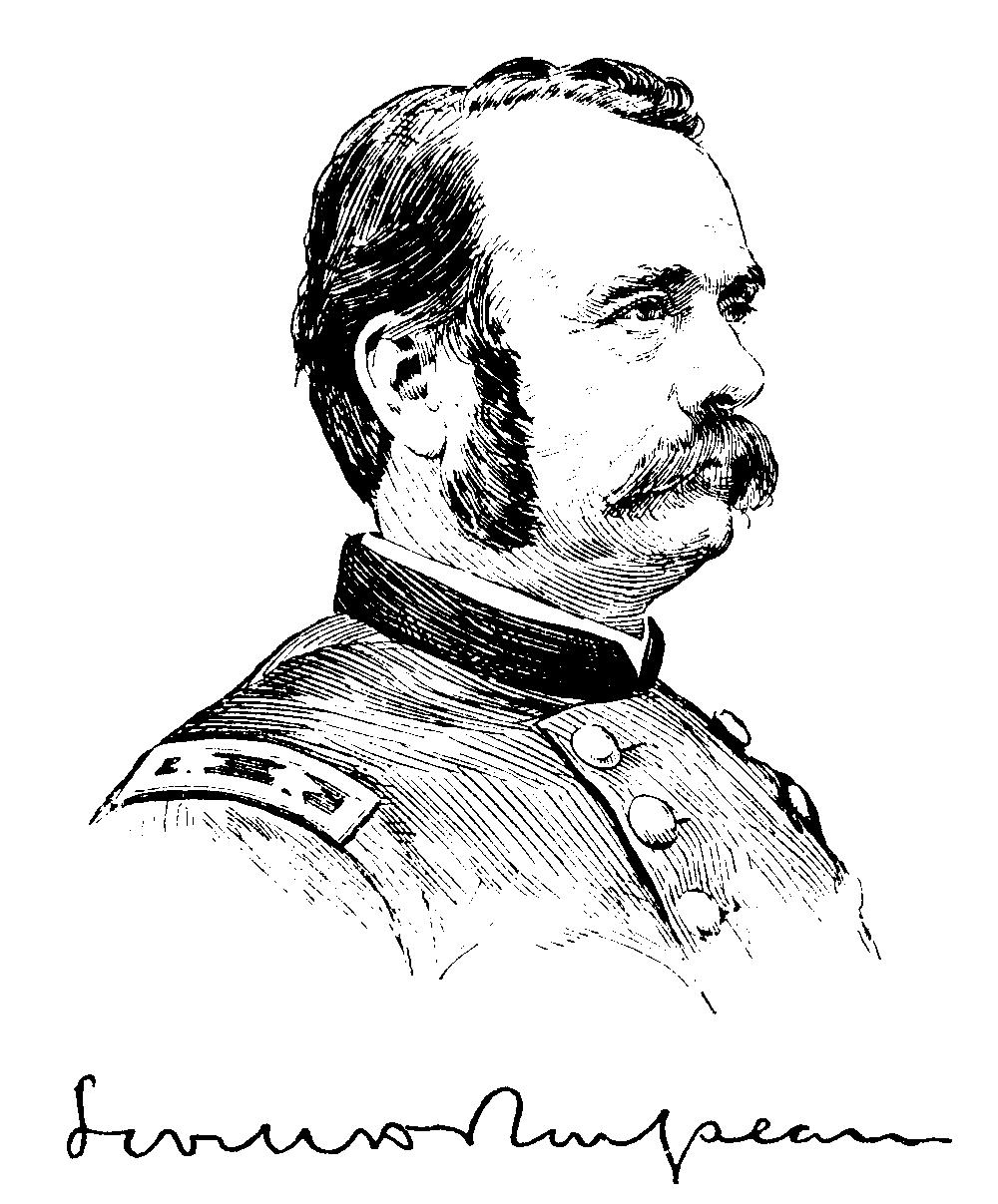
ROUSSEAU, Lovell Harrison, soldier, born in Lincoln county, Kentucky, 4 August, 1818" died in New Orleans, Louisiana, 7 January, 1869. He received but little schooling, and in 1833 his father died, leaving a large family in reduced circumstances, on becoming of age he went to Louisville, Kentucky, and began the study of law. Subsequently he removed to Bloomfield, Indiana, where in February, 1841, he was admitted to the bar. in 1844-'5 he was elected to the Indiana legislature, of which he became an active member. He raised a company during the Mexican war, and was attached to the 2d Indiana regiment, with which he participated in the battle of Buena Vista. After losing nearly one third of his men in that contest, he fell back to the hacienda, doing good service when the wagon-trains were attacked by the Mexicans. In 1847, four days after his return from Mexico, he was elected to the Indiana senate, and served for two terms. He removed to Louisville, Kentucky, in 1849, and there followed his profession, being very successful in the management of difficult cases, especially in addressing the jury. At the beginning of the civil war he was earnest in his efforts to restrain Kentucky from joining the Confederacy, and, resigning his seat in the state senate, began the organization of troops for the National army, and was appointed colonel of the 5th Kentucky volunteers in September, 1861. On I October, 1861, he was commissioned brigadier-general of volunteers and attached to General Don Carlos Buell's army. He took part in the battle of Shiloh, where he led a brigade of General Alexander M. McCook's division, and participated in the battle of Perryville on 8 October, 1862, where for his bravery he was promoted major-general of volunteers. Subsequently he succeeded General Ormsby M. Mitchel in the command of the 5th division of the Army of the Cumberland, serving with great credit, in the battle of Stone River, the Tullahoma campaign, the movement at Chattanooga, and the battle of Chickamauga. From November, 1863, till November, 1865, when he resigned, he had command of the districts of Nashville, Tennessee, and middle Tennessee, and during this time made a raid into Alabama, destroying the Montgomery and Atlanta lines of railway. In 1864 he held the important post of Fort Rosecrans in the defence of Nashville against General John B. Hood. He was elected to congress from Kentucky as a Republican, serving from 4 December, 1865, to 21 July, 1866, when he resigned after being censured by the house for publicly assaulting Josiah B. Grinnell, of Iowa, in the capitol: but he was reelected, serving from 3 December, 1866, till 3 March, 1867. He served on the committee on military affairs, and was one of the representatives that were selected to attend the funeral of General Winfield Scott in 1866. President Johnson appointed him brigadier-general in the regular army on 28 March, 1867, and he also received at the same time the brevet of major-general in the United States army for services during the civil war. He was then sent officially to receive Alaska from the Russian government and to assume control of the territory. General Rousseau was summoned to Washington to testify in the impeachment trial of President Johnson, and was subsequently assigned to the command of the Department of the Gulf, with headquarters at New Orleans. He succeeded General Philip H. Sheridan in this command and continued there until his death.
Unauthorized Site:
This site and its contents are not affiliated, connected,
associated with or authorized by the individual, family,
friends, or trademarked entities utilizing any part or
the subject's entire name. Any official or affiliated
sites that are related to this subject will be hyper
linked below upon submission
and Evisum, Inc. review.
Please join us in our mission to incorporate The Congressional Evolution of the United States of America discovery-based curriculum into the classroom of every primary and secondary school in the United States of America by July 2, 2026, the nation’s 250th birthday. , the United States of America: We The
People. Click Here