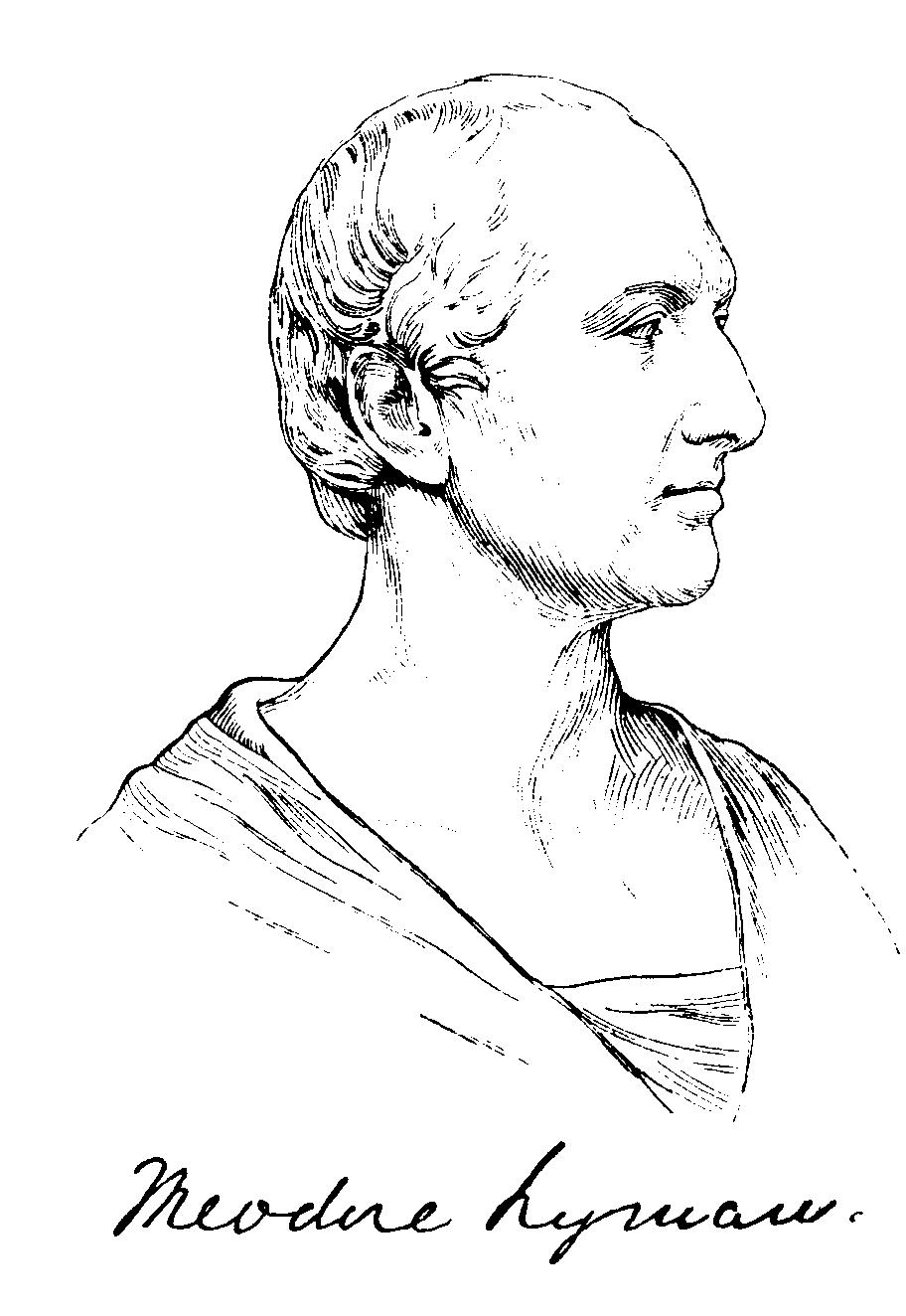
Appleton's Cyclopedia of American Biography, edited by James
Grant Wilson, John Fiske and Stanley L. Klos. Six volumes, New York: D. Appleton
and Company, 1887-1889 and 1999. Virtualology.com warns that these 19th Century
biographies contain errors and bias. We rely on volunteers to edit the historic
biographies on a continual basis. If you would like to edit this biographyplease
submit a rewritten biography in text form.
If acceptable, the new biography will be published above the 19th Century
Appleton's Cyclopedia Biography citing the volunteer editor
Virtual American Biographies
Over 30,000 personalities
with thousands of 19th Century illustrations, signatures, and exceptional life
stories. Virtualology.com
welcomes editing and additions to the
biographies. To become this site's editor or a contributor
Click Here
or e-mail Virtualology here.
LYMAN, Theodore, philanthropist, born in Boston, Massachusetts, 20 February, 1792; died in Brookline, Massachusetts, 18 July, 1849. His father was also Theodore Ly-man, and the son is generally called Theodore Ly-man, Jr. He was graduated at Harvard in 1810, after which he spent two years in literary pursuits at the University of Edinburgh, and then passed a few months on the continent of Europe. In 1817 he again visited Europe and spent two years travelling with Edward Everett through Greece, Turkey, and Bulgaria. On his return he studied law. after which for the three years following he held the office of aide-de-camp to the governor of Massachusetts, and in 1823 had command of the Boston brigade with the rank of brigadier-general.
Under his strict discipline this organization became a creditable body of troops. He also at this time participated in public affairs, and in 1820 became a member of the lower branch of the state legislature, where he continued until 1825, except in 1824, when he was in the state senate. In 1834, and again in 1835, he was elected mayor of Boston. His administration was marked by the destruction of the Ursuline convent in Boston and by the adoption of his recommendation that a sinking fund for the payment of city debt should be established. In 1835 he rescued William Lloyd Garrison from an infuriated mob at the risk of his own life. On the completion of his second term he retired entirely from public life. He was president of the Boston farm-school, to which he bequeathed $10,000, and an active member of the State horticultural society, to which organization he left a similar sum. The object of his greatest benevolence was the State reform-school in Westborough which he founded and to which he gave $22,500 during his lifetime and $50.000 at his death. His works include "Three Weeks in Paris" (Boston, 1814); " The Political State of Italy" (1820); "Account of the Hartford Convention" (1823); "The Diplomacy of the United States with Foreign Nations" (2 vols., 1828).--His son, Theodore, third of the name, naturalist, born in Waltham, Massachusetts. 23 August, 1833, was graduated at Harvard in 1855, and at the Lawrence scientific school of that university in 1858. after which he continued his scientific studies in Europe until 1863. Soon after his return he entered the military service, and was made aide-de-camp on General George G. Meade's staff, with the rank of lieutenant-colonel, on 2 September, 1863, in which capacity he served until 20 April, 1865, being present at the movements on Centerville and Mine Run, the battles of the Wilderness, Spottsylvania Court-House, and Cold Harbor. The investment of Petersburg, the pursuit of the Army of Northern Virginia, and its capture at Appomattox Court-House. From 1865 till 1882 he was fish commissioner of Massachusetts. making the first scientific experiments that were undertaken for the cultivation and preservation of food fishes by any state in the Union. The annual "Reports of the Commissioners on Inland Fisheries of Massachusetts" during his administration were wholly or in part written by him. In 1883 he was elected to congress as an Independent on the issue of reform in the civil service, and served until 3 March, 1885. He has been active in the interests of Harvard, being an overseer of that university from 1868 till 1880, and from 1881 till 1887, and he has also been interested in the administration of charities, is president of the Boston farm-school, and a trustee of the National Peabody education fund and of the Peabody museum of archaeology. Mr. Lyman is a member of scientific societies both at home and abroad, and in 1872 was elected to the National academy of sciences. He has worked chiefly on radiated animals at the Museum of comparative zoology in Cambridge, where since 1860 he has been assistant in zoology. In that connection he has published "Illustrated Catalogue of the Ophiuridae and Astrophytidae in the Museum of Comparative Zoology" (Cambridge, 1865); " Supplement" (1871) ; "Report on Ophiuridae and Astrophytidae dredged by Louis F. de Pourtales" (1869);" Old and New Ophiuridae and Astrophytidae" (1874) ; " Ophiuridae and Astrophytidae of the Hassler Expedition" (1875) ; "Dredging Operations of the United States Steamer 'Blake'; Ophiurans" (1875);" Prodrome of the Ophiuridae and Astrophytidae of the'Challenger' Expedition" (part i., 1878; part ii., 1879); and "Report on the Ophiuridae dredged by t[. M. S. ' Challenger' during the Years 1873-'6" (London, 1882); also various minor articles contributed to scientific journals, and "Papers relating to the Garrison Mob" (1870).
Unauthorized Site:
This site and its contents are not affiliated, connected,
associated with or authorized by the individual, family,
friends, or trademarked entities utilizing any part or
the subject's entire name. Any official or affiliated
sites that are related to this subject will be hyper
linked below upon submission
and Evisum, Inc. review.
Please join us in our mission to incorporate The Congressional Evolution of the United States of America discovery-based curriculum into the classroom of every primary and secondary school in the United States of America by July 2, 2026, the nation’s 250th birthday. , the United States of America: We The
People. Click Here