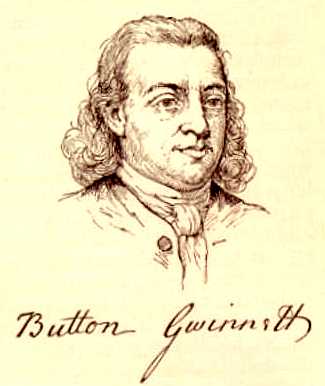
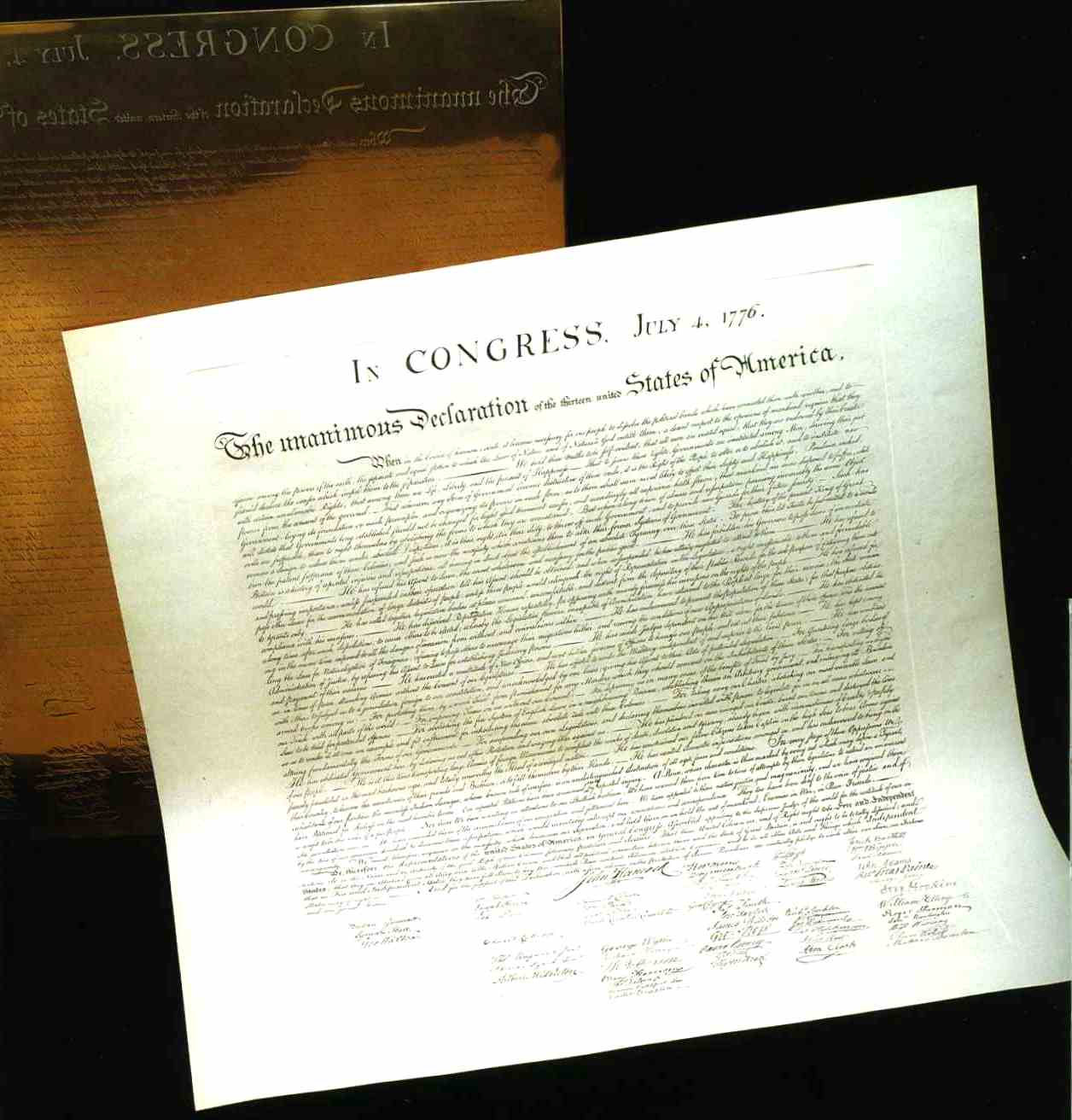
Button Gwinnett (baptized: April 10, 1735 – May 19, 1777), was second of
the signatories (first signature on the left) on the United States Declaration
of Independence as a representative of Georgia.
Button Gwinnett
Signer of the Declaration of Independence
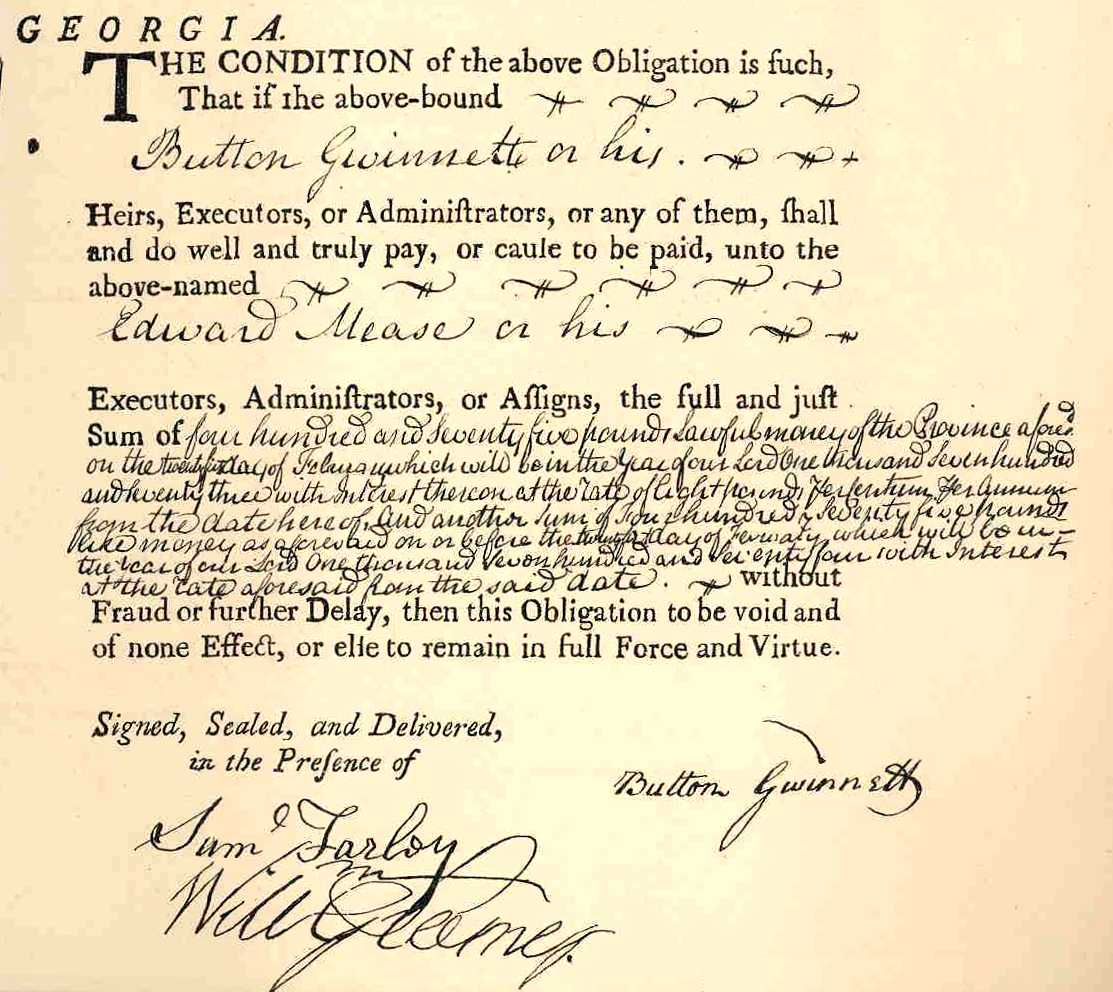
Gwinnett Signed Document Courtesy of
The Forbes Collection of American Historical Documents (Part I)
27 March 2002, 10:00 am at Christie's
20 Rockefeller Plaza, New York CLICK HERE to Enlarge
BUTTON
GWINNETT was born at Down Hatherly, Gloucestshire, England in 1735,
the son of a Welsh clergyman and an English mother. His parents were respectable
and gave their son as good an education as their moderate circumstances would
allow. On coming of age, Gwinnett became a merchant in the city of Bristol. He
married when he was twenty-two and emigrated to Charleston, South Carolina in
the early 1760's. He stayed there for about two years, and then moved to
Savannah, Georgia were in 1765 he established himself as a general trader.In
1770, after selling all his merchandise, he purchased a large tract of land in
on St. Catherine's Island, Georgia, where he devoted himself extensively to the
agricultural pursuits of his plantation.
Prior
to 1775, Gwinnett did not take an active part in politics.However,
his subsequent enthusiasm for maintaining colonial rights attracted the
attention of his fellow citizens.At
the meeting of the provincial assembly held in Savannah on January 20,
1776, he was appointed a representative in congress and he voted for and signed
the Declaration of Independence.In
October 1775, he was re-elected for the following year.In
February 1777, he was appointed a member of the Georgia state government and is
said to have furnished the basis of the constitution that was later adopted.After
the death of the president of the provincial council, a Mr. Bullock, Gwinnett
was appointed to fill the vacant office on March 4, 1777.In
May 1777, he was an unsuccessful candidate for governor of Georgia.During
the Revolutionary War Gwinnett's property was totally destroyed by the British.At
the time that he represented Georgia in Congress, Gwinnett became a candidate
for the office of brigadier general of the continental brigade about to be
assembled in Georgia.His opponent
for the office was Colonel Lackland M'Intosh.M'Intosh
was appointed and Gwinnett, being unnaturally disappointed and short of temper,
was so embittered that he regarded M'Intosh as a personal enemy from that day
on.
Gwinnett
became president of the Executive Council, and he adopted several measures that
were able to mortify his adversary, General M'Intosh.One
of these was the appropriation of great power by the Executive Council over the
continental army in Georgia.General
M'Intosh was consequently treated with disrespect by some of his officers and
soldiers.To humble his adversary
still further, Gwinnett projected a expedition against East Florida giving the
command of the continental troops and the Georgia Militia to himself, excluding
General M'Intosh from even the command of his own brigade.Gwinnett's
office, as president of the council, prevented him from proceeding at the head
of the expedition.The troops where
by Gwinnett's orders placed under the command of a subordinate officer of
M'Intosh's brigade.The expedition
nearly failed and probably contributed to the failure of Gwinnett's election to
the office of Governor in May 1777.
The
loss of the election to Governor blasted Gwinnett's hopes and brought his
political career to an end.General
M'Intosh foolishly celebrated the disappointment and mortification of his
adversary.The animosity between
these two distinguished gentlemen continued to gather strength from this time
on.Finally, Gwinnett, unmindful of
the high offices that he had held and of his obligations to society, challenged
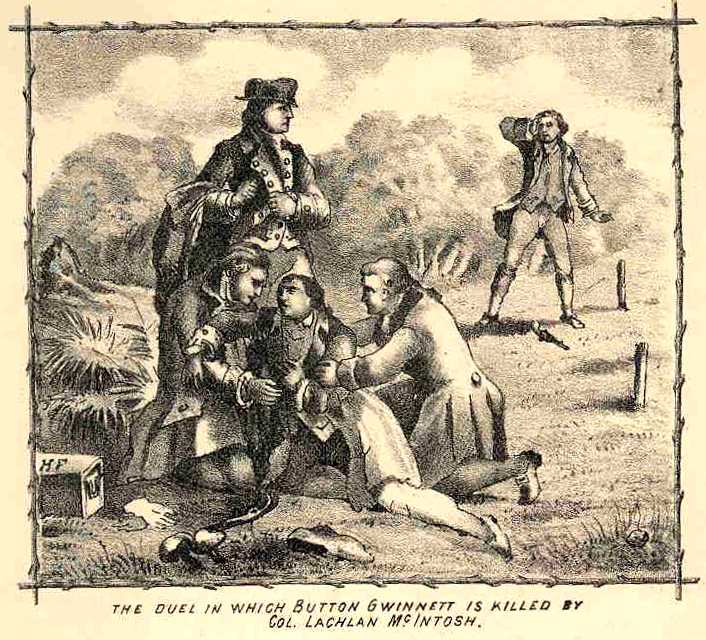
M'Intosh to a duel, which was fought on May 15, 1777.They
fought at a distance of only twelve feet and both were severely wounded.Gwinnett's
wound proved mortal and on May 27, 1777, at forty-five years of age he died a
victim to false ambition and a false sense of honor.
Button Gwinnett was born in England, about the year 1735. His parents were
respectable, and though their pecuniary circumstances were moderate, they gave
him the means of obtaining an excellent education. He first commenced business
as a merchant in Bristol. Soon after his marriage, he resolved to move to
America; and in the year 1770, he embarked with his family, and arrived at
Charleston, South Carolina, where he engaged in trade, and pursued it for two
years. He then disposed of his stock in trade ; and vested the proceeds in a
number of slaves, and a tract of land on St. Catharine's Island, in Georgia.
Thither he removed, and devoted his attention to agriculture.
We possess no means of knowing the history of Mr. Gwinnett's early life. It is
probable, however, that it was distinguished by nothing very remarkable. He is
said to have early favored the cause of the colonies, in opposition to the
claims of the parliament ; and this may have been one motive for his leaving
England, and emigrating to America. But at the time of his settling in Georgia,
he found the public feeling generally, of such an indecisive character, as
induced him to pursue a cautious line of conduct, surrounded as he was by a
large proportion of the men of influence, who were slow in their determination
to oppose the British, and espouse the cause of the American colonies. To this
general manifestation of cautious decision, which powerfully influenced the
political movements of Georgia, there were some exceptions.
Mr. Gwinnett's anticipations of a favorable result of the contest between the
colonies and Great Britain, were, like those of many other sincere friends to
their cause, through the country, not very sanguine. His were not based on any
latent affection for his native country ; nor were they influenced by that
indecision, then so prevalent in Georgia, but brief mistaken judgment, which led
him to form conclusions contrary to his wishes. About this time he became
intimate with one of those men, who was early decided, and openly declared his
sentiments in favor of the colonies, and who was an enthusiastic partisan in
their favor. The frequent discussions which took place, respecting the subject,
and the probability of a successful resistance of the British power, between him
and Doctor Lyman Hall, (who was the person referred to,) served to obviate his
fears, and to bring him forward, to lend his whole powers in a decided hostility
to thft, British, and to a vigorous support of the colonies. This open and
decided manifestation of his feelings, in vindication and support of the cause
of his adopted country, together with a well cultivated mind, and talents highly
respectable, rendered him conspicuous and popular, especially among those who
possessed kindred feelings with his own. The number of such was fast
multiplying, although they still constituted a minority in the colony,-and
notwithstanding Georgia was the last of the colonies, which declared itself in
opposition to the British. The active influence of those decided patriots
finally prevailed, and Georgia joined the confederacy, under what was then
denominated, the Standard of Rebellion. From that period, the popular favor
conferred on Mr. Gwinnett, was extensive, and his rapid promotion in political
life, to the first dignities in the province, indirectly prepared the way for
his sudden precipitation from his elevated station, to the rank of a private
citizen; and a mortified pride, and feelings of resentment towards the
instruments of his humiliation spurred him onward to that step which at once
closed his career in politics, and with it his life. His sun rose suddenly—its
course to the zenith was rapid and brilliant—its descent was hurried and ominous
of evil—and it sat in blood !
In deciding on the apparent luke warmness of Mr. Gwinnett, relative to the
American cause, which for a time marked his political conduct, we should
recollect that his property, lying in an indefensible situation, was exposed to
become a sure sacrifice, should an invasion ensue, and that was a certain
consequence of the commencement of open hostilities. This must be admitted as a
powerful motive to operate on the feelings, and regulate the conduct of men. It
could neither be removed to a place of security, nor protected as it lay. And it
was in fact, totally destroyed by the British. The decided part which he did
take, therefore, furnished a strong testimony to the purity of his patriotism.
In the beginning of 1775, Mr. Gwinnett openly espoused independence of America,
and took a part with the colonies. No part of Georgia had at that time been
represented in the continental congress, except the parish of St. John. This had
previously separated from the province, and had appointed a representative for
that district. Here the patriotism of Georgia seems to have concentered; and
slowly to have diffused self into other more remote parts of the colony, with
rather idilatory progress.
Mr. Gwinnett having attracted the attention of that community to himself, and
become popular, by the spirited manner in which he espoused the cause of his
adopted country, he was appointed a representative in congress by the general
assembly, in February, 1776. His colleagues appointed at the same time, were his
early friend Doctor Lyman Hall, Archibald Bullock, George Houston, and George
Walton. There was one member, that was elected the year preceding, who, when the
subject of independence came to be seriously contemplated, being fixedly opposed
to it, vacated his seat, and Mr. Bullock remained in Georgia after his election.
These particulars will account for the fact, that there were but three of the.
members from Georgia, out- of the six chosen, who signed the Declaration of
Independence ; of whom Mr. Gwinnett was one.
A Brief History of The Declaration of Independence
In the autumn of 1776, Mr. Gwinnett was again elected, and took his seat in
December, in Baltimore, whither congress had removed, to avoid some impending
danger from the approach of the British forces towards Philadelphia.
In this same year, a convention was summoned, during the session of the
provincial assembly, to meet early in 1777, to frame a constitution for the
independent state of Georgia. Of that convention Mr. Gwinnett was a member; and
has the credit of having laid a basis, containing the great outlines of the
constitution subsequently adopted by the state, as their government.
Mr. Bullock, president of the provincial council, dying soon after the
convention adjourned, that high and honorable office became vacant. Mr. Gwinnett
was elected his successor. He had now attained the highest office, and one
deemed the most honorable, within the gift of the state; and it might have been
rationally concluded, that his ambition would be contented for a short season at
least; especially as all his rapid promotions had accumulated upon him, within
one year after his first appearance in public life. But it will be remembered.
that he was a " Native Englishman," had come into a colony, and among a people
of whose real character, Englishmen knew but little ; for whom they were
accustomed to indulge a feeling that partook very little of respect. It is not
very unnatural to conclude, that Mr. Gwinnett inherited a share of that feeling
in common with his countrymen ; and that he considered the honors so profusely
conferred on him, as an acknowledgement by the provincials of that superiority
over them, so generally claimed by his countrymen; and especially by those of
inferior merits.
This rapid elevation of a foreigner, a native of the country with which the
colonies were at open war, and who had resided but a few years among them, began
to excite jealousies among some native citizens, who were candidates for popular
favor. They felt conscious that they had equal, if not superior claims on the
favor of the community, to his. This irritated a temper naturally warm and
precipitate, and provoked him to resent it according to the demands of what are
erroneously termed, " the laws of honor."
Not contented with having held the highest civil office in the gift of the
people, he began to aspire to military promotion. While he was representing the
colony in congress, he offered himself a candidate for the office of brigadier
general, to take command of a brigade to be raised in Georgia, for the
continental service. His competitor was Colonel M'lntosh. Mr. Gwinnett failed.
The disappointment was peculiarly wounding to his feelings. Indeed, his mind
does not appear to have been disciplined to sustain disappointment with
equanimity. He was placed only in the sunshine of uninterrupted prosperity. From
the time of that disappointment, he considered Colonel M'Intosh his personal
enemy. It is probable that the colonel did not take any measures to obviate that
impression, and conciliate his esteem.
The disappointment he experienced in consequence of his failure, and the success
of his competitor for the commission of a brigadier general, was followed by a
succession of events, which tended to aggravate, rather than sooth the wound his
irritable feelings had received by that occurrence. The failure of a military
enterprise in Florida which he had projected, which his rivals and their friends
improved for his deeper mortification ; and this happening when he was offering
him self a candidate for the office of governor, together with the success of a
rival, who he deemed far his inferior in capacity ; all bore on his naturally
jealous mind, with not only an unhappy, but a fatal influence. By this
combination of no. toward events, his aspiring hopes and anticipations were
blasted, and the way was prepared for closing his short, but brilliant political
career, and with it his natural life.
Among those who availed themselves of these events, to deepen the mortification,
and irritate the wound Mr. Gwinnett had sustained, one of the most conspicuous
was General M'Intosh, his successful rival candidate for the office of
brigadier. The free remarks he made on different occasions, ejecting the
reputation of Mr. Gwinnett; and the pleasure he often manifested, grounded on
his humiliation, pointed him out as the first victim to his resentment. The
consequence was a challenge, sent by Gwinnett, and accepted by M'Intosh. They
met, fought with pistols, at the distance of- twelve feet; both were wounded,
and Gwinnett mortally. Thus fell, in the forty-fifth year of his age, Button
Gwinnett, a victim to the laws of false honor, of mortified pride, and
disappointed ambition. He left a widow and several young children behind him.
But they shortly after this event, followed him to the grave. --
The Lives of the Signers of the Declaration
of Independence, By Nathaniel Dwight, Published by A.S. Barnes & Co., 1860,
Edited by Stanley l. Klos 2000
Declaration of Independence
A Brief History and early record of
the printings
Unauthorized Site:
This site and its contents are not affiliated, connected,
associated with or authorized by the individual, family,
friends, or trademarked entities utilizing any part or
the subject's entire name. Any official or affiliated
sites that are related to this subject will be hyper
linked below upon submission
and Evisum, Inc. review.
Please join us in our mission to incorporate The Congressional Evolution of the United States of America discovery-based curriculum into the classroom of every primary and secondary school in the United States of America by July 2, 2026, the nation’s 250th birthday. , the United States of America: We The
People. Click Here