Caesar Rodney - Appleton's Biography edited by Stanley L. Klos
Click on an image to view full-sized
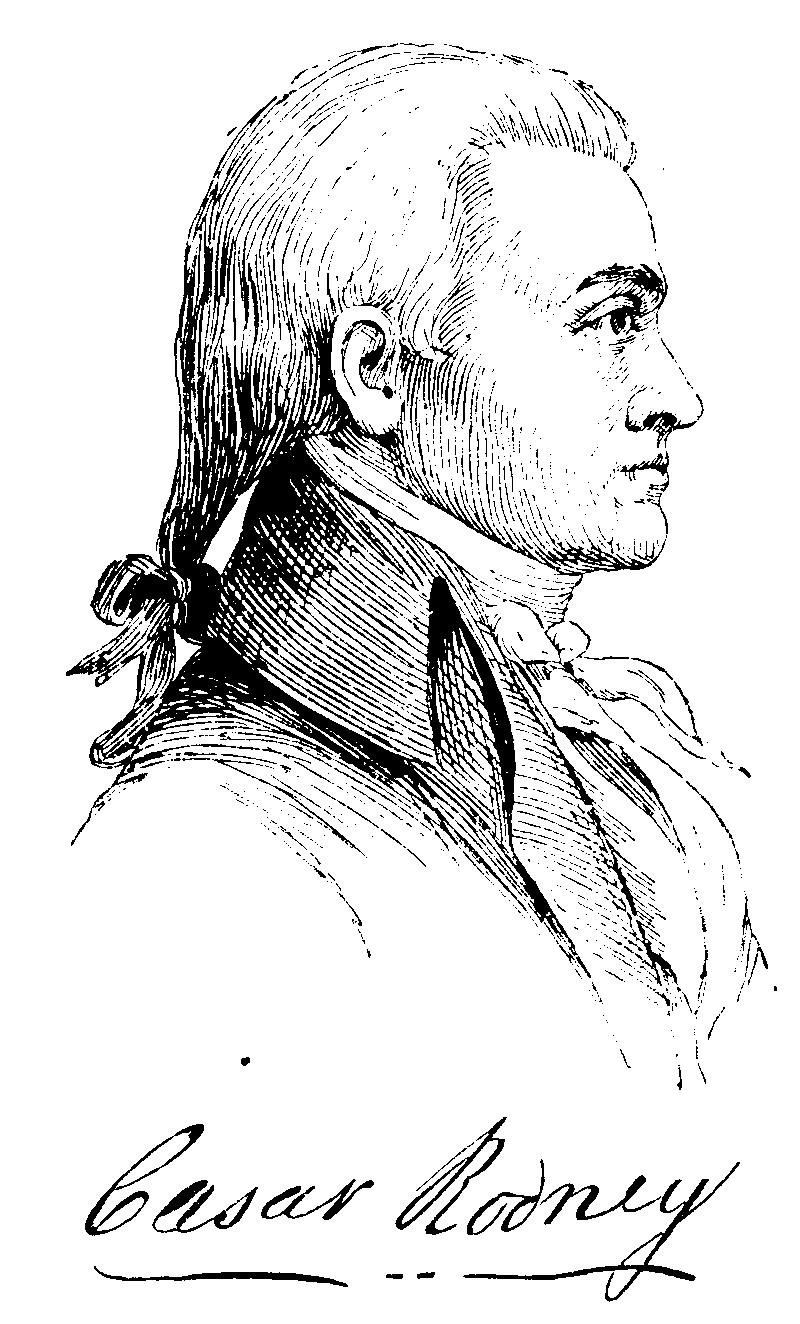
Caesar Rodney
RODNEY, Caesar, signer of the Declaration of Independence, born in Dover,
Delaware, 7 October, 1728; died there, 29 June, 1784. An oil family manuscript
says: "It hath been a constant tradition that we came into England with Maud,
the empress, from foreign parts; and that for service done by Rodney, in her
wars against King Stephen, the usurper, she gave them land within this kingdom."
A painted monument in the village of Rodney-Stoke, Somerset County, bears the
arms of this family. His grandfather, William Rodney (1652-1708), came from
Bristol, England, to Philadelphia soon after William Penn had settled
Pennsylvania, located at Lewes on the Delaware, where in 1689 he was elected
sheriff of Sussex county, and removed to Dover, Kent County, Delaware, where he
held local offices. In 1698-'9 he was a member of the assembly and again in
1700-'4, serving as speaker in the last year, when he was made justice of the
peace.
In 1698-'9 he was a member of William Penn's council, and in 1707 was
appointed justice of New Castle. Caesar inherited a large estate from his
father, Caesar (1707-'45). In 1755-'8 he was high sheriff of Kent county, and at
the expiration of his term he was made a justice of the peace and judge of all
the lower courts In 1756 he was a captain in the county militia. In 1759 he was
a superintendent for the printing of £27,000 of Delaware currency, and
commissioner for the support of a company raised for the French and Indian war.
In 1762-'3 he represented Kent county in the assembly, was recorder in 1764, and
justice of the peace in 1764-'6. In 1765 he was sent as a delegate to the stamp
act congress at New York, and on the repeal of that act he was one of three
commissioners that were appointed by the legislature of Delaware to frame an
address of thanks to the king. In 1766 he was made register of bills, and in
1767, when the tea-act was proposed by the British parliament, the Delaware
assembly appointed him, with Thomas McKean and George Read, to formulate a
second address to tile king, in which armed resistance to tyranny was
foreshadowed. In 1769 he was superintendent of the loan office, and from 1769
till 1773 was an associate justice. In 1770 he was clerk of the peace, and in
1770-'4 Dedimus potestatimus.
In 1772 he was a commissioner to erect the statehouse and other public
buildings in Dover. A bill having been introduced into the colonial assembly for
the better regulation of slaves, Mr. Rodney warmly supported a motion that the
bill be so amended as to prohibit the importation of slaves into the province.
The amendment was negatived by only two votes. When fresh aggressions of the
British ministry disappointed the expectations of the colonists, Mr. Rodney and
his former colleagues were assigned the task of presenting the complaints of the
freemen of Delaware to the sovereign. These pacific measures failing to secure a
redress of grievances, the colonies entered into a correspondence regarding
their common defence. Mr. Rodney became chairman of the committee of safety of
Delaware, and in 1774, meetings of the people having been held at New Castle and
Dover to demand the assembling of a convention, he issued a call as speaker of
the assembly for the representatives of the people to meet at New Castle on 1
August He was chosen chairman of the convention, and was elected a delegate to
the Continental congress, in which he was a member of the general committee to
make a statement of the rights and grievances of the colonists. In March, 1775,
he was again elected to congress after the assembly, by a unanimous vote, had
approved of his action, and that of his colleagues, at the 1st congress. In May
he was appointed a colonel, and in September he became brigadier-general, of
Delaware militia. In 1776 he was alternately in his seat in congress, and at
work in Delaware, stimulating the patriots and repressing the royalists. When
the question of independence was introduced in congress, Mr. Rodney, having
obtained leave of absence, went through the southern part of Delaware preparing
the people for a change of government. His colleagues, Thomas McKean and George
Read, were divided on the question, and the former, knowing Rodney to be
favorable to the declaration, urged him by special message to hasten his return.
He did so, and by great exertion arrived just in season for the final
discussion. His affirmative vote secured the consent of the Delaware delegation
to the measure, and thus effected that unanimity among the colonies that was so
essential to the cause of independence.
The opposition of the royalists, who abounded in the lower counties,
prevented his election the succeeding year; but as a member of the councils of
safety and inspection he displayed great activity in collecting supplies for the
troops of the state that were then with Washington in Morristown, New Jersey He
went to Trenton, where Lord Stirling made him post commandant, and then to
Morristown, but, by Washington's permission, he returned home in February, 1777.
He refused the appointment as a judge of the supreme court, organized in
February, 1777, and on 5 June, 1777, was chosen judge of admiralty, but retained
his military office, suppressed an insurrection against the government in Sussex
county, and when, in August, the British advanced into Delaware, he collected
troops, and, by direction of General Washington, placed himself south of the
main army to watch the movements of the British at the head of Elk river,
Maryland, and, if possible, to cut them off from their fleet. During this period
he was in correspondence with Gem Washington, with whom he had long been on
terms of friendly intimacy.
In September he became major-general of militia, and in December tie was
again elected to congress ; but he did not take his seat, as in the mean time he
had been elected president of Delaware, which office he held for four years,
till January, 1782, when he declined re-election. He was then chosen to
congress, and again in 1783, but did not take his seat. He had been suffering
for many years from a cancer on the face, which ultimately caused his death. As
a public man he displayed great integrity and elevation of character, and,
though a firm Whig, never failed in the duties of humanity toward those that
suffered for adhering to opinions that differed from his own.==
His brother, Thomas Rodney, jurist, born in Sussex county, Delaware, 4 June,
1744 ; died in Rodney, Mississippi, 2 January, 1811, was a justice of the peace
in 1770 and again in 1784, a member of the assembly in 1774 to elect delegates
to the first Constitutional congress, and in 1775 a member of the council of
safety. He was colonel of the Delaware militia and rendered important services
to the Continental army during the Revolutionary war. In 1778 he was chief
justice of Kent county court, in 1779 register of bills, and was a delegate from
Delaware to the Continental congress in 1781-'3 and in 1785-'7. In 1787 he was
made speaker of the assembly, and in 1802 was appointed superintendent of the
Kent county almshouse and Dedimus potestatimus. He was appointed in 1803 United
States judge for the territory of Mississippi, and became a land-owner in
Jefferson county, where the town of Rodney was named in his honor.--
Thomas Rodney's son, Caesar Augustus Rodney, statesman, born in Dover,
Delaware, 4 January, 1772; died in Buenos Ayres, South America, 10 June, 1824,
was graduated at the University of Pennsylvania in 1789, studied law, was
admitted to the bar in 1793, and practised at Wilmington, Delaware He was
elected to congress from Delaware as a Democrat, serving from 17 October, 1803,
till 3 March, 1805, was a member of the committee of ways and means, and one of
the managers in the impeachment of Judge Samuel Chase. In 1807 he was appointed
by President Jefferson attorney-general of the United States, which place he
resigned in 1811. During the war with Great Britain in 1812 he commanded a rifle
corps in Wilmington which was afterward changed to a light artillery company.
which did good service on the frontiers of Canada, In 1813 he was a member of
the Delaware committee of safety. He was defeated for congress and in 1815 was
state senator from New Castle county. In 1817 he was sent to South America by
President Monroe as one of the commissioners to investigate and report upon the
propriety of recognizing the independence of the Spanish-American republics,
which course he strongly advocated on his return to Washington. In 1820 he was
re-elected to congress, and in 1822 he became a member of the United States
senate, being the first Democrat that had a seat in that body from Delaware. He
served till 27 January, 1823, when he was appointed minister to the United
provinces of La Plata. With John Graham he published "Reports on the Present
State of the United Provinces of South America" (London, 1819)
Caesar Rodney (October 7, 1728 – June 26, 1784), was an American lawyer
and politician from St. Jones Neck, in Dover Hundred, Kent County, Delaware,
east of Dover. He was an officer of the Delaware militia during the French and
Indian War and the American Revolution, a signer of the
Caesar Rodney
Signer of the Declaration of Independence
CAESAR RODNEY was born October 7, 1728 near Dover
in Kent County Delaware. His father, Caesar, was a planter who died when the son
was only seventeen, leaving him a large estate. Rodney appears to have gained
most of his education at home as was often the case with planters' sons. He
entered public life early filling posts that included high sheriff of Kent
County, register of wills, recorder of deeds, clerk of the orphan's court and
Justice of the peace.
For more that a
dozen years he was almost continuously a member of the House of Assembly, and at
the age of thirty-three he attended the Stamp Act Congress in New York along
with Thomas McKean. At the age of forty-one, Rodney was chosen speaker of the
assembly and was appointed to the Supreme Court. He was also chosen to represent
Delaware during both the first and second continental congress. He listened
intently to the debates on independence without committing himself, but he was
finally convinced that Britain "was making every kind of exertion in her favor
to reduce us to unconditional submission…that no hope of reconciliation on
constitutional principles could possibly remain".
In May of 1775,
he was appointed a colonel and in September he became brigadier general of the
Delaware militia. In 1776, he was alternately in his seat in congress, and at
work in Delaware, stimulating the patriots and repressing the royalists. When
the question of independence was raised he was delayed in getting to congress
owing to the fact that, after presiding in June over the session of the assembly
that had authorized support of the inter-colonial movement for independence and
which virtually declared Delaware independent of the Crown, he had gone to
Sussex County to look into a threatened Loyalist uprising. He had just returned
home when he learned from his colleague McKean that a vote was pending in
Congress and he rushed northward to give his voice. McKean, knowing Rodney to be
favorable to the declaration, urged him by special messenger to hasten his
return. Rodney had ridden eighty miles through a rain swept night for his trip
was urgent, his vote was needed desperately to break the deadlock in the
Delaware delegation, as Thomas McKean and George Read were divided. His
affirmative vote secured the consent of the Delaware delegation to the measure,
and thus affected that unanimity among the colonies that was so essential to the
cause of independence.
Caesar Rodney at age forty-eight was one of only
three bachelors to sign the Declaration of Independence. Perhaps he chose not to
marry because of a cancer that was already ravaging part of his eye and
face. The cancerous growth on his face, from which he suffered for years and
finally died, may have contributed to the oddity of his appearance, but his
actions showed him to be a man of heroic proportions.
He had
aroused conservative opposition in Kent County, which prevented his being
elected to the state constitutional convention. In 1778, he became President of
Delaware, as the chief executive of the state was then called. Serving until
1781, he was the war governor during a large part of the Revolution. His
declining health interfered with later public service, but he was Speaker of the
upper house of the legislature when he died on June 26,1784, in his fifty-sixth
year.
We invite you to read a
transcription of the complete text of the
Declaration as presented by the National Archives.
&
The article "The
Declaration of Independence: A History,"
which provides a detailed account of the Declaration, from its drafting through
its preservation today at the National Archives.
Virtualology welcomes the addition
of web pages with historical documents and/or scholarly papers on this subject.
To submit a web link to this page
CLICK HERE. Please be sure
to include the above name, your name, address, and any information you deem
appropriate with your submission.
Caesar Rodney (October 7, 1728 – June 26, 1784), was an American lawyer
and politician from St. Jones Neck, in Dover Hundred, Kent County, Delaware,
east of Dover. He was an officer of the Delaware militia during the French and
Indian War and the American Revolution, a signer of the
Caesar Rodney
From Wikipedia, the free encyclopedia
Caesar Rodney
19th century image; no contemporary portrait exists probably
because his face was scarred from cancer.[1]
Caesar Rodney was born
October
7, 1728
on his family's farm on St. Jones Neck, in
Dover Hundred,
Kent County,
Delaware.
The farm, Byfield, is just north of
John Dickinson's mansion, Poplar Hall. He was the son of Caesar
and Mary Crawford Rodney, and grandson of William Rodney, who came to
America in the 1680s and had been
Speaker of the
Colonial Assembly of the
Lower
Counties in 1704. Among the Rodney family ancestors were the prominent
Adelmare family in Treviso, Italy. His mother was the daughter of the Rev.
Thomas Crawford, the
Anglican rector of Christ Church at
Dover. Byfield was an
800 acre (3.2 km²) farm, worked by a small number of slaves. With
the addition of other adjacent properties, the Rodneys were, by the
standards of the day, wealthy members of the local gentry. Sufficient
income was earned from the sale of wheat and barley to the
Philadelphia and
West Indies market to provide enough cash and leisure to allow members
of the family to participate in the social and political life of
Kent County.
Caesar Rodney was first educated at home, but later attended the
Latin School in
Philadelphia. His father died in 1745, when Caesar was 17 years old,
and the younger Rodney was placed under the guardianship of Nicholas
Ridgely, Clerk of the Peace in
Kent County. As the eldest son, he ran the family farm for 10 years
before entering politics. His mother remarried and had two additional
children, but she died in 1763. Subsequently, Caesar was the primary
provider for his younger brothers and sisters, and was especially close to
his brother,
Thomas Rodney, and half sister, Sally Wilson, who kept house for him.
He never married. According to tradition, he courted Mary (Polly) Vining,
aunt of later
U.S. Senator
John M. Vining. However, she married the Rev. Charles Inglis, the
rector of Christ
Episcopal Church in
Dover, where the family attended school.
Early political career
Thomas Rodney described his brother at this time as having a "great
fund of wit and humor of the pleasing kind, so that his conversation was
always bright and strong and conducted by wisdom... He always lived a
bachelor, was generally esteemed, and indeed very popular." Accordingly,
he easily moved into the political world formerly occupied by his father
and guardian. In 1755 he was elected
Sheriff
of
Kent County and served the maximum three years allowed. This was a
powerful and financially rewarding position in that it supervised
elections and chose the grand jurors who set the county tax rate. After
serving his three years he was appointed to a series of positions
including Register of Wills, Recorder of Deeds, Clerk of the Orphan's
Court, Justice of the Peace, and judge in the lower courts. During the
French and Indian War, he was commissioned captain of the
Dover Hundred company in Col. John Vining's regiment of the
Delaware
militia. They never saw active service. From 1769 through 1777 he was an
Associate Justice of the
Supreme Court of the Lower Counties.
Eighteenth century
Delaware
was politically divided into loose factions known as the "Court Party" and
the "Country Party." The majority Court Party was generally
Anglican, strongest in
Kent County and
Sussex County, worked well with the colonial
Proprietary government, and were in favor of reconciliation with the
British government. The minority Country Party was largely
Ulster-Scot, centered in
New Castle County, and quickly advocated independence from the
British. In spite of being members of the
Anglican
Kent County gentry, Rodney and his brother,
Thomas Rodney, increasingly aligned themselves with the Country Party,
a distinct minority in
Kent County. As such he generally worked in partnership with
Thomas McKean from
New Castle County, and in opposition to
George Read.
American Revolution
Rodney joined
Thomas McKean as a delegate to the
Stamp Act Congress in 1765 and was a leader of the
Delaware
Committee of Correspondence. He began his service in the
Assembly of the
Lower
Counties in the 1761/62 session and continued in office through the
1775/76 session. Several times he served as Speaker, including the
momentous day of
June 15,
1775 when
"with Rodney in the chair and
McKean leading the debate on the floor," the
Assembly of the
Lower
Counties voted to separate all ties with the
British Parliament and King.
Because of his military experience Rodney was named
Brigadier General of
Delaware's
militia. As
Delaware
and the other colonies moved from protest to self-government and then to
independence, the situation in strongly
loyalist
Kent and
Sussex County rapidly deteriorated. Numerous local leaders spoke
strongly in favor of maintaining the ties with
Great Britain. Rodney and his militia were repeatedly required to
suppress the resultant insurrections. Some of the
Loyalists were arrested and jailed, some escaped to the swamps or
British ships, and some just remained quietly resistant to the new
government.
A conservative backlash in Delaware led to Rodney's electoral defeat in
Kent County for a seat in the upcoming Delaware Constitutional
Convention and the new
Delaware General Assembly.
The career of one notorious
Loyalist,
Cheney Clow, began at this time. Clow gathered a large group of
sympathizers, built a fort, and prepared to march on the new state capital
at
Dover. Defeated in that attempt, they scattered into the woods and
swamps and wrought havoc throughout the rest of the war, earning an
animosity that was not easily forgotten afterwards. Rodney took
extraordinary steps to try and control Clow and other
loyalists by prohibiting trading with the British, requiring oaths of
allegiance, and by confiscating property of those that would not take the
oaths. Many people left.
Meanwhile Rodney scoured the state for money, supplies and soldiers to
support the national war effort. Delaware Continentals had fought famously
well in many battles from the
Battle of Long Island to the
Battle of Monmouth, but in 1780 the whole army suffered its worst
defeat at the
Battle of Camden in
South Carolina. The small Delaware regiment was nearly destroyed and
the remnant was so reduced it could only fight with a
Maryland
regiment for the remainder of the war. And still the
Loyalists and privateers along the coast kept
Sussex County seething. Rodney had done much to stabilize the
situation, but his health was worsening and he resigned his office
November 6,
1781, just after the conclusive
Battle of Yorktown.
Rodney was elected by the
Delaware General Assembly to the
United States Congress under the
Articles of Confederation in 1782 and 1783, but was unable to attend
due to ill health. However, two years after leaving the State Presidency
he was elected to the 1783/84 session of the
Legislative Council and, as a final gesture of respect, the Council
selected him to be their
Speaker. Regrettably, his health was now in rapid decline and even
though the
Legislative Council met at his home for a short time, he died before
the session ended.
Rodney died
June 25,
1784 at
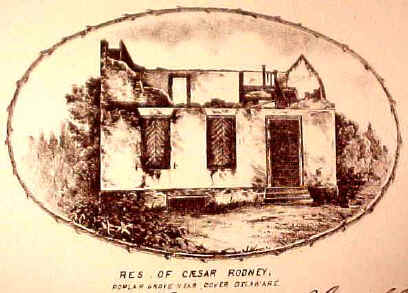
Poplar Grove, his home in
St. Jones Hundred,
Kent County,
Delaware.
He was buried in the family plot at Byerly, but the exact location
of his grave on the farm is unknown. There is a monument in the Christ
Episcopal Church Cemetery in
Dover, built over what were believed at one time to have been his
remains.
John Adams described Rodney, suffering from asthma as well as skin
cancer of the face, as "the oddest looking man in the world; he is tall,
thin and slender as a reed, and pale; his face is not bigger than a large
apple, yet there is sense and fire, spirit, wit and humor in this
countenance." The cancer on his face was a source of great discomfort for
many years and was so disfiguring that he often wore a green silk scarf to
conceal it. Goodrich summed up his character as "a man of great integrity,
and of pure patriotic feeling. He delighted, when necessary, to sacrifice
his private interests for the public good. He was remarkably distinguished
for a degree of good humor and vivacity; and in generosity of character
was an ornament to human nature."
Although they both had military experience, Rodney's background was
almost the exact opposite of his predecessor,
John McKinly. While
McKinly was an
Ulster-Scot
Presbyterian from
New Castle County who was politically aligned with the compromise
seeking "Court Party" of the
Lower
Counties, Rodney was a member of the
Anglican gentry from strongly
Loyalist downstate who eventually became politically aligned with the
independence seeking "Country Party." It should be noted that each man's
personal background and family connections were at variance with the
majority of their chosen parties. Rodney's personal abilities, including
his status as a liaison from the predominantly Ulster-Scot Countries to
the predominantly Anglican Courties, helped him to successfully lead a
much divided Delaware population through the revolutionary era.
Unauthorized Site:
This site and its contents are not affiliated, connected,
associated with or authorized by the individual, family,
friends, or trademarked entities utilizing any part or
the subject's entire name. Any official or affiliated
sites that are related to this subject will be hyper
linked below upon submission
and Evisum, Inc. review.
Please join us in our mission to incorporate The Congressional Evolution of the United States of America discovery-based curriculum into the classroom of every primary and secondary school in the United States of America by July 2, 2026, the nation’s 250th birthday. , the United States of America: We The
People. Click Here