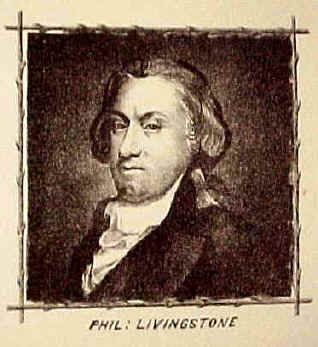
PHILIP LIVINGSTON was born January 15, 1716.Born to wealth, he was reared on the family manor near
Albany, New York; he graduated in the class of 1737 from Yale, married a well-to-do girl from Albany, Christina Ten Broeck. He then established
a thriving import business in New York City.
Livingston helped to found he New York Society Library, the St. Andrews Society, the City's Chamber of Commerce and
King's College (now Columbia University).It was only at the age of forty, however, that he entered into
politics as a member of the city's board of alderman. This office was important and respectable and Livingston was
reelected to the office for nine consecutive years.In 1759, he joined the provincial assembly and subsequently would
represent the colony at the Stamp Act Congress.
While Livingston wrote and spoke against British
oppression, he and his family worked hard for reconciliation.The colony of New York was for a time more under the influence of
the British crown than were most other colonies.Likewise, New York more slowly adopted measures hastening the
revolution.But all along
there were individuals in New York that desplayed patriotic feelings and
were ready to rise in opposition to British agressions. Livingston
was one of those patriots.
Livingston was elected to represent New York in
Congress in 1774.During
the deliberations of this congress, he assisted in preparing an address
to the people of Great Britian.In
the Second Congress, Philip served on a number of important committees,
including the marine committee, the committee on Indian affairs, the
committee on commerce, and the treasury board."He was very useful", a delegate said, "in committees where
a knowledge of figures or commercial subjects was required".Another delegate said, "There was a dignity, with a mixture of
austerity, in his deportment, which rendered it difficult for strangers
to approach him, and which made him a terror to those who swerved from
the line or faltered in the path of personal virtue and patriotic
duty."Another member of
Congress reported, "There is no holding conversation with him.He blusters away."
On the eve of independence there were four
Livingstons in Congress:Philip,
his younger brother William, young cousin John Jay and the still younger
cousin Robert.All
Livingstons believed that America should be free, yet not wholly
independent of the mother country.It was Philip's cousin, Robert, who perhaps summed up the
family's attitude best of all, "Every good man wishes that America
should remain free, in this I join heartily; at the same time I do not
desire she should be wholly independent of the mother country.How to reconcile their jarring principles, I profess I am
altogether at a loss."Once
the vote for independence was in, however, the Livingston family
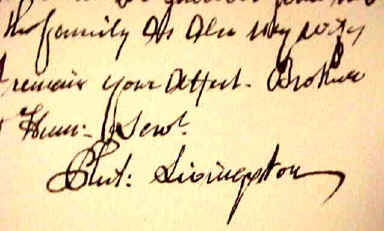
abandoned this position and accepted reality.Philip was the only Livingston present on the day the Declaration
was signed.Thus he signed
for the family.
The following year, Livingston was reelected to
congress by the state convention and in May 1777 he was chosen a senator
for the southern district of the first legislature of the state of New
York.In October of the
same year, he was reelected to Congress and on May 5, 1778 he took his
seat.This was a critical
and dismal period in the history of the Revolution.The British had taken Philadelphia, requiring congress to hold
their sessions at York.At
this time, Livingston's health was severely unstable.His health was so compromised that his doctors gave him no hope
of recovery.Yet, his
patriotic spirit was so strong that he did not hesitate to attend the
sessions of Congress.Prior
to his departure for York, he visited his friends in Albany and gave
them his final farewell as he did not expect to see them again.His family, at this time were at Kingston, and he also said his
good-byes and told them that he would not return.Livingston's sad anticipation proved true.On May 5, 1778, he took his seat in congress and his health
deteriorated rapidly.He
died on June 12, 1778 at the age of sixty-two.He was buried in York.
We invite you to read a transcription
of the complete text of the Declaration as presented by the National Archives.
&
The article "The
Declaration of Independence: A History,"
which provides a detailed account of the Declaration, from its drafting through
its preservation today at the National Archives.
Virtualology welcomes
the addition of web pages with historical documents and/or scholarly papers on
this subject.To submit a web link
to this pageCLICK
HERE.Please be sure to
include the above name, your name, address, and any information you deem
appropriate with your submission.
Unauthorized Site:
This site and its contents are not affiliated, connected,
associated with or authorized by the individual, family,
friends, or trademarked entities utilizing any part or
the subject's entire name. Any official or affiliated
sites that are related to this subject will be hyper
linked below upon submission
and Evisum, Inc. review.
Please join us in our mission to incorporate The Congressional Evolution of the United States of America discovery-based curriculum into the classroom of every primary and secondary school in the United States of America by July 2, 2026, the nation’s 250th birthday. , the United States of America: We The
People. Click Here