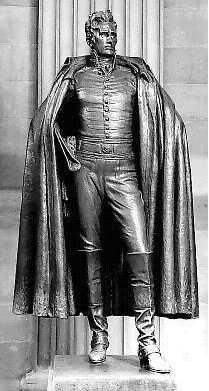
17th President of the United States
7th under the US Constitution
1767-1845
7th President of the United States
ANDREW JACKSON was born on March
15, 1767 to Scott's-Irish parents who came to America only two years earlier in
1765 from Northern Ireland, with their two sons, Hugh and Robert. His father,
also named Andrew Jackson, took up farming in the backwoods Waxhaw settlement on
the border between North and South Carolina. He died in 1767, prior to
Andrew’s birth. His mother, Elizabeth Hutchinson Jackson, moved her family
into the home of a nearby relative, James Crawford. There Jackson spent his
childhood, attending frontier schools and acquiring the reputation of being hot
tempered and easily provoked to fight. He learned to read and read so well that
he was often called upon by to read aloud the Philadelphia papers to the entire
community.
In 1780, when Jackson was 13, the Revolutionary War reached the Carolinas.
All three Jackson boys joined in the fight against the British, Andrew becoming
a orderly and messenger in the mounted militia of South Carolina. Hugh Jackson
was killed in the war, and when the British raided Waxhaw, both Andrew and
Robert were taken prisoner. Sent to the British prison in Camden, South
Carolina, Andrew was struck with a sword across his face and arm and nearly
killed because he refused to polish a British officer’s boots. Andrew and
Robert imprisoned together contracted the epidemic of smallpox that had overrun
the prison. Jackson’s mother got the boys released, but his brother died on
the long trip home. Mrs. Jackson later volunteered to nurse other wounded
American prisoners and she was fatally stricken by cholera. Jackson, now
fourteen years old, was without any immediate family. He managed to finish
school, took up saddle making and started teaching for a year or two. Upon
inheriting $300 from his grandfather, and after spending most of it on fancy
living in Charleston, he moved to Salisbury, North Carolina to study law under
Spruce Macay, a lawyer. He was admitted to the bar in 1787 and set up his own
practice in McLeanville, North Carolina. The next year, he and another lawyer,
John McNairy crossed the Cumberland Mountains to settle in the “Western
District”. There were few lawyers in the frontier village of Nashville, in
what was to be the state of Tennessee, but McNairy had connections and was made
a judge of the district’s superior court. McNairy appointed his friend,
Jackson, as solicitor general, and he soon was making a name for himself
prosecuting debtors, building up a successful law practice and speculating in
land.
The widow of John Donelson, the founder of the city of Nashville, ran the
boarding house where Jackson was living. Mrs. Rachel Donelson Robards, their
daughter was also staying at the house, having been estranged from her abusive
husband. Jackson fell in love and believing that Lewis Robards had obtained a
divorce after moving back to Kentucky, he and Rachel were married in August
1791. Two years later, they learned to their dismay that the Robards divorce was
just finalized, Rachel’s first husband had not obtained a divorce when Andrew
married her, only permission to file for one. The Jacksons were immediately
remarried on January 17, 1794. The Jacksons never had any children of their own,
but in 1809, they adopted an infant nephew of Rachel’s and named him Andrew
Jackson, Jr. They also raised three other nephews of Rachel’s as well as a
Native American boy whose parents had been killed in Jackson’s campaign
against the Creek nation in 1814.
In 1796, the state of Tennessee was carved out of the new territory and
Andrew Jackson was elected a delegate to the state constitutional convention and
its representative in the House. After one year in the House, Jackson was
elected to serve an un-expired term in the Senate. He served from September 1797
to April 1798 and returned to Tennessee to devote his energy to his plantation,
The Hermitage and breeding racehorses. He remained active in local politics, but
he took no interest in national affairs. His hot temper involved him in many
feuds and duels. Most were caused by remarks made about his wife’s honor and
Jackson had never been known to back away from a fight. In 1806, he was
challenged to a duel with Charles Dickinson. Jackson had stated that he would
deliberately allow Dickinson to fire first, as Dickinson was the considered the
faster and better shot. This would give Jackson time to take aim for he was
determined to kill his man with a single bullet, even “if he had shot me
through the brain”. Jackson took a bullet in the chest and without flinching,
calmly killed Dickinson.
Jackson was elected major general of the Tennessee militia in 1802. When the
War of 1812 broke out, Jackson offered his services and early in 1813 the
Governor of Tennessee, Willie Blount, sent Jackson to New Orleans, Louisiana.
Jackson and his men had gone as far as Natchez, Mississippi when word reached
them that the War Department and nullified his orders. Jackson was to disband
the men and send them on their way home; however, his 2,500 troops were without
supplies, food or equipment. Instead, Jackson personally led his men back to
Tennessee and he gained their admiration and respect. They said that he was as
tough as “old hickory” and the nickname stuck. In 1813, he led an ill
equipped and poorly trained troop against the Upper Creek Indians, allies of the
British, who had killed settlers at Fort Mims. In March of 1814, his victory
over the Creek at the Battle of Horseshoe Bend ceded 23 million acres of Native
American land to the United States. Jackson allowed the Creek women and children
to cross the Tallapoosa River to safety before wiping out the Creek forces. In
May 1814, Jackson was made major general of the United States Army and received
orders to proceed to New Orleans and defend the city against a British attack.
He found the city in chaos and declared martial law, amassing an army of 5000
comprised of Frenchmen, pirates, blacks, Creoles as well as his sharp-shooting
Tennessee and Kentucky militia. Jackson was at the disadvantage however, facing
8700 British veterans of European warfare, led by Lieutenant General Sir Edward
Pakenham. On December 13, 1814, Jackson learned of the plan for a surprise
British attack on the city, planned for that evening. Jackson launched his own
surprise attack that same evening and halted the British offensive. On January
8, 1815, the British launched a full attack. Jackson’s troops held and the
British retreated with over 2,000 casualties. The Americans lost only 13 lives
and Jackson became a national hero. The Battle of New Orleans was the only major
victory won on land by Americans during the war, and it was actually fought two
weeks after the war had officially ended with the signing of the Treaty of
Ghent. Because of the slow communication of the time, neither side in the battle
had known the war had ended.
Jackson’s military career had ended in 1819, but he had become a hero of
the frontier and one of the most discernible men in the United States. In 1822,
the Tennessee legislature had suggested he be nominated for President, and in
1824 he was formally proposed as the Democratic-Republican candidate, supported
by a number of his influential friends from Nashville, including Senator John H.
Eaton. His first campaign ended with his winning the bulk of the popular vote
receiving 152,899 to John Quincy Adams’ 105,321, Henry Clay of Kentucky
received 47,265 and William H. Crawford of Georgia received 47,087. However,
Jackson lost the presidency when his failure to gain a majority in the Electoral
College threw the race to the House of Representatives, which voted in favor of
fellow Republican, John Quincy Adams. The debate in the House became ugly; Adams
supporters tried to undercut Jackson’s appeal in any way possible. They
ridiculed his lack of education and accused him of everything from land frauds
to murder. The even resurrected the allegations that Rachel Jackson had been a
bigamist and an adulteress.
As soon as Adams was elected, Jackson readied himself for the 1828 campaign.
He returned to Hermitage while supporters campaigned actively in his behalf.
Early in the campaign, rumors had appeared in pro-Adams newspapers and one had
even editorialized “Ought a convicted adulteress and her paramour husband be
placed in the highest offices of this free and Christian land?” The campaign
quickly forgot the real issues as each side made vicious personal attacks. In
1825, he started an opposition party calling it the Democratic-Republicans.
Jackson won the election having carried the West and the South while Adams
carried the New England States. Jackson became the first President from the
emerging west and created what is today know as the Democratic Party. However,
his victory was short lived when his beloved wife Rachel died of a heart attack
less than three months before his inauguration. Jackson blamed his political
detractors for the grief they caused her in their slanders against her during
the campaign. At her funeral the President-elect said, “May God forgive her
murderers, as I know she forgave them. I never can.”
Still deep in mourning over the death of his wife, a 62-year-old Jackson
arrived in Washington, DC for his inauguration, old wounds and a tubercular
cough were causing him great pain. The outgoing John Quincy Adams refused to
attend his successor’s inauguration and greeted the new President coldly.
However, Jackson’s personal charisma, his penchant for plain talk and his
image as a Washington outsider proved irresistible to the public. He rolled into
office on a wave of populist fervor, and thousands of people nearly caused a
riot at his inaugural reception. Jackson had to flee through a rear door and the
crowd left only when the refreshments were moved to the lawn outside.
Jackson’s was a strong supporter of the “spoils system” which had
existed since the beginning of the republic. He was more open in rewarding his
political supporters with Cabinet positions, and even made it a policy of his
administration. He believed the government had become too bureaucratic and felt
if he replaced the bureaucrats with his own partisans, he was making the
government more democratic. However, Jackson did not rely on his official
Cabinet in policy formation, he instead relied on a group of close friends who
became known as his “Kitchen Cabinet”. His veto in of a bill to recharter
the National Bank infuriated his opponents, but not the people. The rechartering
of the Bank became the chief issue of the election and he was reelected
decisively.
However, by this time, Jackson’s image was propagated to the public mostly
through the rhetorical forms of the day. Through popular songs, cartoons and
newspapers, Jackson was shown as the hero and farmer politician, doing his duty
for his country. In reality, Jackson had lost most of his top teeth by 1828 and
had increasing difficulty delivering speeches. He also had a habit of replying
rashly and speaking out of turn. However, Jackson used the power of the
Presidency like no one before him. He truly believed in the collective wisdom of
the majority and his handling of the White House is a fine example of his
dedication to the people. He considered it the “People’s House” and he
served as their “steward”. His determination to advance democracy to its
farthest limits was a radical idea and he is one of the few who left the office
of the Presidency more popular then when he entered it. However by 1836, he was
weak from tuberculosis and had no thought of seeking a third term. The last days
of his presidency were as much a victory as the first. Thousands came, not to
see the new president, but to say good-bye to their hero, Jackson.
Jackson retired to his plantation “The Hermitage”, near Nashville,
Tennessee. He died on June 8, 1845 at the age of 75.
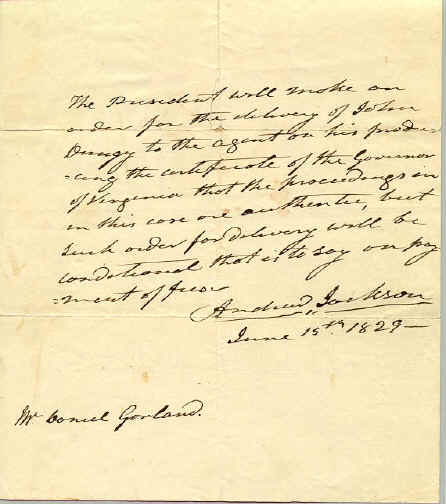
Andrew Jackson autograph letter signed, written in the third person to Daniel
Garland, promising an order to release a fugitive from the Washington County
jail; one page on watermarked wove; June 15, 1829.
Franklin
D. Roosevelt Library and Museum - Repository of the records of President
Franklin Roosevelt and his wife Eleanor Roosevelt, managed by the National
Archives and Records Administration.
Dwight
D. Eisenhower Presidential Library - preserves and makes available for
research the papers, audiovisual materials, and memorabilia of Dwight and Mamie
D. Eisenhower
Unauthorized Site:
This site and its contents are not affiliated, connected,
associated with or authorized by the individual, family,
friends, or trademarked entities utilizing any part or
the subject's entire name. Any official or affiliated
sites that are related to this subject will be hyper
linked below upon submission
and Evisum, Inc. review.
Please join us in our mission to incorporate The Congressional Evolution of the United States of America discovery-based curriculum into the classroom of every primary and secondary school in the United States of America by July 2, 2026, the nation’s 250th birthday. , the United States of America: We The
People. Click Here