Jonathan Dayton - Signer of the US Constitution - A Stan Klos
Company
Jonathan Dayton
Signer of the US Constitution
New Jersey Delegate
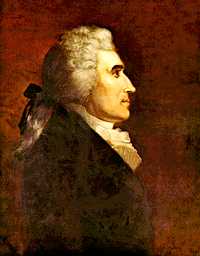
Speaker of the House of Representatives
Fourth and Fifth Congresses
Dayton, Jonathan,
statesman, born in Elizabethtown, New Jersey, 16 October 1760; died there, 9
October 1824, was graduated at Princeton in 1776, studied law, and was admitted
to the bar. He entered the Continental army, and was appointed paymaster of his
father's regiment, 26 August 1776. He held other commissions during the war, was
in many battles, and at Yorktown had command under Lafayette.
He was for a few years a member of the New Jersey House of
Representatives, and its speaker in 1790. He was a delegate from New Jersey to
the convention that framed the Federal constitution in 1787. He was elected to
congress from New Jersey in 1791, and reelected for three consecutive terms,
being speaker during the two last congresses, and serving till 3 March 1799. He
was elected U. S. senator from New Jersey, and served from 2 December 1799, till
3 March 1805. He was arrested for alleged conspiracy with Aaron Burr, but was
not tried. He received the degree of LL.D. from Princeton in 1798.
Autograph Letter Signed dated Elizabethtown May 9, 1818
to General Ebenezer Elmer:
Dear Sir,
There is a steam boat in complete order for running now
for sale at this place, which is probably well calculated to run between your
town or Greenwich of the city of Philadelphia. She will carry conveniently from
50 to 60 passengers, has two handsome airy cabins, built chiefly of live oak,
copper bottomed, of copper boiler, and sails well. She was intended to run
from the stone bridge in the center of this town, twice every day to the city of
New York, but instead of drawing 22 inches as was supposed, she draws 32 of
therefore does not answer for this object although in every other respect well
qualified.
I am not acquainted with the depth of the water in the
creek on which Bridgetown stands, but if exceeding 32 inches, this boat could be
used most advantageously employed between your place of Philadelphia or New
castle to perfect the line of steamboat communication which is worthy the
attention of such a thriving town as yours.
The original cost was upwards of $7,000 but being
purchased with Cash she can be afforded at $5,000 and can be worked with half
the number of men, of little more than half the fuel which the large steam boats
require. If her draft of water had answered to admit her to come up to our
market house of Stone Bridge she would immediately have been taken over by the
citizens in 60 shares of $100 each, or by a company.
If Cohansey Creek is sufficiently deep for her, she
might be very advantageously employed there, if I should be willing to retain an
interest a certain number of shares in her to the amount of a fourth, a fifth,
or a tenth as might be most agreeable.
I willthank you for an early answer, I am Dear Sir
With sincere esteem Yours
Jona: Dayton

Letter provided by
Estoric.com
To
view page one Click Here
Apparently the draft of 32 inches was too great for
Cohansey Creek or General Elmer choose not to invest as Steamboat service was
not established between Bridgeton and Philadelphia until 1845.
Elmer, Ebenezer,
physician, born in Cedarville, New Jersey, in 1752; died in Bridgeton, N. J., 18
October 1843, after receiving an academic education, studied medicine with his
brother, and was admitted to practice. He entered the army as an ensign, and in
1777 was appointed surgeon of the 2d New Jersey regiment. He practiced medicine
in Bridgeton, New Jersey, was a member of the state House of Representatives
from 1789 till 1795, serving as speaker of the assembly in 1791 and 1795, and
was thrice elected to congress, serving from 1801 till 1807. He was appointed
collector of customs in Bridgeton in 1808. He was vice president of the state
council from 1807 to 1815, and held the office of vice president of Burlington
College from 1808 till 1817, and again from 1822 till 1832.
During the war of 1812 he commanded a brigade of New Jersey militia on the
eastern bank of the Delaware. He was president of the Society of the Cincinnati
for New Jersey at the time of his death, and was the last survivor of the
original members, as he was also the last surviving Revolutionary officer of New
Jersey.








