Who was
the First U.S. President? There were actually four first
Presidents
of the United Colonies and States of America Click Here
New Page 1
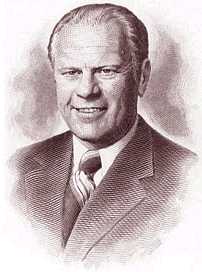
Gerald R. Ford
49th
President of the United States
39th under the US Constitution
GERALD RUDOLPH. FORD was born
as Leslie Lynch King, Jr. in Omaha, Nebraska on July 14, 1913. He was the only
child of Leslie Lynch King and Dorothy Gardner King. Two weeks after his birth,
his mother left her husband and took her son to live with her parents in Grand
Rapids, Michigan. His parents were divorced in 1914 and his mother met Gerald R.
Ford at a church function. They were married on February 1, 1916 and although
Ford never formally adopted her son, he gave the child his name, Gerald Rudolph
Ford, Jr. Young Ford did not know until 1930 that he was not the biological son
of his father, but he took the name legally on December 3, 1935. In later years,
Ford saw his natural father only a few times and learned that he had remarried
and fathered another boy and two girls.
Growing up in Grand Rapids, Ford attended the local grade schools and
worked in his stepfather’s paint and varnish store. The Fords were a close-knit
family, which included three younger half-brothers. He achieved the rank of
Eagle Scout and was the star center for the South High School football team. He
won a football scholarship to the University of Michigan in Ann Arbor in 1931
and played center on their undefeated national football championship teams of
1932 and 1933. After his graduation in 1935, Ford received offers to play
professional football with both the Detroit Lions and the Green Bay Packers but
instead he entered Yale University to study law. He accepted a job as assistant
football coach and freshman boxing coach to finance his studies. He graduated
from Yale in 1941 and returned to Grand Rapids to open a law firm with Philip R.
Buchen, a friend from the University of Michigan.
In April 1942, Ford enlisted in the Navy and was commissioned an ensign.
After orientation, he became a physical fitness instructor at the pre-flight
training school in Chapel Hill, North Carolina. In the spring of 1943, he was
assigned to duty aboard the USS Monterey, which took part in most of the major
operations in the South Pacific. He earned ten battle stars and was discharged
as a lieutenant commander in February 1946.
Ford returned to Grand Rapids and became a partner in the firm of
Butterfield, Keeney and Amberg and became active in local Republican politics.
With the encouragement of his stepfather, who was the county Republican
chairman, Ford decided to run for Congress. He won the election to the House of
Representatives from Michigan’s 5th Congressional District in 1948, receiving 61
percent of the vote in the general election. During the height of the campaign
on October 15, 1948, Ford secretly married Elizabeth (Betty) Bloomer Warren. She
was a fashion consultant for a leading Grand Rapids department store. She had
previously been married to William C. Warren, having been divorced in 1947.
Betty was born in Chicago and had studied dance with Martha Graham and had been
a model in New York. The couple would have four children: Michael Gerald, born
March 14, 1950; John Gardner, born March 16, 1952; Steven Meigs, born May 19,
1956; and Susan Elizabeth, born July 6, 1957.
Ford was reelected twelve times, serving from January 3, 1949 to December
6, 1973. He served on the House Appropriations Committee and rose to prominence
on the Defense Appropriation Subcommittee, becoming its ranking minority member
in 1961. His reputation as a legislator grew and he became House Minority Leader
in 1965. In both the 1968 and 1972 elections Ford was a loyal supporter of
Richard Nixon who had been a friend for many years. In 1973, when Nixon’s Vice
President, Spiro T. Agnew, was forced to resign over a income tax scandal, Nixon
picked Ford as the new Vice President. Following the most thorough background
investigation in the history of the FBI, Ford was confirmed and sworn in on
December 6, 1973. The following year, Nixon resigned over Watergate and Ford
became President. He became the first person to become President of the United
States without having been elected president or vice president. Ford took the
oath of office on August 9, 1974 and within a month he nominated Nelson
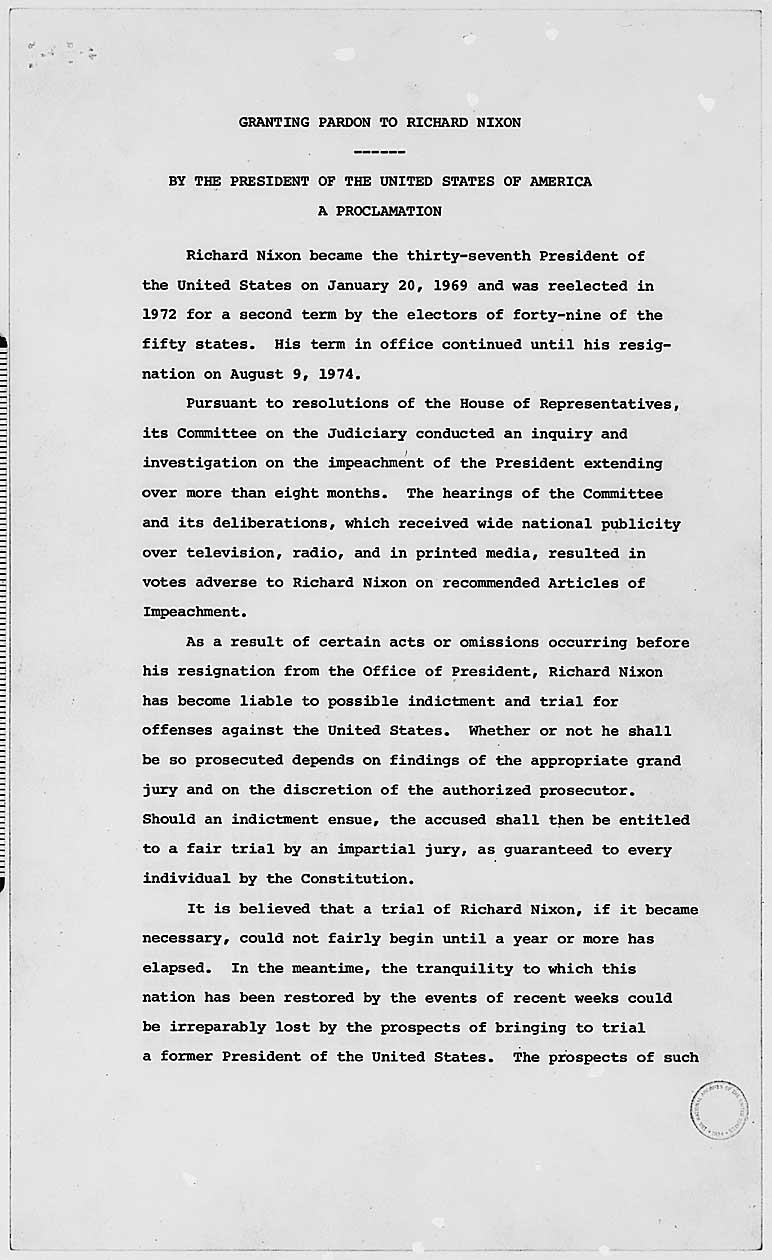
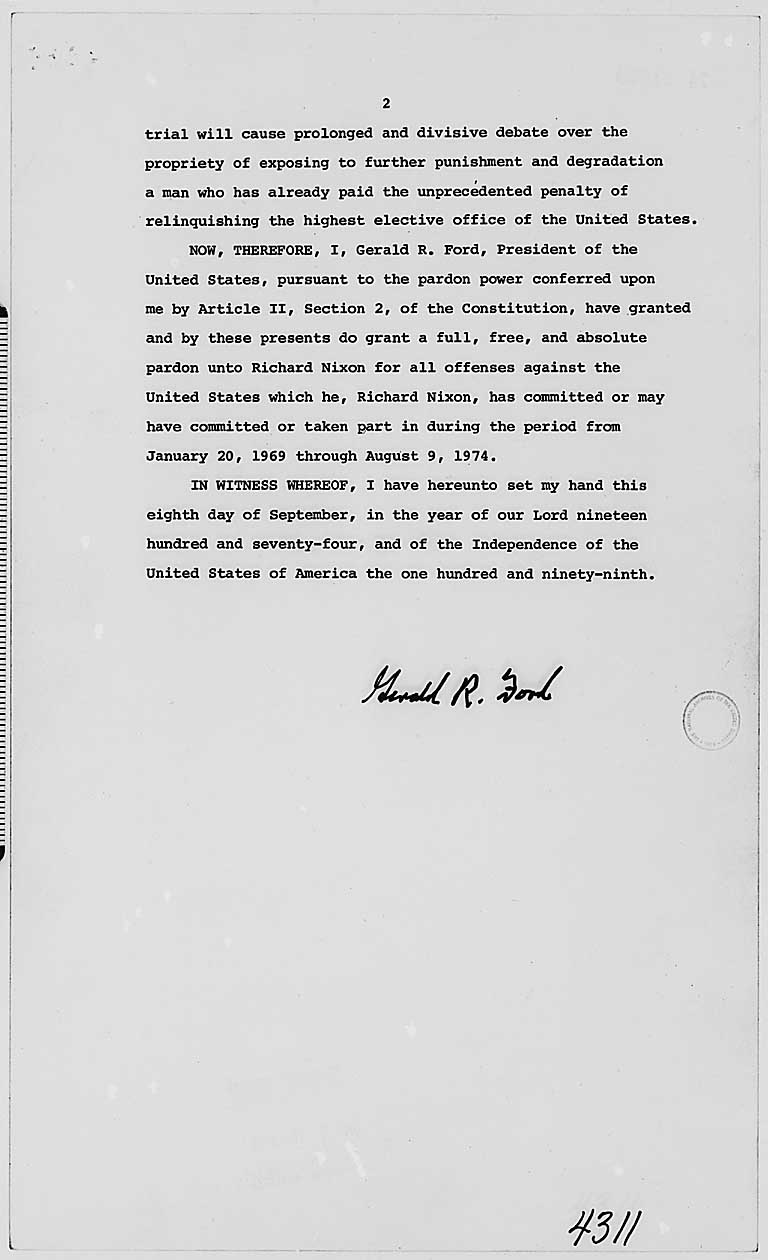
Rockefeller for vice president. On September 9, 1974, Ford granted Nixon a
“full, free and absolute pardon”, believing that protracted impeachment
proceedings would keep the country from focusing on its other problems. Public
reaction was most negative and the decision may have cost him the election in
1976.
Ford presided over a period of steadily improving relations with the
Soviet Union, reaching an agreement on limiting nuclear arms. He had the
misfortune to inherit the weakest American economy of the post-World War II
period. He faced rising inflation, rising unemployment and rising energy use. In
the spring of 1975 the North Vietnamese began their last offensive of the war.
Only a small contingent of American personnel remained in Saigon and as the
North Vietnamese advanced toward the capital, they were forced into a desperate
and chaotic evacuation. On April 30, 1975, the war was officially ended.
On two separate trips to California in September 1975, Ford was the target
of assassination attempts. Both of the assailants were women – Lynette “Squeaky”
Fromme, a follower of convicted murderer Charles Manson, and by Sara Jane Moore.
Ford fought a strong challenge by Ronald Reagan to gain the Republican
nomination during the 1976 campaign. He chose Senator Robert Dole of Kansas as
his running mate but lost to Democrat Jimmy Carter in one of the closest
elections in history.
Ford returned to private life in California where he built a new house in
Rancho Mirage. He continues to actively participate in politics and campaigns
extensively for Republican candidates. In August 1999, Ford received the Medal
of Freedom presented by President Bill Clinton. This honor, the nation’s highest
civilian award, was in recognition of Ford’s role in guiding he nation through
the turbulent times of Watergate, the Nixon resignation and the end of the
Vietnam War.
The Vice President
Speaker of the House
President pro tempore of the Senate
Secretary of State
Secretary of the Treasury
Secretary of Defense
Attorney General
Secretary of the Interior
Secretary of Agriculture
Secretary of Commerce
Secretary of Labor
Secretary of Health and Human Services
Secretary of Housing and Urban Development
Secretary of Transportation
Secretary of Energy
Secretary of Education
Secretary of Veterans Affairs
Research Links
Virtualology is not affiliated with the authors of these links nor responsible
for its content.
Franklin D. Roosevelt Library and Museum - Repository of the records of
President Franklin Roosevelt and his wife Eleanor Roosevelt, managed by the
National Archives and Records Administration.
Dwight D. Eisenhower Presidential Library - preserves and makes available
for research the papers, audiovisual materials, and memorabilia of Dwight and
Mamie D. Eisenhower
Unauthorized Site:
This site and its contents are not affiliated, connected,
associated with or authorized by the individual, family,
friends, or trademarked entities utilizing any part or
the subject's entire name. Any official or affiliated
sites that are related to this subject will be hyper
linked below upon submission
and Evisum, Inc. review.
Please join us in our mission to incorporate The Congressional Evolution of the United States of America discovery-based curriculum into the classroom of every primary and secondary school in the United States of America by July 2, 2026, the nation’s 250th birthday. , the United States of America: We The
People. Click Here