Who was
the First U.S. President? There were actually four first
Presidents
of the United Colonies and States of America Click Here
James Monroe Birthplace - A Stanley L. Klos, Chairman - James Monroe
Birthplace Commission
James Monroe Birthplace Commission
1009 Bainbridge Street, Richmond, VA 23224
Organized to Implement the Plan Developed by
Susan Nelson-Warren Byrd Landscape Architects in 2001
G.
William Thomas, President James Monroe Foundation
Tel:
804-231-1827
Stanley
Y. Klos, Chairman
James Monroe Birthplace Commission
Tel: 800-620-1776
President G.
William Thomas and CommissionerStanley
Y. Klos
signing the 99 year lease on the James Monroe Birthplace
Statement of Purpose: In 1976 the College of William &
Mary began the archaeological survey of the James Monroe Birthplace and
uncovered the ruins of the Monroe Family Home. Unlike George Washington,
whose Westmoreland birthplace is a now a National Park, Monroe did not
leave the family farm at three years old. James Monroe spent his entire
youth working the farm until he left for his education at The College of
William & Mary. The archaeological team uncovered a 20' x 58' house
foundation which coincided with the known 1845 etchings of the birth
home. The archaeological study clearly indicated that James Monroe's
beginnings were humble. The family resided in a small four room, rough
cut wooden farm house with few outbuildings on a 500 acre farm filled
with wetlands.
In 2001 Susan Nelson- Warren Byrd Landscape Architects of
Charlottesville were commissioned by the County of Westmoreland,
Virginia to prepare a master plan for a multi-phase development of James
Monroe's Birthplace site. The county's desire was to create a unique,
economical, and attractive park that celebrates the birth and life of
our nation's fifth president under the 2nd U.S. Constitution, James
Monroe, while providing passive recreation for the local residents.
In order to meet these desires, the county wanted the master plan to
provide general design strategies for the construction of a roadside
parking area, installation of interpretive signs, archaeological
interpretation, the development of bicycle and walking trails, and any
other improvements deemed necessary and desirable. An outstanding Master
Plan was developed by Susan Nelson- Warren Byrd Landscape Architects in
October 2001, and much of the text and illustrations shown below are
drawn from that 2001 Master Plan.
The site and the restoration of the birthplace, now part of a new
master plan, was brought to the attention of the James Monroe Memorial
Foundation's President G. William Thomas. Laurence Gouverneur Hoes and
his wife, Ingrid Westesson Hoes, established the James Monroe Memorial
Foundation (JMMF) in 1928. Laurence Hoes, the great-great-grandson of
James Monroe, had always hoped for the JMMF to acquire the farm and
reconstruct the Monroe Family Home, barn and outbuildings as an
interpretive venue highlighting the modest beginnings of a great U.S.
President.. On April 4th, 2005, the County of Westmoreland signed a 99
year lease with the James Monroe Memorial Foundation which will allow
the Foundation to restore the Birthplace farmhouse, establish an
educational visitor center, and remain the faithful steward of the
Birthplace farm.
The reconstruction of the James Monroe Birthplace farmhouse and
related buildings will cost in excess of $500,000. The James Monroe
Memorial Foundation is currently raising the money and expects to break
ground on July 5, 2006 (174th Anniversary of Monroe's death). The House
is scheduled to be completed by April 2007. President George W. Bush
will be invited to do the official commemoration on April 28th, 2008 the
250th anniversary of James Monroe's birth.
We invite you to participate in the Monroe Birthplace mission
through your underwriting support. A contribution of $50 or more
qualifies you to become a James Monroe Birthplace patron.
All donations made to the James Monroe Memorial Foundation qualify
as charitable contributions for federal tax purposes to an IRC Sec.
501(c)(3) organization. There are many ways to make a gift. Some have
added benefits for the donor depending on age, type of asset
contributed and the form of gift selected. The James Monroe Memorial
Foundation will work with you and your advisors to effectively
accomplish your philanthropic objectives.
An outright gift of cash made via personal check, credit card,
money order, wire transfer, bank draft, or currency is perhaps the
easiest way to participate. Extending a gift in installments over time
may be more convenient for many donors, possibly allowing them to make
larger gifts. Also, some firms will match dollar for dollar or more,
the charitable contributions of their employees. For more information
on outright gifts or sponsorship, CLICK
HERE.
To make an online donation for the restoration of the birthplace,
click
Community Context: There are currently four primary land
uses adjacent to the James Monroe Birthplace site. This means that
there is potential for development pressure immediately surrounding
the site. In order to preserve the historic and scenic aspect of the
site, the master plan calls for the establishment of conservation
easements and land use restrictions on adjacent properties. The park
will fit into a network of bicycle routes, canoe routes, birding
trails, and historic tours that are all economically pertinent to the
county. The master plan calls for the protection and preservation of
all archaeological resources while emphasizing community outreach
through volunteer research and investigation. The site offers an
excellent opportunity for school groups, Boy and Girl Scouts, and
other interested parties to study and understand ecological habitats.
Proper forest management is intended to provide long-term benefits for
the park by producing yields of timber for profit, educating the
public on sustainable forestry, and attracting wildlife. Managing the
proposed meadow can be tied into forest management while providing an
excellent opportunity to help restore the state's declining Bobwhite
Quail population.
Role of the landscape architect/entrant vs. the role of other
participants, including owner/client and collaborators: The
landscape architect was the primary consultant with responsibility for
all aspects of the master plan preparation and was influenced by a
series of meetings and presentations where input was gathered from
Westmoreland County's residents and public officials. The master
planning process included comprehensive documentation and analysis of
the site and its geographic and historical relationship to its
context. Through investigating maps and narrative on James Monroe, his
family, and Westmoreland County, the site's cultural and natural
history was chronicled. Evaluation of opportunities and constraints
were performed in conjunction with potential program and site issues.
Composed within the body of a descriptive narrative, the produced
document includes pertinent mappings, proposed plans and vignettes.
Special Factors: The site of James Monroe's birth affords a
distinct opportunity for interpreting the overlapping conditions of
both cultural and natural histories. This master planning process will
serve as a catalyst for defining how the site is used in the future as
part of the public domain. While the life of James Monroe will serve
literally as the structural and symbolic spine of the site, the place
will also be defined by the continuous transformation and evolution of
the forest and meadows, the fluctuation s of light and weather, the
cycles of seasons, and by the way people engage it: daily, seasonally,
and across generations.
Significance: The site can be a model of how to build and
maintain development respectful to its ecosystem. Low impact
recreational activities proposed are in keeping with the ecological
conservation efforts and program of the park. Reclaimed and recycled
building materials are proposed for pavilions, boardwalks, signs, and
edging. The James Monroe Memorial Foundation may seek to utilize 18th
Century wood and material to reconstruct the Farm house, kitchen and
Barn. Eventually the farmhouse and the visitor center will contain
artifacts related to James Monroe or his era.
The emphasis of storm water management on site could play an
important role in educating developers in the Chesapeake Bay watershed
on the importance of water and habitat conservation. Creating
demonstration plots for sustainable forestry provides a useful
education tool while making the site visible to science -based
researchers. Protecting and preserving all resources associated with
James Monroe's birth is beneficial for the enjoyment and education of
the public. These long-term plans would be an important tool for tying
in the local community with state and nation wide education programs.
Westmoreland County Statement: The James Monroe Birthplace
Park Master Plan provides a vision that creates a long-term strategy
for the future development of a historical public park. The plan
allocates space to meet all programmatic goals, circulation and
parking, preservation of historic and natural areas, and interprets
the life of James Monroe while giving the visitor the best possible
experience. The landscape architect exceeded our objective by reaching
out to the local community through incorporating a wide range of
educational and research initiatives. The plan is a firm guide for the
County to pursue a renewal of the site.
James Monroe Scholarship Award
New Page 1
James Monroe 15th President of the United
States
5th under the US Constitution
JAMES MONROE was born on April 28, 1758
in Westmoreland County, Virginia. He was one of five children of Spence Monroe
and Elizabeth Jones who were both natives of Virginia. The Monroe’s lived on a
small farm and young James walked several miles each day to attend the school of
Parson Campbell, who taught him the stern moral code that he followed throughout
his life.
When he was 16, Monroe entered the College of William and Mary. During his
first year there, his father died and the cost of his education and his
guardianship was taken over by his uncle, Judge Joseph Jones, who became his
trusted advisor. The year was 1774 and the colonies were moving ever closer to
war with Great Britain. Young Monroe was finding it difficult to concentrate on
his studies and in 1775, he left college to go to war. He became a lieutenant
and during the Battle of Trenton, his captain was wounded and the command was
given to him. However, he too was wounded at that battle and while recovering he
was named aide-de-camp to Major General Lord Stirling. He fought with George
Washington at Valley Forge and in 1779, and now a major, Monroe was commissioned
to lead a militia of Virginia regiment as a lieutenant colonel. However, his
unit was never formed and his military career was at its end. He became an aide
to Thomas Jefferson, who was the Governor of Virginia at this time. He also
became Jefferson’s student in the study of law and with Jefferson’s
guidance, he began to see what course his life would take.
In 1782, at the age of 24, Monroe was elected to the Virginia State
Legislature. He was the youngest member of the Executive Council and in 1783,
was elected to the United States Congress that was meeting in New York City. He
served in Congress for three years and during this time he became interested in
the settlement of the “western” lands between the Allegheny Mountains and
the Mississippi River. He was chairman of two important expansion committees –
one dealing with travel on the Mississippi River and the other involving the
government of the western lands.
Congress was meeting at that time in New York City, and while there Monroe
met Elizabeth Kortright, whom he married on February 16, 1786. The couple had
three children: Eliza Kortright Monroe (1786-1835), James Spence Monroe
(1799-1800), and Maria Hester Monroe (1803-1850).
In October, 1786, Monroe resigned from Congress and settled in
Fredericksburg, Virginia with his new bride. He was elected to the town council
and once again to the Virginia Legislature. He was a delegate to the Virginia
convention to ratify the new Constitution and was strongly opposed, feeling that
it was a threat to fee navigation of the Mississippi. He voted against the
constitution, but once it was ratified he accepted the new government without
any misgivings.
In 1789, the Monroe’s moved to Albemarle County, Virginia. Their estate,
Ash Lawn, was very near Jefferson’s estate, Monticello. In 1790, he was
elected to a recently vacated seat in the United States Senate and was named to
a full six-year term the following year. In the spring of 1794, Monroe accepted
the diplomatic position of Minister Plenipotentiary to France. His assignment
was to help maintain friendly relations with France despite efforts to remain on
peaceful terms with France’s enemy, Great Britain. Monroe was recalled in
September 1796 and felt he had been betrayed by his opponents who used him to
appease France while they made great concessions to Britain in Jay’s Treaty
that the United States had signed in 1794. He remained bitter about it for the
rest of his life.
Monroe returned home in June 1797 and after two years of retirement from
public office, he was elected governor of Virginia, a position that he served
from 1799 until 1803. His great friend and mentor, Thomas Jefferson had been
elected President in 1800 and in 1803, Monroe was sent back to France to help
Robert R. Livingston complete the negotiations for the acquisition of New
Orleans and West Florida. The French Emperor, Napoleon I, offered to sell
instead the entire Louisiana colony and although the Americans were not
authorized to make such a large purchase, they began negotiations. In April
1803, the Louisiana Purchase was concluded, more than doubling the size of the
nation. Monroe spent the next two years in useless negotiations with Britain and
Spain and returned to the United States in late 1807.
Monroe returned to Virginia politics and once more served in the legislature
and was elected Governor for a second time. In 1811, Monroe became President
Madison’s Secretary of State and when the War of 1812 was declared, he loyally
supported Madison. He served as Secretary of State throughout the war and
simultaneously served as Secretary of War for the latter part. He was back in
uniform at the time of the British attack on Washington and led the Maryland
militia in an unsuccessful attempt to hold off the British at Bladensburg. On
December 24, 1814, the Treaty of Ghent was signed ending the war. In 1815,
Monroe returned to the normal peacetime duties of Secretary of State.
Monroe was the logical presidential nominee at the end of Madison’s second
term, and he won the election easily. On March 4, 1817 James Monroe took his
oath of office. Some of the notable events of his term were: Congress fixed 13
as the number of stripes on the flag to honor the original colonies; the
boundary between Canada and the United States was fixed at the 49th parallel.;
Spain ceded Florida to the United States in exchange for the cancellation of $5
million in Spanish debt; The Missouri Compromise, admitted Missouri as a slave
state, but forbade slavery in any states carved from the Louisiana Territory
north of 36 degrees 30 minutes latitude. By the end of his first term,
Monroe’s administration had been one of high idealism and integrity and his
personal popularity was at an all time high. Monroe was virtually unopposed for
reelection. He carried every state and received every electoral vote cast with
the exception of one, cast by a New Hampshire elector for John Quincy Adams.
With the exception of the Monroe Doctrine, Monroe’s second term as
president was relatively uneventful. The two principles of the Doctrine,
noncolonization and nonintervention, were not new or original. However, it was
Monroe who explicitly proclaimed them as policy and it was a keystone of foreign
policy for many years.
Monroe had no thought of seeking a third term as the election of 1824 neared.
He was 67 years old when he turned over the presidency to John Quincy Adams. He
retired to Oak Hill, Virginia. He was plagued by financial worries and he was
forced to sell his estate Ash Lawn to meet his debts. After his wife died, he
sold Oak Hill and moved to New York City to live with his youngest daughter,
Maria Hester Gouverneur and her husband. Monroe died there on July 4, 1831, the
fifty-fifth anniversary of the signing of the Declaration of Independence.
Message of President James Monroe at the commencement of the first
session of the 18th Congress The Monroe Doctrine
Unrestricted. (NWL-46-PRESMESS-18AE1-1)
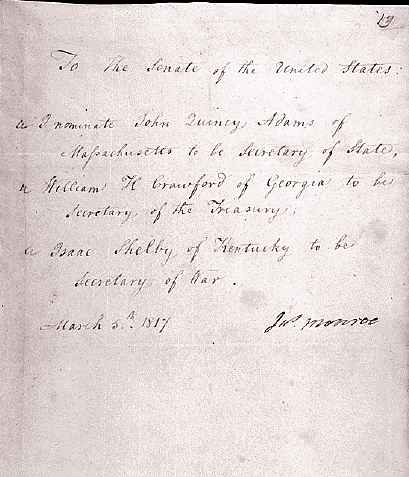
Message of
President James Monroe nominating John Quincy Adams to be Secretary of
State, William Crawford to be Secretary of the Treasury, and Isaac Shelby to be
Secretary of War. (NWL-46-MCCOOK-1(15))
Click on an image to view full-sized
1876 Appleton's Biography on James Monroe.
MONROE, James, fifth president
of the United States, died in Westmoreland county, Virginia, 28 April,
1758" died in New York city, 4 July, 1831. Although the attempts to trace
his pedigree have not been successful, it appears certain that the Monroe family
came to Virginia as early as 1650, and that they were of Scottish origin. James
Monroe's father was Spence Monroe, and his mother was Eliza, sister of Judge
Joseph Jones, twice a delegate from Virginia to the Continental congress. The
boyhood of the future president was passed in his native county, a neighborhood
famous for early manifestations of patriotic fervor. His earliest recollections
must have been associated with public remonstrance against the stamp-act (in
1766), and with the reception (in 1769)of a portrait of Lord Chatham, which was
sent to the gentlemen of Westmoreland, from London, by one of their
correspondents, Edmund Jennings, of Lincoln's Inn.
To the college of William and Mary, then rich and prosperous, James Monroe
was sent but soon after his student life began it was interrupted by the
Revolutionary war. Three members of the faculty and twenty-five or thirty
students, Monroe among them, entered the military service. He joined the army in
1776 at the headquarters of Washington in
New York, as a lieutenant in the 31 Virginia regiment under Colonel Hugh Mercer.
He was with the troops at Harlem, at White Plains, and at Trenton,
where, in leading the advance guard, he was wounded in the shoulder.
During 1777-'8 he served as a volunteer aide, with the rank of major, on the
staff of the Earl of Stifling, and took part in the battles of the Brandywine,
Germantown, and Monmouth.
After these services he was commended by Washington for a commission in the
state troops of Virginia, but without success, he formed the acquaintance of Governor
Jefferson, and was sent by him as a military commissioner to collect
information in regard to the condition and prospects of the southern army. He
thus attained the rank of lieutenant-colonel but his services in the field were
completely interrupted, to his disappointment trod chagrin. His uncle, Judge
Jones, at all times a trusted and intimate counselor, then wrote to him; "
You do well to cultivate the friendship of Mr. Jefferson . . . and while you
continue to deserve his esteem, he will not withdraw his countenance."
The future proved the sagacity of this advice, for Monroe's intimacy with
Jefferson, which was then established, continued through life, and was the key
to his early advancement, and perhaps his ultimate success. The civil life of
Monroe began on his election in 1782 to a seat in the assembly of Virginia, and
his appointment as a member of the executive counsel. He was next a delegate to
the 4th, 5th, and 6th congresses of the confederation, where, notwithstanding
his youth, he was active and influential. Bancroft says of him that when
Jefferson embarked for France, Monroe remained "not the ablest but the
most conspicuous representative of Virginia on the floor of congress, lie sought
the friendship of nearly every leading statesman of his commonwealth, and every
one seemed glad to call him a friend."
On 1 March, 1784, the Virginia delegates presented to congress a deed that
ceded to the United States Virginia's claim to the northwest
territory, and soon afterward Jefferson presented his memorable plan for the
temporary government of all the western possessions of the United States from
the southern boundary (lat. 31. N.) to the Lake of the Woods. From that time
until its settlement by the ordinance of 13 July, 1787, this question was of
paramount importance. Twice within a few months Monroe crossed the Alleghenies
for the purpose of becoming acquainted with the actual condition of the country.
One of the fruits of his western observations was a memoir, written in 1786, to
prove the rights of the people of the west to the free navigation of the
Mississippi.
Toward the close of 1784 Monroe was selected as one of nine judges to decide
the boundary dispute between Massachusetts and New York. He resigned this place
in May, 1786, in consequence of an acrimonious controversy in which he became
involved. Both the states that were at difference with each other were at
variance with Monroe in respect to the right to navigate the Mississippi, and
lie thought himself thus debarred from being acceptable as an umpire to either
of the contending parties, to whom he owed his appointment.
In the congress of 1785 Monroe was interested in the regulation of commerce
by the confederation, and he certainly desired to secure that result: but he was
also jealous of the rights of the southern states, and afraid that their
interests would be overbalanced by those of the north. His policy was therefore
timid and dilatory. A report upon the subject by the committee, of which he was
chairman, was presented to congress, 28 March, 1785, and led to a long
discussion, but nothing came of it. The weakness of the confederacy grew more
and more obvious, and the country was drifting toward a stronger government. But
the measures proposed by Monroe were not entirely abortive. Says John
Q. Adams:"They led first to the partial convention of delegates
from five states at Annapolis in September, 1786, and then to the general
convention at Philadelphia in 1787, which prepared and proposed the constitution
of the United States. Whoever contributed to that event is justly entitled to
the gratitude of the present age as a public benefactor, and among them the name
of Monroe should be conspicuously enrolled."
According to the principle of rotation then in force, Monroe's congressional
service expired in 1786, at the end of a three years' term. He then intended to
make his home in Fredericksburg, and to practice law, though he said he should
be happy to keep clear of the bar if possible. But it was not long before he was
again called into public life. He was chosen at once a delegate to the assembly,
and soon afterward became a member of the Virginia convention to consider the
ratification of the proposed constitution of the United States, which assembled
at Richmond in 1788. In this convention the friends of the new constitution were
led by James Madison, John
Marshall, and Edmund Randolph.
Patrick Henry was their chief opponent, and
James Monroe was by his side, in company with William Grayson and George
Mason. In one of his speeches, Monroe made an elaborate historical argument,
based on the experience of Greece, Germany, Switzerland, and New England,
against too firm consolidation, and he predicted conflict between the state and
national authorities, and the possibility that a president once elected might be
elected for life. In another speech he endeavored to show that the rights of the
western territory would be less secure under the new constitution than they were
under the confederation. He finally assented to the ratification on condition
that certain amendments should be adopted. As late as 1816 he recurred to the
fears of a monarchy, which he had entertained in 1788, and endeavored to show
that they were not unreasonable.
Under the new constitution the first choice of Virginia for senators fell
upon Richard Henry Lee and William Grayson.
Tim latter died soon afterward, and Monroe was selected by the legislature to
fill the vacant place. He took his seat in the senate, 6 December, 1790, and
held the office until May, 1794, when he was sent as envoy to France. Among the
Anti-Federalists he took a prominent stand, and was one of the most determined
opponents of the administration of Washington. To Hamilton he was especially
hostile. The appointment of Gouverneur Morris
to be minister to France, and of John Jay to be
minister to England, seemed to him most objectionable. Indeed, he met all the
Federalist attempts to organize a strong and efficient government with
incredulity or with adverse criticism. It was therefore a great surprise to him,
as well as to the public, that, while still a senator, he was designated the
successor of Morris as minister to France.
For this difficult place he was not the first choice of the president, nor
the second: but he was known to be favorably disposed toward the French
government, and it was thought that he might lead to the establishment of
friendly relations with that power, and, besides, there is no room to doubt that
Washington desired, as , John Quincy Adams has said, to hold the balance between
the parties at home by appointing Jay, the Federalist, to the English mission,
and Monroe, the Republican, to the French mission. It was the intent of the
United States to avoid a collision with any foreign power, but neutrality was in
danger of being considered an offence by either France or England at any
moment.
Monroe arrived in Paris just after the fall of Ropespierre, and in the
excitement of the day he did not at once receive recognition from the committee
of public safety. He therefore sent a letter to the president of the convention,
and arrangements were made for his official reception, 15 August, 1794. At that
time he addressed the convention in terms of great cordiality, but his
enthusiasm led him beyond his discretion, he transcended the authority that had
been given to him, and when his report reached the government at home Randolph
sent him a dispatch, " in the frankness of friendship," criticizing
severely the course that the plenipotentiary had pursued. A little latex the
secretary took a more conciliatory tone and Monroe bellowed he never would have
spoken so severely if all the dispatches from Paris had reached the United
States in due order.
The residence of Monroe in France was a period of anxious responsibility,
during which he did not succeed in recovering the confidence of the authorities
at home. When Pickering succeeded Randolph in the department of state. Monroe
was informed that he was superseded by the appointment of Charles C. Pinckney.
The letter of recall was dated 22 August. 1796. On his return he published a
pamphlet of 500 pages, entitled "A View of the conduct of the
Executive" (Philadelphia, 1797) in which he printed his instructions,
correspondence with the French and United States governments, speeches, and
letters received from American residents in Paris. This publication made a great
stir. Washington, who had then retired from public life. appears to have
remained quiet under the provocation, but he wrote upon his copy of the
"View" animadversions that have since been published.
Party feeling, already excited, became fiercer when Monroe's book appeared,
and personalities that have now lost their force were freely uttered on both
sides. Under these circumstances Monroe became the hero of the Anti-Federalists,
and was at once elected governor of Virginia. He held the office from 1799 till
1802. The most noteworthy occurrence during his administration was the
suppression of a servile insurrection by which the city of Richmond was
threatened. Monroe's star continued in the ascendant. After Thomas Jefferson's
election to the presidency in 1801, an opportunity occurred for returning Mr.
Monroe to the French mission, from which he had been recalled a few years
previously. There were many reasons for believing that the United States could
secure possession of the territory beyond the Mississippi belonging to France.
The American minister in Paris, Robert R Livingston, had already opened the
negotiations, and Monroe was sent as an additional plenipotentiary to second,
with his enthusiasm and energy, the effort that had been begun. By their joint
efforts it came to pass that in the spring of 1803
a treaty was signed by which France gave up to the United States for a
pecuniary consideration the vast region then known as Louisiana. Livingston
remarked to the plenipotentiaries after the treaty was signed; " We have
lived long, but this is the noblest work of our lives."
The story of the negotiations that terminated in this sale is full of
romance. Bonaparte, Talleyrand, and Marbois
were the representatives of France. Jefferson. Livingston, and Monroe
guided the interests of the United States. The French were in need of money and
the Americans could afford to pay well for the control of the entrance to the
Mississippi. England stood ready to seize the coveted prize. The moment was
opportune; the negotiators on both sides were eager for the transfer. It did not
take long to agree upon the consideration of 80,000,000 francs as the
purchase-money, and the assent of Bonaparte was secured. "I have given
to England," he said, exultingly, "a maritime rival that will
sooner or later humble her pride."
It is evident that the history of the United States has been largely
influenced by this transaction, which virtually extended the national domain
from the mouth of the Mississippi river to the mouth of the Columbia. Monroe
went from Paris to London, where he was accredited to the court of St. James,
and subsequently went to Spain in order to negotiate for the cession of Florida
to the United States. But he was not successful in this and returned to London,
where, with the aid of William Pinckney, who was sent to re-enforce his efforts,
he concluded a treaty with Great Britain after long negotiations frequently
interrupted. This treaty failed to meet the expectations of the United States in
two important particulars--it made no provisions against the impressments of
seamen, and it secured no indemnity for loss that Americans had incurred in the
seizure of their goods and vessels. Jefferson was so dissatisfied that he would
not send the treaty to the senate.
Monroe returned home in 1807 and at once drew up an elaborate defense of his
political conduct. Matters were evidently drifting toward war between Great
Britain and the United States. Again the disappointed and discredited
diplomatist received a token of popular approbation. He was for the third time
elected to the assembly, and in 1811 was chosen for the second time governor of
Virginia. He remained in this office but a short time, for he was soon called by
Madison to the office of secretary of state. He held the portfolio during the
next six years, from 1811 to 1817. In 1814-'15 he also acted as secretary of
war. While he was a member of the cabinet of Madison, hostilities were begun
between the United States and England. The public buildings in Washington were
burned, and it was only by the most strenuous measures that the progress of the
British was interrupted.
Monroe gained much popularity by the measures that he took for the protection
of the capital and for the enthusiasm with which he prosecuted the war measures
of the government Monroe had now held almost every important station except that
of president to which a politician could aspire. He had served in the
legislature of Virginia, in the Continental congress, and in the senate of the
United States. He had been a member of the convention that considered the
ratification of the constitution, twice he had served as governor, twice he had
been sent abroad as a minister, and he had been accredited to three great
powers. He had held two places in the cabinet of Madison. With the traditions of
those days, which regarded experience in political affairs a qualification for
an exalted station, it was most natural that Monroe should become a candidate
for the presidency. Eight years previously his fitness for the office had been
often discussed.
Now, in 1816, at the age of fifty-nine years, almost exactly the age at which
Jefferson and Madison attained the same position, he was elected president of
the United States, receiving 183 votes in the electoral college against 34 that
were given for RufusKing, the candidate of the
Federalists. He continued in this office until 1825. His second election in 1821
was made with almost complete unanimity, but one electoral vote being given
against him. Daniel D. Tompkins was vice-president during both presidential
terms. John Quincy Adams, John C. Calhoun, William
H. Crawford, and William Wirt, were members of the cabinet during his entire
administration. The principal subjects that engaged the attention of the
president were the defenses of the Atlantic seaboard, the promotion of internal
improvements, the conduct of the Seminole war, the acquisition of Florida, the
Missouri compromise, and the resistance to foreign interference in American
affairs, formulated in a declaration that is called the "Monroe
doctrine."
Two social events marked the beginning and the end of his administration:
first, his ceremonious visit to the principal cities of the north and south; and
second, the national reception of the Marquis
de Lafayette who came to this country as the nation's guest The purchase of
the Floridas was brought to a successful issue, 22 February, 1819 by a treaty
with Spain, concluded at Washington, and thus the control of the entire Atlantic
and Gulf seaboard, from the St. Croix to the Sabine, was secured to the United
States. Monroe's influence in the controversies that preceded the Missouri
compromise does not appear to have been very strong. He showed none of the
boldness which Jefferson would have exhibited under similar circumstances. He
took more interest in guiding the national policy with respect to internal
improvements and the defense of the seaboard. He vetoed the Cumberland road
bill, 4 May, 1822, on the ground that congress had no right to execute a system
of internal improvement ; but he held that if such powers could be secured by
constitutional amendment good results would follow. Even then he held that the
general government should undertake only works of national significance, and
should leave all minor improvements to the separate states.
There is no measure with which the name of Monroe is connected so important
as his enunciation of "the Monroe doctrine." The words of this
famous utterance constitute two paragraphs in the president's message of 2
December, 1823. In the first of these paragraphs he declares that the
governments of Russia and Great Britain have been informed that the American
continents henceforth are not to be considered subjects for future colonization
by any European powers. In the second paragraph he says that the United States
would consider any attempt on the part of the European powers to extend their
system to any portion of this hemisphere as dangerous to our peace and safety.
He goes further, and says that if the governments established in North and South
America who have declared their independence of European control should be
interfered with by any European power, this interference would be regarded as
the manifestation of unfriendly disposition to the United States. These
utterances were addressed especially to Spain and Portugal. They undoubtedly
expressed the dominant sentiments of the people of the United States at the time
they were uttered, and, moreover, they embodied a doctrine which had been
vaguely held in the days of Washington, and from that time to the administration
of Monroe had been more and more clearly avowed.
It has received the approval of successive administrations and of the
foremost publicists and statesmen. The peace and prosperity of America have been
greatly promoted by the declaration, almost universally assented to, that
European states are not to gain new dominion in America. For convenience of
reference the two passages of the rues-sage are here quoted: "At the
proposal of the Russian imperial government, made through the minister of the
emperor residing here, full power and instructions have been transmitted to the
minister of the United States at St. Petersburg, to arrange, by amicable
negotiation, the respective rights and interests of the two nations on the
northwest coast of this continent. A similar proposal had been made by his
imperial majesty to the government of Great Britain, which has likewise been
acceded to. The government of the United States has been desirous, by this
friendly proceeding, of manifesting the great value which they have invariably
attached to the friendship of the emperor, and their solicitude to cultivate the
best understanding with his government. In the discussions to which this
interest has given rise, and in the arrangements by which they may terminate,
the occasion has been judged proper for asserting, as a principle in which the
rights and interests of the United States are involved, that the American
continents, by the free and independent condition which they have assumed and
maintain, are henceforth not to be considered as subjects for future
colonization by any European power .... We owe it, therefore, to candor, and to
the amicable relations existing between the United States and those powers, to
declare that we should consider any attempt on their part to extend their system
to any portion of this hemisphere as dangerous to our peace and safety. With the
existing colonies or dependencies of any European power we have not interfered,
and shall not interfere. But with the governments who have declared their
independence and maintained it, and whose independence wehave, on great
consideration and on just principles, acknowledged, we could not view any
interposition for the purpose of oppressing them, or controlling in any other
manner their destiny, by any European power, in any other light than as the
manifestation of an unfriendly disposition toward the United States."
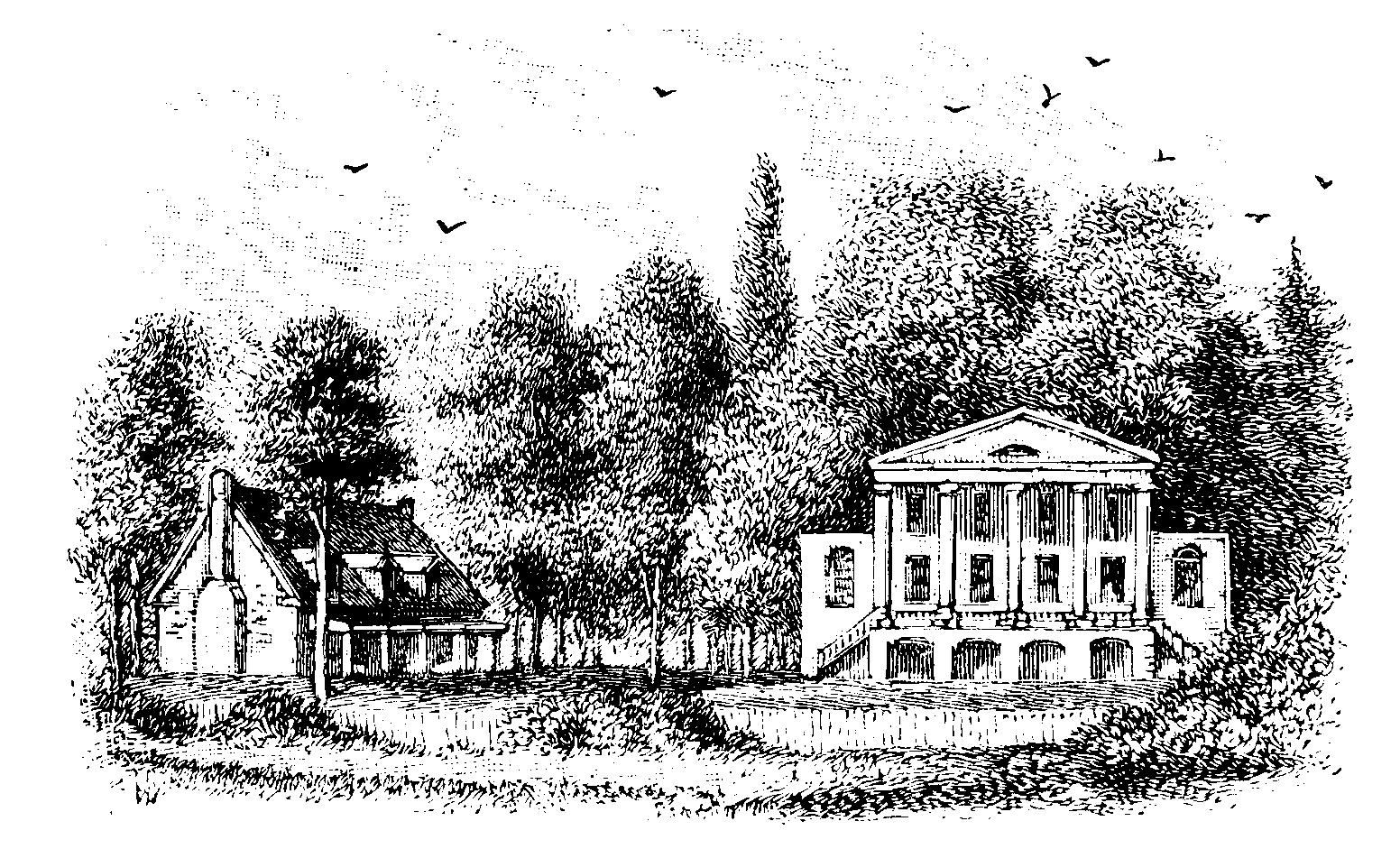
At the close of Monroe's second term as president he retired to private life,
and during the seven years that remained to him resided part of the time at Oak
Hill, Loudon County, Virginia, and part of the time in the city of New York. The
illustration above represents both the old and the new Oak Hill mansions. He
accepted the office of regent in the University of Virginia in 1826 with
Jefferson and Madison. He was asked to serve on the electoral ticket of Virginia
in 1828, but declined on the ground that an ex-president should not be a
party-leader. He consented to act as a local magistrate, however, and to become
a member of the Virginia constitutional convention. The administration of Monroe
has often been designated as the "era of good feeling."
Schouler, the historian, has found this heading on an article that appeared
in the Boston Centinel of 12 July, 1817. it is, on the whole, a suitable phrase
to indicate the state of political affairs that succeeded to the troublesome
period of organization and preceded the fearful strains of threatened disruption
and of civil war. One idea is consistently represented by Monroe from the
beginning to the end of his public life--the idea that America is for Americans,
that the territory of the United States is to be protected and enlarged, and
that foreign intervention will never be permitted. In his early youth Monroe
enlisted for the defense of American independence. He was one of the first to
perceive the importance of free navigation upon the Mississippi: he negotiated
with France and Spain for the acquisition of Louisiana and Florida; he gave a
vigorous impulse to the second war with Great Britain in de-fence of our
maritime rights when the rights of a neutral power were endangered; and he
enunciated a dictum against foreign interference which has now the force of
international law. Judged by the high stations he was called upon to fill, his
career was brilliant; but the writings he has left in state papers and
correspondence are inferior to those of Jefferson, Madison, Hamilton, and others
of his contemporaries. He is rather to be honored as an upright and patriotic
citizen who served his party with fidelity and never condescended to low and
unworthy measures. He deserved well of the country, which he served faithfully
during his career. After his retirement from the office of president he urged
upon the government the judgment of unsettled claims which he presented for
outlays made during his prolonged political services abroad and for which he had
never received adequate remuneration.
During the advance of old age his time was largely occupied in
correspondence, and he undertook to write a philosophical history of the origin
of free governments, which was published long after his decease. While attending
congress, Monroe married, in 1786, a daughter of Lawrence Kortright, of New
York. One of his two daughters, Eliza., married George Hay, of Virginia, and the
other, Maria, married Samuel L. Gouverneur of New York. A large number of
manuscripts, including drafts of state papers, letters addressed to Monroe, and
letters from him, have been preserved. Most of these have been purchased by
congress and are preserved in the archives of the state department ; others are
still held by his descendants. Schouler, in his "History of the United
States," has made use of this material to advantage, particularly in
his account of the administrations of Madison and Monroe, which he has treated
in detail. Bancroft, in his "History of the Constitution,"
draws largely upon the Monroe papers, many of which he prints for the first
time. The eulogy of John Quincy Adams his (Boston diary 1831) afford and the
best contemporary view of Monroe's characteristics as a statesman.
Jefferson, Madison, Webster, Calhoun, and Benton have left their appreciative
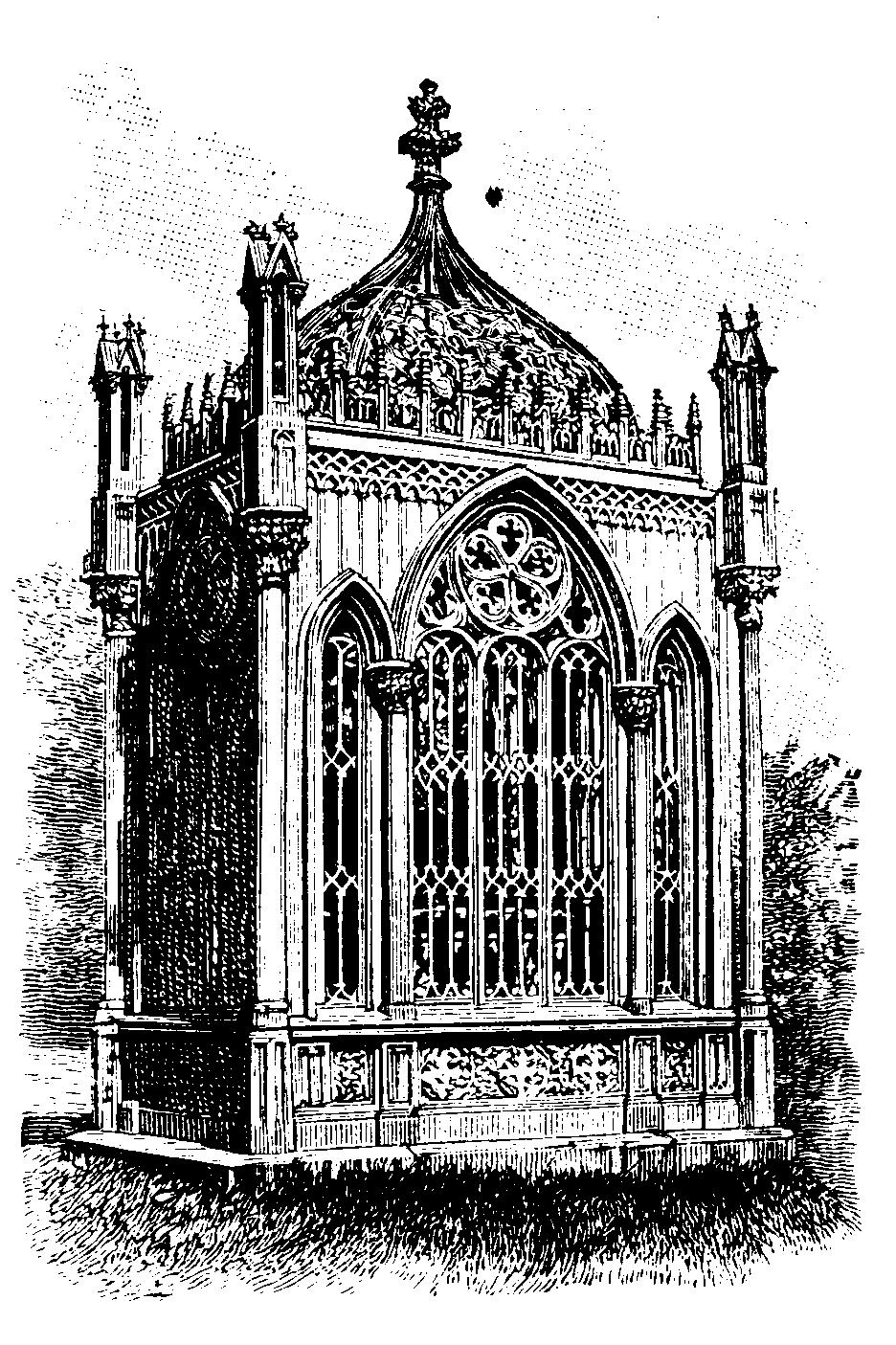
estimates of his character The remains of James Monroe were buried in Marble
cemetery, Second street, between First and Second avenues, New York, but in 1858
were taken to Richmond, Virginia, and there re-interred on the 28th of April, in
Hollywood. (See illustration above.) See Samuel P. Waldo's "Tour of James
Monroe through the Northern and Eastern States, with a Sketch of his Life"
(Hartford, 1819); " Life of James Monroe, with a Notice of his
Administration," by John Quincy Adams (Buffalo, 1850) : "Concise
History of the .Monroe Doctrine," by George F. Tucker (Boston, 1885): and
Daniel C. Gilman's life of Monroe, in the "American Statesmen " series
(Boston, 1883). In the volume last named is an appendix by J. F. Jameson, which
gives a list of writings pertaining to Monroe's career and to the Monroe
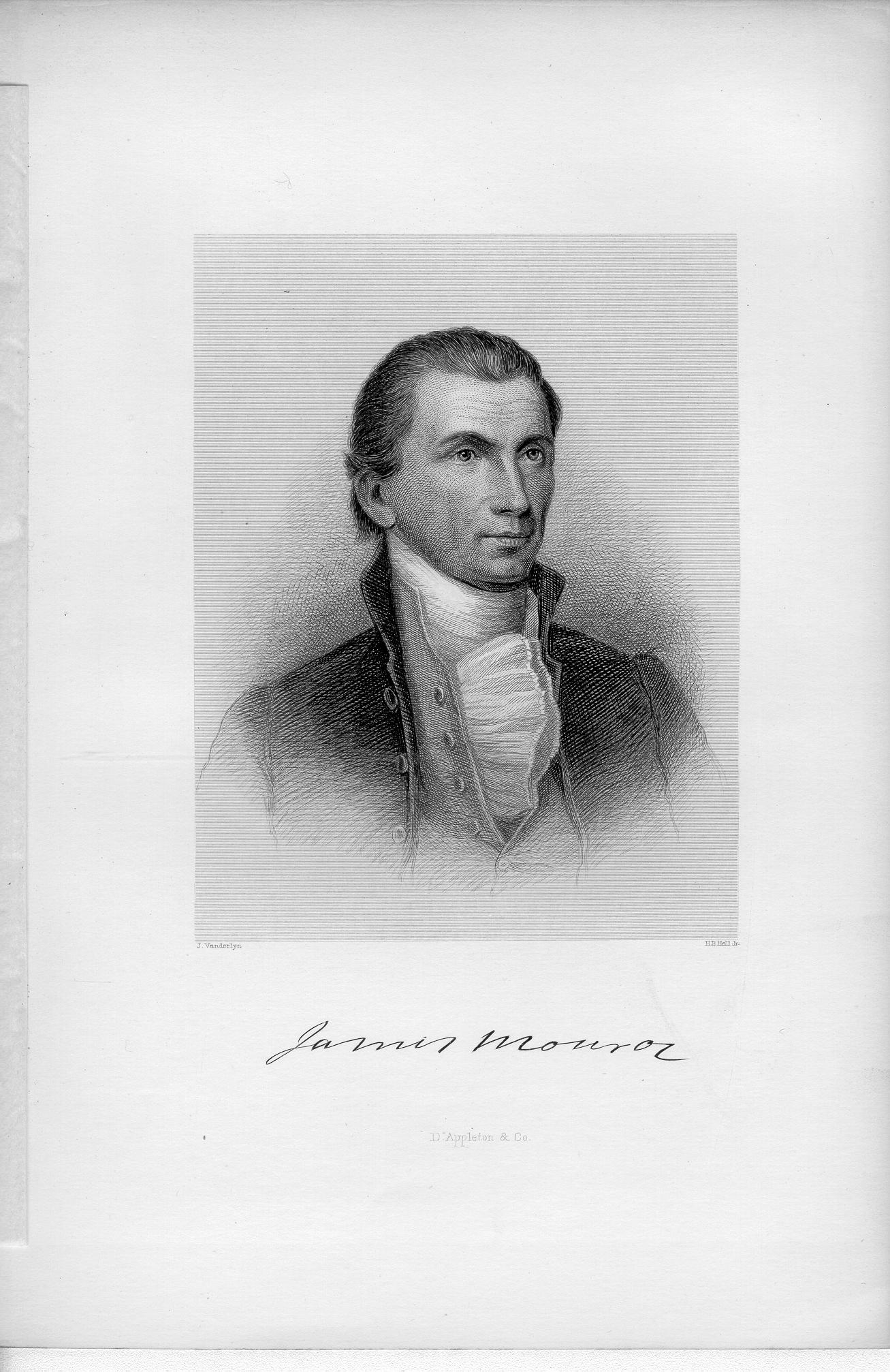
doctrine. Monroe's portrait by Stuart is in the possession of Thomas J.
Coolidge, and that by Vanderlyn is in the city-hall, New York, both of which
have been engraved.--
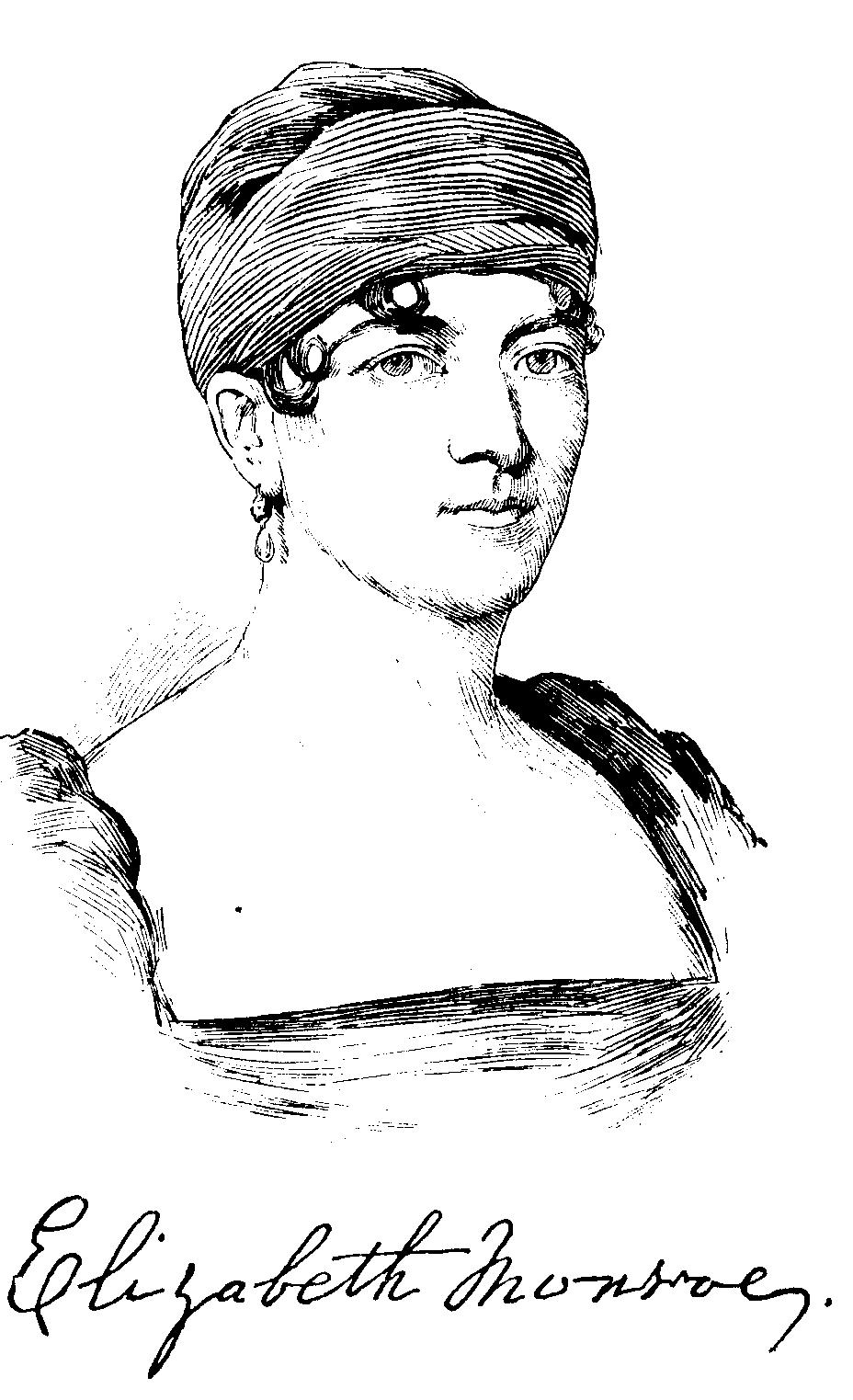
His wife, Elizabeth Kortright, born in New
York city in 1768; died in Loudon county, Virginia, in 1830, was the daughter of
Lawrence Kortright, a captain in the British army. She married James Monroe in
1786, accompanied him in his missions abroad in 1794 and 1803, and while he was
United States minister to France she effected the release of Madame de
Lafayette, who was confined in the prison of LaForce, hourly expecting to be
executed. On the accession of her husband to the presidency, Mrs. Monroe became
the mistress of the White House; but she mingled little in society on account of
her delicate health. She is described by a contemporary writer as "an
elegant and accomplished woman, with a dignity of manner that peculiarly fitted
her for the station." The above vignette is copied from the only
portrait that was ever made of Mrs. Monroe, which was executed in Paris in 1796
His nephew, James Monroe, soldier, in Albemarle county, Virginia, 10
September, 1799; died in Orange, New Jersey, 7 September, 1870, was a son of the
president's elder brother, Andrew. He was graduated at the United States
military academy in 1815, assigned to the artillery corps, and served in the war
with Algiers, in which he was wounded while directing part of the quarter-deck
guns of the "Guerridre" in an action with the "Mashouda"
off Cape de Gata, Spain. He was aide to General Winfield
Scott in 1817-'22, became 1st lieutenant of the 4th artillery on the
reorganization of the army in 1821, and served on garrison and commissary duty
till 1832, when he was again appointed Gem Scott's aide on the Black Hawk
expedition, but did not reach the seat of war, owing to illness. He resigned his
commission on 30 September, 1832, and entered politics, becoming an alderman of
New York city in 1833, and president of the board in 1834. In 1836 he declined
the appointment of aide to Governor William L. Marcy. He was in congress in
1839-'41, and was chosen again in 1846, but his seat was contested, and congress
ordered a new election, at which he refused to be a candidate. During the
Mexican war he was active in urging the retention in command of General Scott.
In 1850-'2 he was in the New York legislature, and in 1852 was an earnest
supporter of his old chief for the presidency. After the death of his wife in
that year he retired from politics, and spent much of his time at the Union
club, of which he was one of the earliest members. Just before the civil war he
visited Richmond, and, by public speeches and private effort, tried to prevent
the secession of Virginia, and in the struggle that followed he remained a firm
supporter of the National government. He much resembled his uncle in personal
appearance.
Unauthorized Site:
This site and its contents are not affiliated, connected,
associated with or authorized by the individual, family,
friends, or trademarked entities utilizing any part or
the subject's entire name. Any official or affiliated
sites that are related to this subject will be hyper
linked below upon submission
and Evisum, Inc. review.
Please join us in our mission to incorporate The Congressional Evolution of the United States of America discovery-based curriculum into the classroom of every primary and secondary school in the United States of America by July 2, 2026, the nation’s 250th birthday. , the United States of America: We The
People. Click Here