Who was
the First U.S. President? There were actually four first
Presidents
of the United Colonies and States of America Click Here
New Page 1
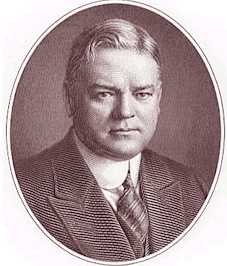
Herbert Hoover
41st President of the United States
31st under the US Constitution
Herbert Hoover analyzes 5 periods in the
development of the history of the Depression -
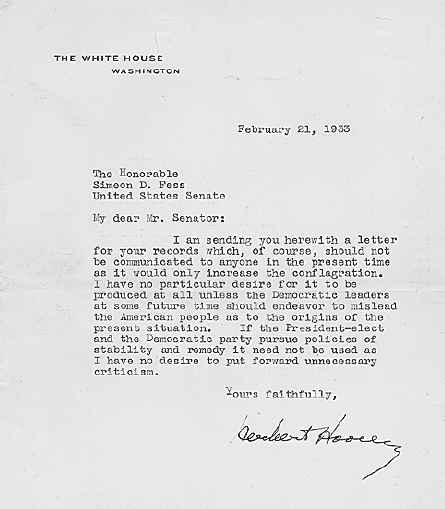
Transmittal Letter
Following a conversation with Senator Simeon Fess on 2/20/33, Herbert
Hoover wrote Fess to record his analysis of key events and developments during
the first five periods of Depression. Hoover's letter was written during the
darkest days of his administration. The banking crisis of 1933 was entering
its worst phase and Hoover was trying to reach an understanding with Roosevelt
that would prevent a total collapse of the nation's banking system. Hoover
also wrote a short letter to transmit his four page analysis in which he
cautioned Fess that his letter "should not be communicated to anyone in the
present time as it would only increase the conflagration." -
Courtesy of:
National
Archives and Records Administration
HERBERT CLARK HOOVER was born on August
1, 1874 in West Branch, Iowa, the second of three children of devote Quakers.
His father, Jesse Clark Hoover was the village blacksmith, and his mother was
Huldah Randall Minthorn. When young Hoover was only six years old, his father
died of typhoid fever and less than three years later, his mother died of
pneumonia. In 1884, the children moved to Newberg, Oregon to live with their
mother’s brother, Henry John Minthorn, a country doctor who had a strong
interest in education. In Newberg, Hoover worked on a farm and he attended a
Quaker academy that his uncle helped direct.
In 1888, young Hoover worked as an office boy in a land settlement office in
nearby Salem and he studied mathematics attending night school. His professor of
mathematics, Joseph Swain, helped him gain admittance to the new Leland Stanford
Junior University in Palo Alto, California. A coincidental meeting with an
engineer in Salem resulted in his resolve to study engineering, and he was
admitted in 1891 to Stanford’s first class. He worked his way through college,
typing, doing laundry and working as a secretary for a geology professor. During
his senior year, he met a young geology student from Iowa, Lou Henry, who would
later become his wife. He graduated with his bachelor’s degree in mining
engineering in May 1895.
After graduation, Hoover worked in gold mining in California and Colorado. He
then joined the staff of a leading mining engineer in San Francisco, who
recommended him to the London mining firm of Bewick, Moreing and Company, in
1897. Hoover introduced California mining methods to the company’s Western
Australia operations. While in Australia, Hoover suggested the company purchase
an extremely productive gold mine, and he was rewarded with a substantial
increase in salary. He turned to the administrative side of the business,
working with the government and bargaining with labor. A year later, the company
offered him a position as chief engineer of the Chinese Engineering and Mining
Company. Hoover accepted, but returned to Monterey, California, where on
February 10, 1899, he married Lou Henry. They would eventually have two sons:
Herbert Clark Hoover (1903 – 1969) and Allan Henry Hoover (1907 – 1993).
The couple arrived in Peking in March 1899. During the Boxer Rebellion in
June and July of 1900, the Hoovers risked their lives transporting food and
medical supplies to the besieged foreigners, walled up in the city. Later that
year, they returned to London, where Hoover was given a one-fifth interest in
Bewick, Moreing and Company, which had mines in Australia, New Zealand, South
Africa, Canada and Nevada. They had gold, silver, tin, copper, coal and lead
mines, and they also owned a turquoise mine in Egypt. Hoover became a well-known
consulting engineer and by 1914 he was managing director or chief consulting
engineer in a score of mining companies. By the age of 34, he had acquired
worldwide recognition in his profession, as well as interests and chairmanships
in a number of mining companies. He organized a firm of consulting engineers
that also had worldwide interests and his travels did not stop. He published
books on metals and mining engineering and gave lectures at Stanford and
Columbia universities.
When World War I began, Hoover was asked to organize and direct an American
Relief Committee, aiding stranded and penniless Americans in Europe. Hoover
became a public figure and was appointed as head of the Commission for Relief in
Belgium, bringing him world fame. When the United States entered the War in
April 1917, President Wilson appointed Hoover the U.S. food administrator,
working to increase food production, reduce consumption, eliminate waste,
stabilize prices and improve distribution. After the War ended, Hoover returned
to Europe and established the American Relief Administration, to assist in the
economic restoration and the feeding millions of diseased and undernourished
children.
Returning to the United States in September 1919, Hoover’s friends launched a
campaign to give him the nomination for president. He did not get the
nomination, but the new Republican President, Warren G. Harding, offered Hoover
the position as Secretary of Commerce, which he accepted and continued to hold
under Harding’s successor, Coolidge. As head of the Department of Commerce,
Hoover strengthened and expanded its activities, especially into federal
regulation of the new technologies of radio broadcasting and commercial
aviation.
When President Calvin Coolidge withdrew from the 1928 presidential race, the
Republican Party nomination was wide open. At the June convention, Hoover was
nominated on the first ballot, and named Charles Curtis, the U.S. Senator from
Kansas, as candidate for vice president. Aided by the country’s prosperity, plus
anti-Catholic sentiment against Democrat Al Smith, Hoover swept to victory.
Hoover carried every Northern state except Massachusetts and Rhode Island with
444 electoral votes to Smith’s 87 and 21,437,277 popular votes to Smith’s
15,007,698.
The country was extraordinarily prosperous when Hoover began his
administration, with large Republican majorities in Congress. Early in his
administration he attacked the problem of low agriculture prices due to an
increase in productivity and the amount of land being farmed. In April 1929, he
called a special session of Congress and the Agricultural Marketing Act of 1929
was enacted, establishing the first large-scale government program to aid the
farmer in peacetime.
Seven months into his Presidency, On October 29, 1929, “Black Tuesday”, the
stock market crash plunged thousands of businesses and individuals into
bankruptcy, ushering in the most extended economic downturn in American history,
the Great Depression. At first Hoover felt the financial catastrophe was simply
panic and that the economy was sound and would soon return to normal. However,
public confidence was not restored and he was forced to propose direct action by
the government to defeat the depression. Hoover cut taxes, increased public
works and created the Reconstruction Finance Corporation to make government
loans. But he drew the line at direct loans to individuals, even though more
than 12 million Americans were unemployed. Shanty towns of homeless families
became known as “Hoovervilles”, and the Democrats regained their majority in the
Congressional elections of 1930.
Hoover was defeated before he even ran for reelection, as the Democrats had
blamed the Republicans and the president for the depression. Running against
Franklin D. Roosevelt, Governor of New York, the Republicans were branded the
“Party of hard times”. Roosevelt won the election in November 1932 with 472
electoral votes to Hoover’s 59. The popular vote for Roosevelt was 22,829,501
and Hoover received 15,760,684.
Hoover settled in his Palo Alto, California home after retiring from the
presidency. He donated his 20,000 volume Hoover Library on War, Revolution and
Peace to Stanford University. He remained active in politics, figuring
prominently in the 1940 Republican National Convention. He served in Europe at
President Truman’s request after World War II, recommending ways to avert a
postwar famine and again in 1947 when he was named chairman of the Commission on
Organization of the Executive Branch of Government, which is commonly called the
Hoover Commission. He maintained throughout his old age an impressive schedule
of writing and public speaking. He wrote The Ordeal of Woodrow Wilson (1958)
when he was 83, the first book ever written by one president about another whom
he had served.
Hoover died on October 20, 1964, at the age of 90. He had survived beyond his
term of office longer than any president ever had.
Presidents of the Continental
Congress
United Colonies of The United States
Peyton Randolph September 5, 1774 to October
22, 1774
and May 20 to May 24, 1775
Henry Middleton October 22, 1774 to October 26, 1774
The Vice President
Speaker of the House
President pro tempore of the Senate
Secretary of State
Secretary of the Treasury
Secretary of Defense
Attorney General
Secretary of the Interior
Secretary of Agriculture
Secretary of Commerce
Secretary of Labor
Secretary of Health and Human Services
Secretary of Housing and Urban Development
Secretary of Transportation
Secretary of Energy
Secretary of Education
Secretary of Veterans Affairs
Research Links
Virtualology is not affiliated with the authors of these links nor responsible
for its content.
Franklin D. Roosevelt Library and Museum - Repository of the records of
President Franklin Roosevelt and his wife Eleanor Roosevelt, managed by the
National Archives and Records Administration.
Dwight D. Eisenhower Presidential Library - preserves and makes available
for research the papers, audiovisual materials, and memorabilia of Dwight and
Mamie D. Eisenhower
Herbert Hoover
41st President of the United States
31st under the US Constitution
HERBERT CLARK HOOVER was born on August
1, 1874 in West Branch, Iowa, the second of three children of devote Quakers.
His father, Jesse Clark Hoover was the village blacksmith, and his mother was
Huldah Randall Minthorn. When young Hoover was only six years old, his father
died of typhoid fever and less than three years later, his mother died of
pneumonia. In 1884, the children moved to Newberg, Oregon to live with their
mother’s brother, Henry John Minthorn, a country doctor who had a strong
interest in education. In Newberg, Hoover worked on a farm and he attended a
Quaker academy that his uncle helped direct.
In 1888, young Hoover worked as an office boy in a land settlement office in
nearby Salem and he studied mathematics attending night school. His professor of
mathematics, Joseph Swain, helped him gain admittance to the new Leland Stanford
Junior University in Palo Alto, California. A coincidental meeting with an
engineer in Salem resulted in his resolve to study engineering, and he was
admitted in 1891 to Stanford’s first class. He worked his way through college,
typing, doing laundry and working as a secretary for a geology professor. During
his senior year, he met a young geology student from Iowa, Lou Henry, who would
later become his wife. He graduated with his bachelor’s degree in mining
engineering in May 1895.
After graduation, Hoover worked in gold mining in California and Colorado. He
then joined the staff of a leading mining engineer in San Francisco, who
recommended him to the London mining firm of Bewick, Moreing and Company, in
1897. Hoover introduced California mining methods to the company’s Western
Australia operations. While in Australia, Hoover suggested the company purchase
an extremely productive gold mine, and he was rewarded with a substantial
increase in salary. He turned to the administrative side of the business,
working with the government and bargaining with labor. A year later, the company
offered him a position as chief engineer of the Chinese Engineering and Mining
Company. Hoover accepted, but returned to Monterey, California, where on
February 10, 1899, he married Lou Henry. They would eventually have two sons:
Herbert Clark Hoover (1903 – 1969) and Allan Henry Hoover (1907 – 1993).
The couple arrived in Peking in March 1899. During the Boxer Rebellion in
June and July of 1900, the Hoovers risked their lives transporting food and
medical supplies to the besieged foreigners, walled up in the city. Later that
year, they returned to London, where Hoover was given a one-fifth interest in
Bewick, Moreing and Company, which had mines in Australia, New Zealand, South
Africa, Canada and Nevada. They had gold, silver, tin, copper, coal and lead
mines, and they also owned a turquoise mine in Egypt. Hoover became a well-known
consulting engineer and by 1914 he was managing director or chief consulting
engineer in a score of mining companies. By the age of 34, he had acquired
worldwide recognition in his profession, as well as interests and chairmanships
in a number of mining companies. He organized a firm of consulting engineers
that also had worldwide interests and his travels did not stop. He published
books on metals and mining engineering and gave lectures at Stanford and
Columbia universities.
When World War I began, Hoover was asked to organize and direct an American
Relief Committee, aiding stranded and penniless Americans in Europe. Hoover
became a public figure and was appointed as head of the Commission for Relief in
Belgium, bringing him world fame. When the United States entered the War in
April 1917, President Wilson appointed Hoover the U.S. food administrator,
working to increase food production, reduce consumption, eliminate waste,
stabilize prices and improve distribution. After the War ended, Hoover returned
to Europe and established the American Relief Administration, to assist in the
economic restoration and the feeding millions of diseased and undernourished
children.
Returning to the United States in September 1919, Hoover’s friends launched a
campaign to give him the nomination for president. He did not get the
nomination, but the new Republican President, Warren G. Harding, offered Hoover
the position as Secretary of Commerce, which he accepted and continued to hold
under Harding’s successor, Coolidge. As head of the Department of Commerce,
Hoover strengthened and expanded its activities, especially into federal
regulation of the new technologies of radio broadcasting and commercial
aviation.
When President Calvin Coolidge withdrew from the 1928 presidential race, the
Republican Party nomination was wide open. At the June convention, Hoover was
nominated on the first ballot, and named Charles Curtis, the U.S. Senator from
Kansas, as candidate for vice president. Aided by the country’s prosperity, plus
anti-Catholic sentiment against Democrat Al Smith, Hoover swept to victory.
Hoover carried every Northern state except Massachusetts and Rhode Island with
444 electoral votes to Smith’s 87 and 21,437,277 popular votes to Smith’s
15,007,698.
The country was extraordinarily prosperous when Hoover began his
administration, with large Republican majorities in Congress. Early in his
administration he attacked the problem of low agriculture prices due to an
increase in productivity and the amount of land being farmed. In April 1929, he
called a special session of Congress and the Agricultural Marketing Act of 1929
was enacted, establishing the first large-scale government program to aid the
farmer in peacetime.
Seven months into his Presidency, On October 29, 1929, “Black Tuesday”, the
stock market crash plunged thousands of businesses and individuals into
bankruptcy, ushering in the most extended economic downturn in American history,
the Great Depression. At first Hoover felt the financial catastrophe was simply
panic and that the economy was sound and would soon return to normal. However,
public confidence was not restored and he was forced to propose direct action by
the government to defeat the depression. Hoover cut taxes, increased public
works and created the Reconstruction Finance Corporation to make government
loans. But he drew the line at direct loans to individuals, even though more
than 12 million Americans were unemployed. Shanty towns of homeless families
became known as “Hoovervilles”, and the Democrats regained their majority in the
Congressional elections of 1930.
Hoover was defeated before he even ran for reelection, as the Democrats had
blamed the Republicans and the president for the depression. Running against
Franklin D. Roosevelt, Governor of New York, the Republicans were branded the
“Party of hard times”. Roosevelt won the election in November 1932 with 472
electoral votes to Hoover’s 59. The popular vote for Roosevelt was 22,829,501
and Hoover received 15,760,684.
Hoover settled in his Palo Alto, California home after retiring from the
presidency. He donated his 20,000 volume Hoover Library on War, Revolution and
Peace to Stanford University. He remained active in politics, figuring
prominently in the 1940 Republican National Convention. He served in Europe at
President Truman’s request after World War II, recommending ways to avert a
postwar famine and again in 1947 when he was named chairman of the Commission on
Organization of the Executive Branch of Government, which is commonly called the
Hoover Commission. He maintained throughout his old age an impressive schedule
of writing and public speaking. He wrote The Ordeal of Woodrow Wilson (1958)
when he was 83, the first book ever written by one president about another whom
he had served.
Hoover died on October 20, 1964, at the age of 90. He had survived beyond his
term of office longer than any president ever had.
Presidents of the Continental
Congress
United Colonies of The United States
Peyton Randolph September 5, 1774 to October
22, 1774
and May 20 to May 24, 1775
Henry Middleton October 22, 1774 to October 26, 1774
The Vice President
Speaker of the House
President pro tempore of the Senate
Secretary of State
Secretary of the Treasury
Secretary of Defense
Attorney General
Secretary of the Interior
Secretary of Agriculture
Secretary of Commerce
Secretary of Labor
Secretary of Health and Human Services
Secretary of Housing and Urban Development
Secretary of Transportation
Secretary of Energy
Secretary of Education
Secretary of Veterans Affairs
Research Links
Virtualology is not affiliated with the authors of these links nor responsible
for its content.
Franklin D. Roosevelt Library and Museum - Repository of the records of
President Franklin Roosevelt and his wife Eleanor Roosevelt, managed by the
National Archives and Records Administration.
Dwight D. Eisenhower Presidential Library - preserves and makes available
for research the papers, audiovisual materials, and memorabilia of Dwight and
Mamie D. Eisenhower
Unauthorized Site:
This site and its contents are not affiliated, connected,
associated with or authorized by the individual, family,
friends, or trademarked entities utilizing any part or
the subject's entire name. Any official or affiliated
sites that are related to this subject will be hyper
linked below upon submission
and Evisum, Inc. review.
Please join us in our mission to incorporate The Congressional Evolution of the United States of America discovery-based curriculum into the classroom of every primary and secondary school in the United States of America by July 2, 2026, the nation’s 250th birthday. , the United States of America: We The
People. Click Here