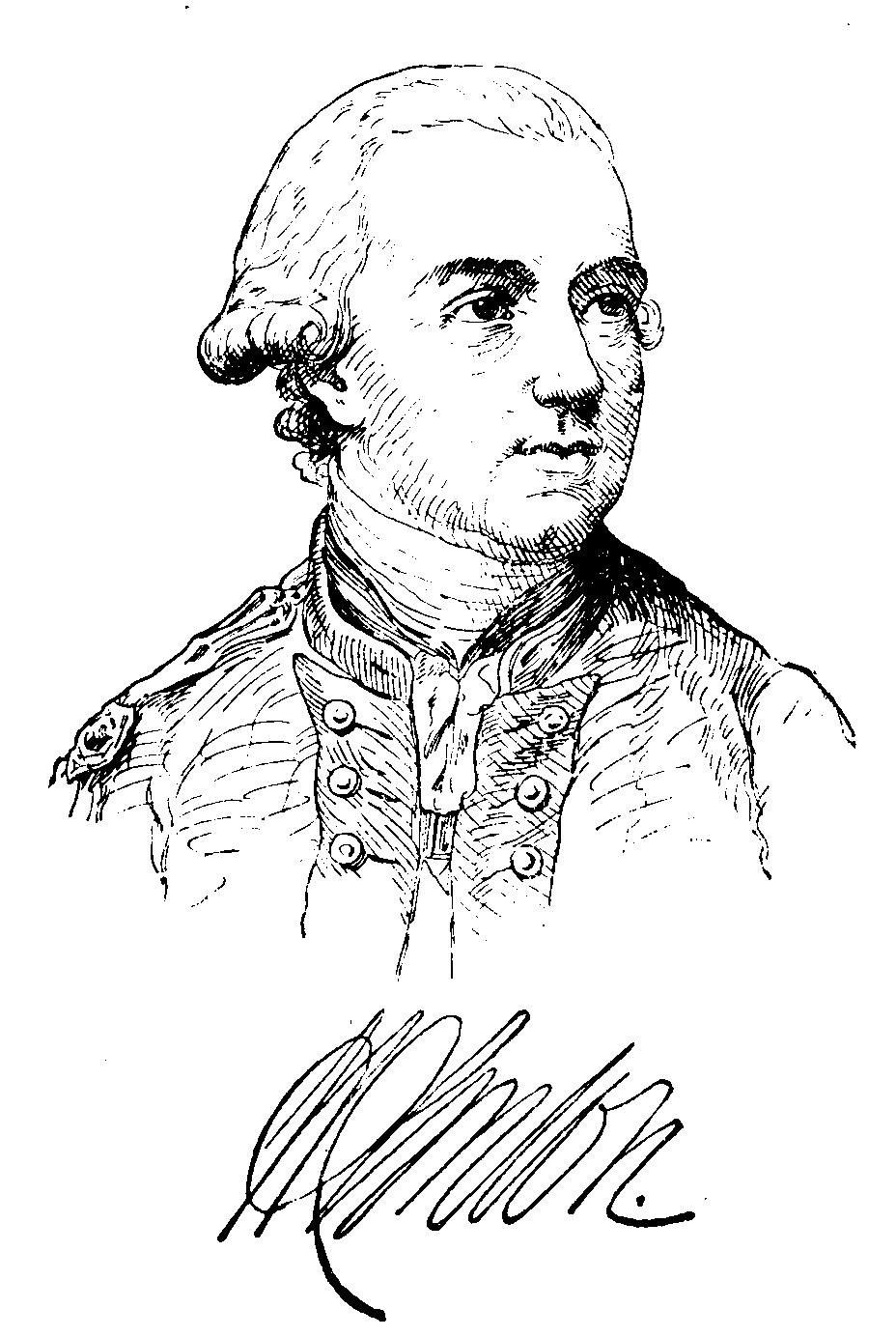
Appleton's Cyclopedia of American Biography, edited by James
Grant Wilson, John Fiske and Stanley L. Klos. Six volumes, New York: D. Appleton
and Company, 1887-1889 and 1999. Virtualology.com warns that these 19th Century
biographies contain errors and bias. We rely on volunteers to edit the historic
biographies on a continual basis. If you would like to edit this biographyplease
submit a rewritten biography in text form.
If acceptable, the new biography will be published above the 19th Century
Appleton's Cyclopedia Biography citing the volunteer editor
Virtual American Biographies
Over 30,000 personalities
with thousands of 19th Century illustrations, signatures, and exceptional life
stories. Virtualology.com
welcomes editing and additions to the
biographies. To become this site's editor or a contributor
Click Here
or e-mail Virtualology here.
CLINTON, George, colonial governor of New York, died 10 July, 1761. He was the youngest son of Francis, sixth Earl of Lincoln, and appointed commodore and governor of Newfoundland in 1732. On 21 May, 1741, he became governor of New York, and entered on the duties of the office in September, 1743. His want of skill in civil affairs peculiarly exposed him to the tumults and commotions of colonial government. In his controversies with the assembly, instigated by Chief-Justice James DeLancy, Colden, afterward lieutenant governor, was his champion with the pen, his chief opponent being Horsmanden. Clinton was succeeded, in October, 1753, by Sir died Osborne, and afterward became governor of Green-with hospital. He was vice-admiral of the red in 1745, and admiral of the fleet in 1757.--His son, Sir Henry, British general, born in 1738" died in Gibraltar, Spain, 23 December, 1795, became a captain of the guards in 1758, and served in Hanover during the remainder of the seven years' war. In May, 1775, having attained the rank of major general, he was sent to Boston, along with Burgoyne and Howe. In the following winter he went on an expedition to North Carolina to co-operate with the loyalists there and redeem the colony for the king. Sir Peter Parker, with the fleet and re-enforcements from Ireland, was to join him there, but was detained by contrary winds and did not reach the American coast till 3lay. The overwhelming defeat of the Tories at Moore's Creek in February made Clinton think it unsafe to land in North Carolina. He cruised up and down the coast until Parker's arrival, and it was then decided to go south and capture Charleston. On 28 June they attacked Fort Moultrie, in Charleston harbor, and were totally defeated. Clinton then sailed for New York and took part in General Howe's campaigns from the battle of Long Island to the capture of Philadelphia. When Howe sailed for Chesapeake bay in the summer of 1777, Clinton was left in command of New York. About this time he was made K. C.B. In September he stormed Forts Clinton and Montgomery, on the Hudson river, and sent a force to relieve Burgoyne at Saratoga, but too late to be of any avail. On Sir William Howe's resignation, 14 April, 1778, Clinton was appointed commander-in-chief of his majesty's forces in America, with the rank of lieutenant-general. In June he evacuated Philadelphia, and on his retreat through New Jersey fought an indecisive battle with Washington at Monmouth Court-House. In December, 1779, he set sail for South Carolina, taking Lord Cornwallis with him, and leaving General Knyphausen in command of New York. In the spring he invested Charleston, and on 12 May succeeded in capturing that City, together with the whole southern army of 6,000 men under General Lincoln. This was one of the heaviest blows dealt to the Americans during the revolutionary war, and it may well have consoled Sir Henry Clinton for his humiliating defeat before Charleston in 1776. Leaving Cornwallis in command at the south, Sir Henry returned to New York, and during the summer matured, in concert with Benedict Arnold, the famous scheme for the treasonable surrender of West Point. He accomplished nothing more of a military nature, as his army in New York was held in virtual blockade by Washington. In October, 1781, Sir Henry set sail for Chesapeake bay with a large naval and military force, to relieve Lord Cornwallis, but did not arrive in the neighborhood until after the surrender; on hearing of which, without landing, he returned to New York. He was soon afterward superseded by Sir Guy Carleton, and returned to England in June, 1782. He was elected to parliament, and afterward made governor of Limerick. In 1793 he was appointed to the command of Gibraltar. He wrote "A Narrative of the Campaign in 1781 in North America" (London, 1783; reprinted, Philadelphia, 1865); a rejoinder to Lord Cornwallis's " Observations" on the aforesaid ; and "Observations on Stedman's History of the American War" (London, 1794).
Unauthorized Site:
This site and its contents are not affiliated, connected,
associated with or authorized by the individual, family,
friends, or trademarked entities utilizing any part or
the subject's entire name. Any official or affiliated
sites that are related to this subject will be hyper
linked below upon submission
and Evisum, Inc. review.
Please join us in our mission to incorporate The Congressional Evolution of the United States of America discovery-based curriculum into the classroom of every primary and secondary school in the United States of America by July 2, 2026, the nation’s 250th birthday. , the United States of America: We The
People. Click Here