JONATHAN TRUMBULLwas born in
Lebanon, Connecticut, the son of Joseph Trumbull, October 12, 1710 and
died August 17, 1785.Trumbull
was a merchant and governor of Connecticut during the American
Revolution.He was the only
colonial governor who supported the independence movement.Relying on his prior experience in trans-Atlantic trade, he
played an important part in obtaining supplies for and provisioning the
Continental Army.With
Trumbull's leadership, Connecticut shipped supplies as far afield as
Valley Forge.Before becoming governor, Trumbull held several legislative
and judicial posts.He was
educated at Harvard College where he prepared for the ministry.These plans suddenly
changed in early 1732 when Joseph Jr. was lost at sea aboard a
brigantine vessel named The Lebanon bound for the Barbados.
Upon
the death of his older brother, Jonathan abandoned the ministry, and
took the place of his older brother in his father's business.Because of his competence and the failing health of his
father, Jonathan was managing all the family business within four years
of his brother's death. Jonathan's experience as a merchant proved to be
valuable during the revolution when procurement of supplies for the
Continental Army with almost worthless Continental notes required tact
and diplomacy.
Jonathan
Trumbull's notoriety in Lebanon as a successful businessman grew and he
was elected to the General Assembly.In 1735, Jonathan Trumbull married Faith Robinson (1718 -1780), a
direct descendent of John and Priscilla Alden. This marriage raised
Jonathan's status to one of almost nobility, having married into the
direct lineage of the first settlers of New England.Their
marriage produced six children, Joseph (1737 - 1778), Jonathan Jr.,
(1740 - 1809) the second of four "Governor Trumbulls", Faith
(1743 - 1775), Mary (1745 - 1831), David (1751- 1822) and John (1756 -
1843) a famous early American painter.
The
wisdom and respect that Jonathan Trumbull had earned allowed him to hold
positions in the Colonial general assembly beginning in 1733.During
the French and Indian War, Jonathan served as a colonel of the Twelfth
Connecticut Regiment.From
1766 until 1769, Jonathan Trumbull served as Deputy Governor of
Connecticut.From 1769 until his retirement in 1784, Jonathan Trumbull was
the Governor of Connecticut.During
his term, he redefined the role of governor from mostly a powerless
figurehead to a mastermind in the logistics of running the state.
Jonathan Trumbull was
the only colonial governor to hold his job for the periods of time
before and after the Revolutionary War.Jonathan
was instrumental in providing Continental Army troops with provisions.He arranged for numerous cattle drives that originated in
Hartford to supply General Washington's almost starving troops in Valley
Forge and Morristown with provisions.Because
of his efforts, Connecticut was referred to as the "Provisions
State" and Jonathan, its governor was referred to as "Brother
Jonathan" by General Washington because of his passionate ability
to raise supplies for the needy Continental Army.Jonathan
mobilized Connecticut's resources and encouraged the manufacture of
items within Connecticut to support the war effort.
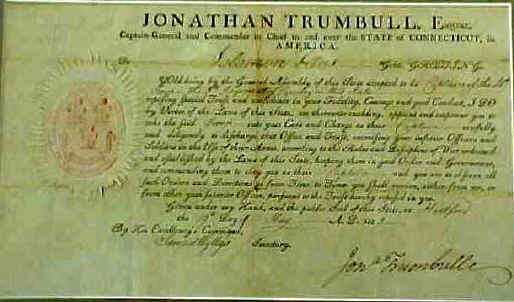
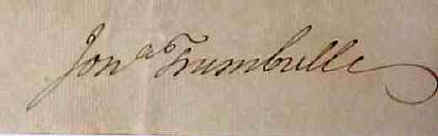
Document
signed May 19, 1802, oblong legal folio, appointment of Solomon Petus as
"Captainof the 4th Troop in the 8th Regiment of
Cavalry.Framed.
Please join us in our mission to incorporate The Congressional Evolution of the United States of America discovery-based curriculum into the classroom of every primary and secondary school in the United States of America by July 2, 2026, the nation’s 250th birthday. , the United States of America: We The
People. Click Here