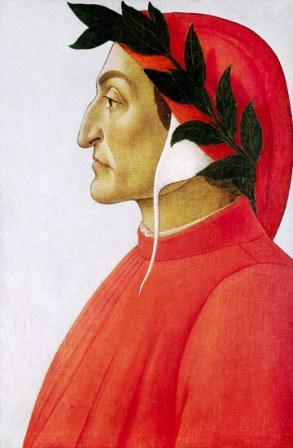
Dante
Alighieri / Alighiero , said simply Dante , christened as Alighiero During the
Alighieri , the Alighieri family , ( Florence , between 22 May and 13 June 1265
- Ravenna , 14 September 1321 ) was a poet , writer and politician Italian .
Considered the father of the Italian language , is the author of the comedy ,
became notorious as the Divine Comedy , universally regarded as the greatest
work written in Italian and one of the greatest masterpieces of world
literature.
His name, according to the testimony of Jacopo Alighieri , is a ipocoristico of
in the documents was followed by the patronymic Alagherii or noble de Alagheriis,
while the variant Alighieri said only with the advent of Boccaccio .
It is known as the great poet , or, par excellence , the poet.
The date of Dante's birth is unknown, but, in general, is shown around 1265 ,
based on some hints autobiographical listed in Vita Nova and the poem of '
Inferno - which begins with the verse " In the middle of the journey of our life
"as in his other works, following a tradition well known, half of human life is
considered to be 35 years, and unfolding the imaginary journey in 1300, dates
back to 1265. Some verses of the Paradiso then tell us that he was born under
the sign of Gemini , so in a period between May 21 and June 21 :
"with you was born and hid vosco who is father of all mortal life when I feel
'of the first Tuscan air"( Paradiso, XXII , vv. 115-117 )
According to indirect references can then go back to the date of the birth of
Dante in the period between May 14 and June 13 of 1265. However, if unknown is
the day of his birth, certain, however, is that of baptism : the 26 March 1266 ,
Holy Saturday . That day were brought to the sacred source all born the year for
a solemn ceremony collective. Dante was baptized with the name of Durante, then
syncopated in Dante, in memory of a relative Ghibelline .
Boccaccio says that his birth was heralded by flattering auspices. The mother of
Dante in fact, just before giving birth to him, he had a vision : he dreamed of
being under a laurel high, in the midst of a vast meadow with a spring welling
up along with the smaller Dante just given birth, and the child tend to see the
small hand towards the leaves, eat the berries and turn into a beautiful peacock
.
Dante was born in the important family Florentine of Alighieri , due to the
current of the Guelphs , a political alliance involved in a complex opposition
to the Ghibellines , the Guelfs themselves were divided then in Guelph Guelph
blacks and whites .
Dante believed that his family descended from the ancient Romans ( Inferno ,
Canto XV , 76 ), but the relative farthest of which he is the great-great
grandfather name is Cacciaguida Elisei ( Paradiso , Canto XV , 135 ), who lived
around 1100 . From the legal point of view, therefore, the alleged nobility
which it derives from this ancestry, already in itself questionable, however it
was extinguished by time. His paternal grandfather, Bellincione , was a commoner
and a commoner married the sister of Dante.
His father, Aleghiero or Alighiero of Bellincione , do not place the glorious
profession of composer ( moneychangers ), which managed to get a decent decorum
to large family. It was a Guelph but without political ambitions: that the
Ghibellines, after the battle of Montaperti not like other exiled Guelphs,
judging it a dangerous opponent.
Dante's mother was Bella degli Abati : Bella was short for Gabriella, Abati was
an important Ghibelline family. Little is known about her. Dante will be silent
forever. He died when Dante was five or six years, and Alighiero soon remarried
Lapa Chiarissimo Cialuffi that gave birth to Francesco and Tana (Gaetana) and
perhaps - but it could also have been the daughter of Bella degli Abati -
another daughter mentioned by Boccaccio as the wife of Florentine auctioneer
Leone Poggi and mother of his friend Andrea Poggi. It is believed that she
alludes to Dante's Vita Nova ( XXIII, 11-12 ), calling it "young and kind [...]
of propinquissima sanguinitade joint."
When Dante was twelve years old, in 1277 , it was agreed his marriage to Gemma ,
daughter of Messer Manetto Donati , who later married at the age of twenty.
Contract marriages in this early age was quite common at that time, it was done
with an important ceremony, which required formal documents signed before a
notary public. The family to which belonged Gemma - the Donati - was one of the
most important in the late medieval Florence and later became the reference
point for the political party opposite to that of the poet, the Guelphs blacks .
Politically Dante belonged to the faction of the White Guelphs , who, despite
being in the Investiture Controversy sided with the pope, had many noble
families of the nobility and feudal oldest and most were opposed to an excessive
increase of the temporal power of the Pope. Dante, in particular, in his work De
monarchy called for the independence of imperial power by the pope, while
acknowledging the latter a higher moral authority.
By Gemma Dante had three children: James , Peter and Antonia, and a possible
fourth, John. Antonia became a nun with the name of Sister Beatrice, appears in
the Convent of Olivetane in Ravenna . He says his son was also a "Iohannes
filius Dantis Aligherii de Florentia," which appears as a witness in a deed
dated 21 October 1308 in Lucca .
A Florence had a political career quite important: after the entry into force of
the Regulations of Giano della Bella ( 1295 ), which excluded the ancient
nobility of politics allowing the middle classes to get roles in the Republic ,
provided that enrolled in an ' Art Dante matriculated at ' Art of Physicians and
Pharmacists .
The exact number of his political positions is not known, because the minutes of
the meetings have been lost. However, through other sources, it is possible to
reconstruct much of his activity was in the People's Council from November 1295
to ' April 1296 , and was in the group of "Elders" who in December 1296 renewed
the rules for the election of priors , that is the most important
representatives of each Art, from May to September of 1296 was part of the
Council of One Hundred . He was sent as ambassador in sometimes, as in May of
1300 in San Gimignano . The same year he was prior from June 15 to August 15 .
Although the membership of the Guelph party, he always tried to oppose the
interference of his nemesis Pope Boniface VIII . With the arrival of Cardinal
Matteo d'Acquasparta , sent as a peacemaker, at least nominal (actually sent by
the pope to scale the power of the White Guelphs, at that time on the rise on
Blacks), Dante tried, successfully, to hinder his work. He himself went to the
pope to try to find a compromise peace but the journey was stopped and convicted
in absentia.
As a member of the Council of One Hundred , was one of the promoters of the
controversial measure that sent the two extremes of Tuscany leaders and "hot
heads" of the two factions. This was not only a provision useless (they soon
returned in dribs and drabs) but did risk a coup by the Blacks, they were going
to take advantage of the situation when the Whites were without leaders,
excessively delaying the start of their exile. In addition, the measure drew on
those responsible, including Dante, and the hatred of the enemy is the distrust
of "friends", and that he himself was described as the beginning of his
downfall.
By sending Charles of Valois to Florence , sent by the pope as the theoretical
peacemaker, but in fact conqueror, the Republic sent an embassy to Rome, in
turn, of which he was an essential part of Dante himself, accompanied by Maso
Minerbetti and Armor from Signa .
Dante was then in Rome, it seems unduly restrained by Boniface VIII, when
Charles of Valois , the first citizen turmoil took a pretext to fire to Florence
with a coup. On 9 November 1301 Cante Gabrielli from Gubbio was appointed
Podestà of Florence. These belonged to the Guelph blacks, began a policy of
systematic persecution of the political leaders of the white part hostile to the
pope, and that resulted in their deaths at the end or exile. Two sentences
later, that of January 27 and that of 10 March 1302 , which also hit several
members of the families of Looking and especially Gherardini of Montagliari, the
poet was condemned by Cante Gabrielli , in absentia, the burning and destruction
of houses . Dante was achieved by the provision of exile in Rome and never saw
Florence.
The years of exile and death
During the exile, Dante was the guest of various courts and families of Romagna
, including the Ordelaffi , Ghibelline lords of Forlì , where he probably was
when the Emperor Henry VII of Luxembourg entered Italy. Here it is possible that
he knew the works of the famous thinker jew Hillel ben Samuel of Verona , who
had recently died, after having spent the last years of Forlì his life.
After the unsuccessful attempted coups of 1302 , Dante, as captain of the army
of exiles, organized together with Ordelaffi Scarpetta , head of the Ghibelline
party and lord of Forlì , a new attempt to return to Florence . The company,
however, was unfortunate: the mayor of Florence , another Forli (enemy of
Ordelaffi ) Fulcieri from Calboli , managed to gain the upper hand in the battle
of Castel Puliciano, failed, too, the diplomatic action in the spring of 1304 ,
Cardinal Niccolò da Prato , papal legate of Pope Benedict XI , on which Dante
had placed much hope, July 20 of the same year the Whites, assembled at the
plate, a village a few kilometers from Florence, decided to embark on a new
military attack against Blacks. Dante, believing politically correct to wait for
a more favorable moment, was against yet another armed struggle, being in the
minority to the point that the most intransigent formulated on him the suspicion
of treason, he decided not to join the battle and distance themselves from the
group . As planned by the same, the battle of Lastra was a real failure with the
death of four hundred men between Ghibellines and white. The prophetic message
comes to us from Cacciaguida :
"Of their bestiality their own proceedings Shall furnish proof; yes ch'a thou
wilt be nice to have you done the same for you. " ( Paradiso , Canto XVII ,
67-69 )
Dante returned to Forlì still in 1.31 thousand - 1 311 and 1316 (date uncertain,
the latter).
Dante ended his travels to Ravenna , where he found refuge at the court of Guido
Novello da Polenta , lord of the city, However, relations with Verona did not
cease, as evidenced by its presence in Padua on 20 January 1320 , to discuss the
Quaestio de aqua et earth , his last Latin work.
He died in Ravenna on 14 September 1321 returning from an embassy to Venice .
Moving from swampy valleys of Comacchio contracted malaria .
Venice at the time was rubbing against Ravenna and in alliance with Forlì :
historians think that Dante was chosen for this mission because a friend of
Ordelaffi , the Lords of Forlì , and thus can easier to find a way to resolve
differences. The funeral, in full regalia, were officiated in the church of San
Francesco in Ravenna , where, under a side porch, was placed the first
sarcophagus of the poet. Around the sarcophagus was built in 1483 a cell,
designed by the sculptor Pietro Lombardo , in 1780 Camillo Morigia , on behalf
of the cardinal legate Luigi Valenti Gonzaga , designed the neo-classical temple
still visible. To subtract the remains of the poet to a possible theft by the
Florentines, the Franciscans removed the bones from the grave, hiding behind a
door in the walled convent, this episode gave rise to the legend that the tomb
was actually a cenotaph, which is a grave empty. The bones were discovered
accidentally by a builder during the restoration of 1865, carried out in the
sixth centenary of Dante's birth, and then reported in the temple of Morigia.
In the tomb of Dante, under a small altar is the ' inscription in Latin verse
dictated by Bernard Canaccio in 1366 :
" IURA MONARCHIAE SUPEROS Phlegethon LACUSQUE Glazing Cecini VOLUERUNT FATA
QUOUSQUE SED Quia PARS MELIORIBUS HOSPITA Castris ACTOREMQUE suum PETIIT
FELICIOR ASTRIS HIC CLAUDOR DANTES PATRIIS EXTORRIS AB ORIS quem genuit PARVI
FLORENTIA MATER AMORIS. "
Little is known about the study of Dante. The culture Dante, formed in an
educational context totally different from the current one, can be reconstructed
in the absence of reliable data documentaries, primarily from works. The result
is an image of a keen student of theology , philosophy , physics , astronomy ,
grammar and rhetoric , in short, of all the disciplines of the trivium and
quadrivium provided by schools and Universitates medieval.
However, it is likely that the poet has attended the study religious and laity
of which has been known in Florence . Some believe that Dante studied at the '
University of Bologna , but there is no evidence in this regard. In a verse of
the Divine Comedy ( Paradiso , Canto X , 133-138 ) That, in reading them Mulches
de Vico, silogizzò real envious , Dante alludes to Rue du Fouarre , where they
carried out the lessons of the Sorbonne : This made me think of some
commentator, in a purely conjectural, that Dante may have actually gone to Paris
.
Obviously, the official culture of the university was essentially in Latin .
Consequently, the literary culture of Dante is mainly based on Latin authors: in
particular Virgil , who had a decisive influence on the works of Dante. Dante,
however, certainly knew a good number of poets vulgar, Italian and Provencal. In
his works there is a clear link with the Tuscan poetry of Guittone d'Arezzo and
Bonagiunta Orbicciani (see Purgatorio , Canto XXIV , 52-62 ), of Guido
Guinizzelli and School Sicilian poetic - a literary movement active at the court
of Frederick II , which was expressed in the current vernacular and which at the
time was beginning to be known in Tuscany , having Giacomo da Lentini (the
famous "Notaro" in the above quote) its greatest exponent. The knowledge of the
Provencal by Dante can be reconstructed either by the citations contained in the
De vulgari eloquentia is included in the verses Provencal Purgatorio ( Canto
XXVI , 140-147 ).
The choice of Dante to use the vernacular to write some of his work may have
impacted greatly the works of Andrea da Grosseto , writer of the thirteenth
century who used the vernacular spoken by him, the Grosseto dialect of the time,
for the translation of works prosaic in Latin , such as treaties of Albertano
from Brescia .
By virtue of his interests, Dante learned the tradition of minstrels, the
Provencal poets and the same Latin culture, professing, as already mentioned, a
particular devotion to Virgil :
" Thou 'my teacher' my author, thou 'only one from whom' I took The beautiful
style that has done me honor. " ( Inferno , Canto I , 85-87 )
It should be noted that, during the Middle Ages , the ruins of the ' Roman
Empire finally declined, leaving room for dozens of small states: the Sicily ,
for example, was so distant - culturally and politically - from Tuscany as was
the Provence . The same regions, in essence, did not share a common language or
culture nor could enjoy easy connections. Based on these premises, it is
possible to suppose that Dante was for its time an intellectual current, acute
and interests, as we would say today, international.
At eighteen, Dante met Lapo Gianni , Cino da Pistoia and after Brunetto Latini :
together they became the capiscuola of the Dolce Stil Novo . Brunetto Latini was
later recalled by the poet in the Divine Comedy ( Inferno , XV, 82) for what he
had taught Dante, not merely as a master but as one of the greatest luminaries
who profoundly marked his literary career and philosophical teacher of rhetoric
, clever compiler treated encyclopedic , had to introduce him to courtly
literature Provençal and French , writing Tresor own in France . Brunetto
highlights the relationship between the study of grammar ( Latin ) and rhetoric
and philosophy courtly love , laying the foundations of the speculative
interests of the future Dante. Other studies have also reported, or shall be
deducted from Vita Nova or the Divine Comedy , as regards the painting and music
.
At the age of nine years Dante fell in love with Beatrice , daughter of Folco
Portinari . It is said that Dante saw her only once and never spoke to her (but
other versions are to be considered equally valid). More interesting, however,
beyond the meager biographical details that are left, it is the Beatrice deified
and thus sublimated of Vita Nova , the angel who brings about the spiritual
conversion of Dante on Earth, the psychological study that makes the poet on his
falling in love . L ' introspection psychological , the ' autobiography ,
unknown to the Middle Ages also looking to Petrarch and farther still, to the
Renaissance . The name Beatrice assume especially in the Divine Comedy, its real
importance, because, etymologically speaking, means Bearer of bliss , so that
only this figure can lead Dante along the path of Paradise .
It is difficult to understand what this love consisted, but something extremely
important for Italian culture was happening: it is in the name of this love that
Dante gave his imprint to the Dolce Stil Novo and lead poets and writers to
discover the themes of love, in a way never so emphasized before.
Love for Beatrice (as in a different manner Petrarch show for his Laura ) will
be the starting point for the formulation of his conception of the dolce stil
novo, new concept of courtly love sublimated by his intense religious
sensibility (the cult of Mary with the praise came to Dante through the current
pauperistiche of the thirteenth century, the Franciscans and later), and then
moved to the philosophy after the death of his beloved, which symbolically marks
the separation from the love theme and the rise of the Great Poet to Wisdom,
dazzling light and impenetrable that surrounds God in Heaven of the Divine
Comedy .
When Beatrice died in 1290 , Dante tried to find a refuge in Latin literature .
The Convivio know that he had read De consolatione Philosophiae of Boethius and
De amicitia of Cicero . He then dedicated himself to philosophical studies at
religious schools like the Dominican in Santa Maria Novella . Took part in the
disputes that the two main religious orders ( Franciscan and Dominican )
publicly or indirectly held in Florence , one explaining the doctrine of the
mystics and of Saint Bonaventure , the other presenting the theories of St.
Thomas Aquinas . His "excessive" passion for philosophy would later be
criticized by the Beatrice in Purgatory .
Dante was also a soldier, and ' 11 June 1289 he fought in the battle of
Campaldino that saw the Knights Florentines opposed to Arezzo , and then, in
1294 , was part of the delegation of knights who escorted Carlo Martello d'Anjou
(son of Charles II ' Anjou ) when he was in Florence . Dante himself cites
Charles Martel of Anjou in the Divine Comedy ( Paradiso , Canto VIII , 31 and
Canto IX , 1 ).
Unauthorized Site:
This site and its contents are not affiliated, connected,
associated with or authorized by the individual, family,
friends, or trademarked entities utilizing any part or
the subject's entire name. Any official or affiliated
sites that are related to this subject will be hyper
linked below upon submission
and Evisum, Inc. review.
Please join us in our mission to incorporate The Congressional Evolution of the United States of America discovery-based curriculum into the classroom of every primary and secondary school in the United States of America by July 2, 2026, the nation’s 250th birthday. , the United States of America: We The
People. Click Here