Edited
A.C. Image Copyright©
2001 by VirtualologyTM
Sarah
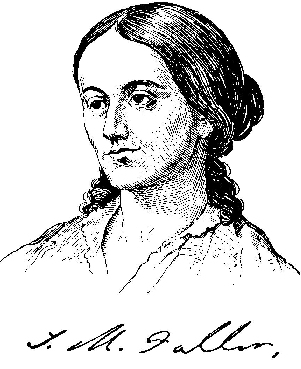
Margaret Fuller, Marchioness Ossoli, author, born in Cambridgeport,
Massachusetts, 23 May 1810; died off Fire Island beach, 16 July 1850, was the
eldest of eight children. She derived her first teaching from her father,
studied Latin at the age of six, and injured her health by over application. At
thirteen she was a pupil at the famous school of Dr. Park, in Boston, where she
began the study of Greek. Thence she went to a school in Groton, kept by the
Misses Prescott. On the sudden death of her father, Margaret vowed that she
would do her whole duty toward her brothers and sisters, and she faithfully kept
the vow, teaching school in Boston and Providence, and afterward taking private
pupils, for whom she was paid at the rate of two dollars an hour.
During
the transcendental period she knew intimately the leading minds of the time
Emerson, Hawthorne, Ripley, Channing, Clarke, Hedgeand in the company of such
was very brilliant, meeting them as equals. She first met Emerson in 1835, and
the next year visited him at Concord. She went occasionally to Brook Farm,
though never fully believing in the success of that experiment, and never living
there. She held conversations in Boston, conducted the "Dial,"
translated from the German, projected works, and wrote the "Summer on the
Lakes," the record of a season spent in traveling from June to September
1843. In December 1844, she went to New York as literary critic of the
"Tribune," then under the management of Horace Greeley, in whose
household she at first lived. While in New York she visited the prisons,
penitentiaries, asylums, theatres, opera houses, music halls, picture galleries,
and lecture rooms, writing about everything in the "Tribune," and
doing much to move the level of thought on philanthropic, literary, and artistic
matters. Her intimacies here were mainly with practical, honest, striving
people. Even William H. Channing was a minister at large, C. P. Cranch received
boarders, and Lydia Maria Child was connected with the press. This she called
her "business life," and she pursued it unremittingly for about twenty
months, after which, having saved a little money, she went to Europe on the
invitation of Mr. and Mrs. Francis Spring. This was in 1846.
In
Europe she saw the foremost people in the literary, social, political, and
reformatory world, spent the late summer and autumn in traveling, established
herself for a time at Rome in the spring of 1847, passed that summer in
Switzerland and the more northern Italian cities, and returned to Rome in
October. She was married in December to Giovanni Angelo, Marquis Ossoli, was a
mother in 1848, and entered with zeal into the Italian struggle for independence
in 1849. Her conduct during the siege of the City by the French was of the most
heroic, disinterested, humane, and tender kind. Her service in the hospitals won
the heartiest praise. She was a friend of Mazzini. Though racked with anxiety
for her husband and child, she appeared entirely oblivious of herself. On the
capture of Rome by the French in June 1849, and the consequent dispersal of the
leaders in the defense, she and her husband took refuge in Rieti, a village in
the mountains of Abruzzi, where the child had been left in charge of a
confidential nurse, and after some months removed to Florence, which, after a
delightful sojourn, they left for Leghorn, whence passage for America was taken
on the "Elizabeth," a merchant vessel that sailed 17 May 1850.
Horace
Sumner, a younger brother of Charles Sumner, and Celeste Paolini, a young
Italian girl, were the only other passengers. The voyage began disastrously. The
captain died of smallpox, and was buried at sea in the waters off Gibraltar.
Head winds kept them there a week. The boy was dangerously seized with smallpox
soon afterward. As the voyage neared its ending, a violent southeast wind became
in the evening a gale, by midnight a hurricane, and the vessel was driven on the
shore at Fire Island in the early morning at four o'clock. The wreck was
complete. A great wave swept the deck, and carried all before it. The boy was
drowned in the arms of the steward while the latter was trying to reach the
land, and the lifeless body was carried on the beach. Neither mother nor father
was heard of more.
Of
Ossoli little is known. It is not strange that to most people he should be a
name only, for he was married but a short time, he was not seen out of his
native country, and there was known but slightly save to a small number of
friends, while his inability to speak any language except his own naturally
prevented his mingling with Americans. But he was a gentleman, sincere, true,
and self-respecting. All we know of him is to his credit. He was sufficiently
educated for his rank in society. That he was a devoted husband is certain,
ready to share his wife's fortune whatever it might be, and in all respects
thoughtful of her happiness, believing in her entirely. His future in this
country would have been melancholy. He must have been dependent on the efforts
of his wife, and those efforts, even though incessant and reasonably successful,
might not have availed to support a family.
It
will be seen that her career naturally fell into three divisions. The first
period lasted till her life in New York in 1844. The second included her
experience there. The third embraced her activity in Rome. The first, which may
be called the transcendental epoch, could not be repeated. It was extremely
interesting, exciting, stimulating to the mind. She was under stimulating
influences. Self-culture was then the keynote of her endeavor. The third could
not be reproduced. That extraordinary episode, with its raptures of
self-devotion, was as exceptional, in its way, as the first. The second epoch
that of literary production was still open to her, enlarged and simplified. She
was essentially a critic. She was not a reformer, and could not have been, had
her means been ever so ample. She lived by her pen, and her livelihood must have
been precarious so much so that some of her admirers looked on the final
catastrophe as deliverance for her. What she might have become if she had lived,
it is useless to conjecture.
She possessed brilliant gifts of many kinds. She had a warm heart, but her
natural talent was for literature. She wrote a great deal for magazines, various
papers, a complete account of which may be found in Higginson's
"Life." Her collected works, including "Summer on the Lakes"
(1843), " Woman in the Nineteenth Century" (1844), and "Papers on
Literature and Art" (1846), were edited by her brother, Rev. Arthur B.
Fuller (Boston, 1855). Her book on the Roman republic was lost with her. The
life of Margaret Fuller has been written by Emerson, Clarke, and Channing,
edited for the most part by William Henry Channing (1852). This is strongest on
the transcendental side. There is also a memoir of her by Julia Ward Howe, in
the "Eminent Women" series (Boston, 1883), and one by Thomas Wentworth
Higginson in the "American Men of Letters" series (Boston, 1884). The
last is the most complete, though somewhat warped by the author's idea that
Margaret Fuller's career culminated in philanthropy. Her brother, Richard
Frederick, author, born in Cambridge, Massachusetts, 15 May 1821; died in
Wayland, Massachusetts, 30 May 1869, was graduated at Harvard in 1844, and
became a lawyer in Boston. Besides the life of his brother, mentioned below, he
published "Visions in Verse" (Boston, 1864). --
Edited
AC American Biography Copyright©
2001 by VirtualologyTM
Research Links
Virtualology is
not affiliated with the authors of these links nor responsible for each
Link's content.
MARGARET
FULLER HOME PAGE
MARGARET FULLER. HOME PAGE. ... Informative Links: ... I hope this page has been
helpful.
Eventually all of Margaret Fuller's works will be available on-line. ...
The
Margaret Fuller Society
The Margaret Fuller Society. ... June 20: Fuller at 2001 SSAWW. Call for Papers:
Panel
on Margaret Fuller and Women's Health at SSAWW (July 20 Deadline). ...
Margaret
Fuller
Margaret Fuller. (1810-1850). Margaret Fuller, the
first female foreign correspondent and the first ...
Margaret
Fuller House -- NRHP Travel Itinerary
... 59. Margaret Fuller (1810-1850), critic, social reformer Home to Margaret
Fuller
until the age of 16, this three-story, Federal style house is associated with
...
MARGARET
FULLER: Grasping Freedom's Moment
MARGARET FULLER: A MAN'S MIND AND A WOMAN'S HEART? Frederic A. Moritz. ...
Margaret
Fuller Quotations
... Women's Voices: Quotations from Women. Margaret Fuller. Very early, I knew
that the only object in life was to grow. I accept the universe! ...
Margaret
Fuller: Summer on the Lakes, in 1843
Margaret Fuller (Sarah Margaret Fuller, Marchesa d'Ossoli) Summer On The Lakes,
in 1843 An Electronic Edition, A photograph of young Margaret Fuller. ...
Margaret
Fuller - Quotation Guide
Click Here, ... Margaret Fuller: Only the dreamer shall
understand realities, though in truth his ...
Margaret
Fuller
[Waypages]. Margaret Fuller. Interested in Margaret Fuller?
Use this as your starting point to find biographies,: ...
Quotations
by Margaret Fuller
... Search for books by and about Margaret Fuller "Men for the sake
of getting a living forget to live." -Margaret Fuller ...
Fuller:
Margaret Fuller
... Fuller: Margaret Fuller Port If ye would like to moderate the Margaret
Fuller Campfire, please drop becket@jollyroger.com a line. ...
MARGARET
FULLER - Jim's Favorite Famous Quote, Quip, Axiom, ...
Please visit our sponsors. Click Here to Visit our Sponsor. ... Margaret
Fuller (1810-1850). ...
Margaret
Fuller
Distinguished Women of Past and Present. ... Margaret Fuller.
(1810-1850). Margaret Fuller, the first ...
Margaret
Fuller
Margaret Fuller. When education is pushed to the point of pain, power comes
forth
in the form of a genius. This genius, Margaret Fuller, was put on the downside
...





