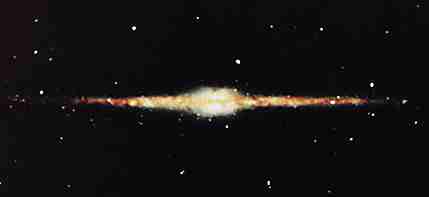
The image is a near-infrared image of the Milky Way. It shows the Milky Way
from an edge-on perspective with the north pole of our Galaxy at the top and the
south pole at the bottom. At near-infrared wavelengths, the dominant source of
light is stars within our Galaxy. Even though our solar system is part of the
Milky Way, the view looks distant because most of the light comes from the
population of stars that are closer to the galactic center (the big bulge in the
middle of the disk) rather than our own Sun.
Stars sometimes form in colorful ways, such as these which are
forming in a small region in the nearby Large Magellanic Cloud (LMC)
galaxy. After a star is born, it may do several things to energize its
immediate neighborhood. It may develop a strong wind which pushes away
nearby gas; it may be so hot and intense that emitted light boils away
nearby dust and gas; and it may be so massive that it soon goes
supernova and catapults its elements back to the interstellar medium.
Astronomers study regions like this one, named DEM192, to better
understand how these and other processes proceed. This picture is a
composite of three separate photographs, each sensitive to only one
specific color of light, a color that distinguishes a specific chemical
element. Image: NASA and C. Smith
The extraordinary polar ring galaxy NGC 4650A. Located about 130
million light-years away, NGC 4650A is one of only 100 known polar ring
galaxies. Their unusual disk-ring structure is not yet fully understood.
One possibility is that polar rings are the remnants of colossal
collisions between two galaxies sometime in the distant past, probably
at least 1 billion years ago. What is left of one galaxy has become the
rotating inner disk of old red stars in the center. Meanwhile, another
smaller galaxy which ventured too close was probably severely damaged or
destroyed. During the collision the gas from the smaller galaxy would
have been stripped off and captured by the larger galaxy, forming a new
ring of dust, gas, and stars which orbit around the inner galaxy almost
at right angles to the old disk. This is the polar ring which we see
almost edge-on in Hubble's Wide Field and Planetary Camera 2 image of
NGC 4650A, created using three different color filters (which transmit
blue, green, and near-infrared light). Image: NASA
A NASA Hubble Space Telescope (HST) view of the magnificent spiral
galaxy NGC 4603, the most distant galaxy in which a special class of
pulsating stars called Cepheid variables have been found. It is
associated with the Centaurus cluster, one of the most massive
assemblages of galaxies in the nearby universe. The Local Group of
galaxies, of which the Milky Way is a member, is moving in the direction
of Centaurus at a speed of more than 1 million miles an hour under the
influence of the gravitational pull of the matter in that direction.
Image: NASA
In 1995, the majestic spiral galaxy NGC 4414 was imaged by the Hubble
Space Telescope as part of the HST Key Project on the Extragalactic
Distance Scale. An international team of astronomers, led by Dr. Wendy
Freedman of the Observatories of the Carnegie Institution of Washington,
observed this galaxy on 13 different occasions over the course of two
months. Images were obtained with Hubble's Wide Field and Planetary
Camera 2 (WFPC2) through three different color filters. Based on their
discovery and careful brightness measurements of variable stars in NGC
4414, the Key Project astronomers were able to make an accurate
determination of the distance to the galaxy. The resulting distance to
NGC 4414 is 19.1 megaparsecs or about 60 million light-years. Image:
NASA
The spiral galaxy M33 is a mid-sized member of our Local Group of
galaxies. M33 is also called the Triangulum Galaxy for the constellation
in which it resides. About four times smaller in radius than our Milky
Way Galaxy and the Andromeda Galaxy (M31), M33 is much larger than the
many of the local dwarf spheroidal galaxies. M33's proximity to M31
causes some to think that M33 is a satellite galaxy of M31, which is a
more massive galaxy. M33's proximity to our Milky Way galaxy causes it
to appear more than twice the angular size of the full moon, and, thus,
it is visible with a good pair of binoculars. In this picture, visible
light is shown in red and ultraviolet light is superposed in blue. Stars
in M33 are the most distant ever to be studied spectroscopically. Image:
NASA
M74 is about the same size as our own Milky Way Galaxy. Like our
Milky Way, M74 is classified as a spiral galaxy. M74's sweeping lanes of
stars and dust, combined with its small nucleus, make it a classic Grand
Design Spiral. On the Hubble Sequence of Galaxies, M74 is listed as
"Sc". In this picture, visible light is shown in red and
ultraviolet light is superposed in blue. In general, older stars are
redder and younger stars are blue. Studies with the Ultraviolet Imaging
Telescope show that the disk of M74 has undergone significant star
formation in just the past 500 million years. Image: NASA
Unauthorized Site:
This site and its contents are not affiliated, connected,
associated with or authorized by the individual, family,
friends, or trademarked entities utilizing any part or
the subject's entire name. Any official or affiliated
sites that are related to this subject will be hyper
linked below upon submission
and Evisum, Inc. review.
Please join us in our mission to incorporate The Congressional Evolution of the United States of America discovery-based curriculum into the classroom of every primary and secondary school in the United States of America by July 2, 2026, the nation’s 250th birthday. , the United States of America: We The
People. Click Here