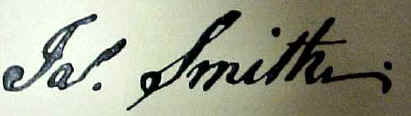
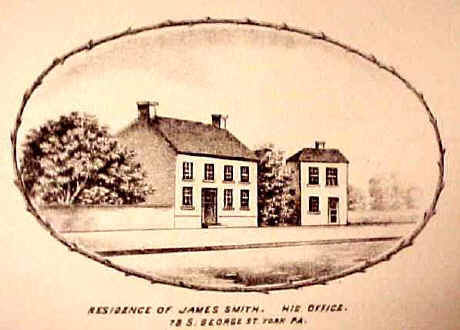
JAMES SMITH was born in Northern Ireland in 1719, however
the exact date of his birth is uncertain, as he never told it.When James was ten, his father brought his
family to Pennsylvania in 1729 and engaged in farming on the Susquehanna
River.James received his early
education from a Presbyterian tutor who taught him Latin, Greek, and
surveying.Later he was educated at the
College of Philadelphia, studied law with his brother in Lancaster and was admitted
to the bar when he was twenty-six years old.
James settled first in Shippensburg as a lawyer and
surveyor, and afterward in York, where for many years he was the sole
practitioner at the bar.During this
period of his life he gained a reputation as a bit of an "eccentric" and a man
who was very fond of the bottle."He
loved wine, and drank much of it," a neighbor said.He was quite the humorist and an excellent storyteller.He had "an uncouthness of gesture, a certain
ludicrous case of countenance, and a drawling mode of utterance, which taken in
conjunction with his eccentric ideas, produced an effect irresistibly comical."
Smith prospered as a lawyer, and then at the age of
forty, married a girl from New Castle, Delaware, Eleanor Armor, who was twenty
years his junior.He also engaged in
extensive iron manufacturing on Codorus creek, and at the beginning of the
Revolution possessed considerable property.
Smith for a long time did not display even a remote
interest in politics, preferring to help raise his five children and develop
his flourishing law practice.However,
when Parliament closed the port of Boston for dumping tea in the harbor, Smith
actively opposed the British by raising he first volunteer company in the state
for the purpose of resisting Great Britain, and was a member of the convention
to consider the expediency of abstaining from importing any goods from
England.He was later elected as the
battalion's colonel.
In July 1776, while representing York County at the
Pennsylvania constitutional convention, he was selected to attend the Second
continental congress.He did attend as
a recognized supporter of independence and signed the Declaration.He remained in congress until February 1777,
and again from December 1777 through 1778.He was not conspicuous, but his speeches were frequently enlivened by
humor.
James Smith held several state posts after leaving
congress, and he was re-elected to that body in 1785, but refused the office
because of his advanced age.While he did
continue to practice law for a few more years, he completely discontinued his
political activities.
James Smith died in York on July 11, 1806, at the
age of eighty-seven.
We invite you to read a transcription
of the complete text of the Declaration as presented by the National Archives.
&
The article "The
Declaration of Independence: A History,"
which provides a detailed account of the Declaration, from its drafting through
its preservation today at the National Archives.
Virtualology welcomes
the addition of web pages with historical documents and/or scholarly papers on
this subject.To submit a web link
to this pageCLICK
HERE.Please be sure to
include the above name, your name, address, and any information you deem
appropriate with your submission.
Please join us in our mission to incorporate The Congressional Evolution of the United States of America discovery-based curriculum into the classroom of every primary and secondary school in the United States of America by July 2, 2026, the nation’s 250th birthday. , the United States of America: We The
People. Click Here