Joseph Hewes - Signer of the Declartion of Independence Biography by
Appleton's edited by Stanley L. Klos
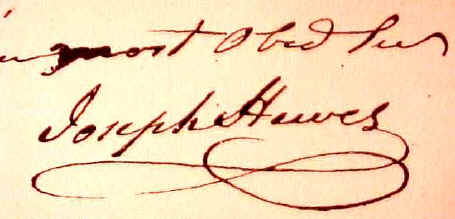
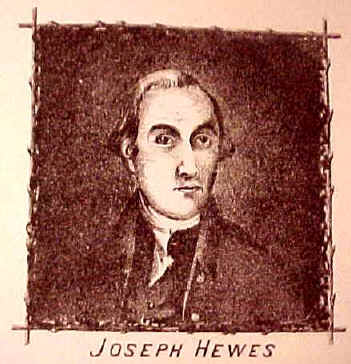
Joseph Hewes
Signer of the
Declaration of Independence
JOSEPH HEWES was born in 1730 in Kingston, New
Jersey. His parents were Quaker by faith. They were Connecticut farmers who
moved to New Jersey in 1728 in search of a more quiet and secure life away from
marauding Indians and free of religious prejudices. In the 1720's, many parts of
New England were suffering from the frequent hostility of Indians who would roam
through the forests and communities raiding the inhabitants and marking their
route with the most shocking barbarities. The Indians murderous spirit was
inflamed by the government of Massachusetts, which had increased the bounty paid
on Indian scalps and prisoners to a hundred pounds. By way of retaliation, the
Indians often made their bloodthirsty raids into Massachusetts and sometimes
extended their journeys to the farms of Connecticut. The Hewes barely escaped
the death they wished to avoid in their flight to New Jersey. On passing the
Housatonic River, a party of Indians came so close to them that Mrs. Hewes was
wounded in the neck by a ball shot from the gun of one of their attackers. When
they finally arrived in New Jersey, they found a peaceful and secure home.
Hewes,
after receiving a public education, was enrolled in Princeton College. He
graduated and moved to Philadelphia, where he entered a counting house and was
trained to be a merchant. On leaving his employer, he entered into the
mercantile business for himself, and soon became an active and prosperous
merchant. At the age of thirty, he moved to North Carolina and settled in the
village of Edenton, where he became a ship owner and a merchant. The same
prosperity, which he had attained in Philadelphia, followed him and within a few
years he had acquired a handsome fortune. It was in Edenton, that he met John
Paul Jones, whom he helped to get his first command in the navy. He was a man of
integrity and honor, acquiring the confidence and esteem of the people and they
elected him to represent them in the colonial provincial legislature. With
increasing usefulness to his constituents and increasing credit to himself, he
was re-elected for several successive years.
In 1774, he was elected to represent North
Carolina in the Continental congress that was assembling in Philadelphia. While
Hewes seldom spoke in Congress, he participated actively and tirelessly in
several vital committees. Hewes was a member of the committee to "state the
rights of the colonies in general, the several instances in which these rights
are violated or infringed, and the means most proper to be pursued for obtaining
a restoration of them". Hewes assisted in preparing the committee's celebrated
report. In the beginning of 1775, the Society of Friends (the Quakers), to which
he and his family belonged, held a general convention denouncing the proceedings
of congress. Hewes, being a true Patriot, at once severed his connection with
the Society and became a promoter of war against Britain.
Hewes, although a merchant who had been engaged in
commercial business with England for over twenty years, cheerfully assisted in
forming a plan of the non-importation association, and most readily became a
member of it. In 1776, he was a member of the secret committee of the committee
on claims, and was virtually the first secretary of the navy. John Adams, who
was especially fond of him, would often boast that he and Hewes "laid the
foundation, the cornerstone of the American Navy". With General Washington,
Hewes conceived the plan of operations for the ensuing campaign, and voted in
favor of the immediate adoption of the declaration, North Carolina being the
first of all the colonies to declare in favor of throwing off all connection
with Great Britain.
During the recess of congress, from the end of
July until September, he made a visit to his friends in New Jersey, and in
September again resumed his seat. He served from then until October 29, 1779,
representing the state of North Carolina, with the exception of a little more
than a year, during which he devoted himself to his private affairs and to the
interests of his state.
The last time that he appeared in congress was on
October 29, 1779, after which, an illness that he had had for quite some time
confined him to his bed, and on November 10, 1779, he died. Congress attended
his funeral on the following day, as did the general assembly of Pennsylvania,
the president and supreme executive council, the minister plenipotentiary of
France and numerous citizens. In testimony of their respect for him, congress
resolved to wear crape armbands for one month, in mourning. Hewes had remained a
bachelor – the girl he loved had died a few days before their wedding and he
never married – leaving no children to inherit his large estate.
Unauthorized Site:
This site and its contents are not affiliated, connected,
associated with or authorized by the individual, family,
friends, or trademarked entities utilizing any part or
the subject's entire name. Any official or affiliated
sites that are related to this subject will be hyper
linked below upon submission
and Evisum, Inc. review.
Please join us in our mission to incorporate The Congressional Evolution of the United States of America discovery-based curriculum into the classroom of every primary and secondary school in the United States of America by July 2, 2026, the nation’s 250th birthday. , the United States of America: We The
People. Click Here