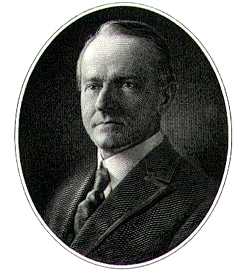
JOHN CALVIN COOLIDGE
was born July 4, 1872 in Plymouth Notch, Vermont. He was the only son of John
Calvin Coolidge, a jack-of-all-trades, teacher, storekeeper, farmer, politician,
and even mechanic when necessary and Victoria Josephine Moor, a handsome woman
who loved poetry and natural beauty, who died when Calvin was 12. The Coolidges
lived in the rear of the combined general store and post office, and young
Coolidge attended the local school. He was later enrolled in the Black River
Academy in Ludlow, Vermont and in 1891, attended Amherst College in Amherst,
Massachusetts, being the first of the Vermont Coolidges to attend college.
Following his graduation cum laude from Amherst in 1895, Coolidge read law in
the offices of John Hammond and Henry Field in Northampton, Mass. Two years
later he was admitted to the bar. He decided to practice law in Northampton, and
although he never prospered as an attorney, he was able to earn enough to become
financially independent in a short time.
On October 4, 1905 Coolidge married Grace Anna Goodhue from Vermont, who
taught at the Clarke Institute for the Deaf in Northampton. Vivacious, witty,
and friendly, with a pleasant smile, she was the opposite of her quiet husband.
They had two sons, John Coolidge (1906 - ) and Calvin Coolidge, Jr. (1908 –
1924).
His relationship with Hammond and Field led him into politics, which came
easily to him because his father was a frequent officeholder in Vermont. In
Northampton, Hammond and Field were political leaders and found Coolidge a
willing political apprentice. In 1898 he was elected as a city councilman. From
that day until his retirement from the presidency he was seldom out of public
office. In 1905 he suffered his only election defeat, in a contest for school
committeeman. In 1906 he was elected to the Massachusetts House of
Representatives. During his two one-year terms in the state house, Coolidge made
little impression. Coolidge was elected mayor of Northampton in 1909 and
reelected in 1910. In 1911 he was sent to the state Senate, where he became a
Republican leader. After his election to a third Senate term in 1913, Coolidge
was elected to the powerful position as president of the state Senate. In 1915
he ran successfully for lieutenant governor. Coolidge used his three years as
lieutenant governor to acquire more knowledge of government, and in 1918 he was
elected governor of Massachusetts.
As governor, Coolidge became nationally known in 1919, when the Boston
policemen went on strike. Coolidge, who had earlier refused to take action,
brought in troops and asked for federal soldiers in case a general strike should
occur. The policemen returned to work and when Coolidge was asked to let
suspended policemen return to their jobs, Coolidge refused, saying, "There is no
right to strike against the public safety by anybody, anywhere, anytime." His
statement was applauded throughout the nation. At the Republican National
Convention in 1920, he won the nomination for vice president, joining Warren G.
Harding on the ticket. Harding and Coolidge received an overwhelming victory of
7 million votes. The vote in the Electoral College was 404 to James M. Cox’s
127.
Little was expected of the vice president, and Coolidge was not very active.
He presided over the Senate, attended Cabinet meetings, and ranked next to the
president in ceremonial affairs. "Silent Cal," as he was called, started to
convey himself more in longer speeches and in newspaper articles, but he had
little enthusiasm for his job and had developed no power as a national political
figure. When Harding died suddenly in San Francisco, California, on August 2,
1923, Coolidge was visiting his father in Vermont. He received the news of the
president's death in the early hours of August 3 and took the presidential oath
in the farmhouse parlor by the light of kerosene lamps. Coolidge’s father, who
was a justice of the peace, administered the oath of office. However, because
his father could only swear in people for Vermont offices, Coolidge had to
repeat the oath in Washington, D.C., 18 days later.
Coolidge’s reputation for honesty served him well when the Harding scandals
came to light. He moved swiftly to restore confidence in the White House, and
otherwise followed his conviction that “the business of America is business.”
The country was enjoying high productivity and low unemployment and he was the
apostle of prosperity, economy, and respectability during the 1924 presidential
campaign. His opponents exhausted themselves with charges about the government's
deficiencies, while he received credit for his equanimity and the economic
upturn. With his slogan, “Keep cool with Coolidge”, he won easily, but
1924 was a sad year for Coolidge, for in July his younger son, Calvin, Jr., died
of blood poisoning.
Coolidge, the dour and frugal teetotaler from Vermont was utterly out of step
with the Jazz Age of his second term. As bootlegging, corruption and stock
market speculating became rampant, Coolidge, who preferred to lead by example,
tended to administrative affairs and quietly trimmed $2 billion from the
national debt. He did not seek reelection in 1928. He retired in 1929 to
Northampton, where he busied himself writing newspaper and magazine articles. He
seldom took an active role in politics. His health declined rapidly, and on
January 5, 1933, he died of coronary thrombosis.
Presidents of the Continental
Congress
United Colonies of The United States
Peyton Randolph September 5, 1774 to October
22, 1774
and May 20 to May 24, 1775
Henry Middleton October 22, 1774 to October 26, 1774
The Vice President
Speaker of the House
President pro tempore of the Senate
Secretary of State
Secretary of the Treasury
Secretary of Defense
Attorney General
Secretary of the Interior
Secretary of Agriculture
Secretary of Commerce
Secretary of Labor
Secretary of Health and Human Services
Secretary of Housing and Urban Development
Secretary of Transportation
Secretary of Energy
Secretary of Education
Secretary of Veterans Affairs
Research Links
Virtualology is not affiliated with the authors of these links nor responsible
for its content.
Franklin D. Roosevelt Library and Museum - Repository of the records of
President Franklin Roosevelt and his wife Eleanor Roosevelt, managed by the
National Archives and Records Administration.
Dwight D. Eisenhower Presidential Library - preserves and makes available
for research the papers, audiovisual materials, and memorabilia of Dwight and
Mamie D. Eisenhower
Unauthorized Site:
This site and its contents are not affiliated, connected,
associated with or authorized by the individual, family,
friends, or trademarked entities utilizing any part or
the subject's entire name. Any official or affiliated
sites that are related to this subject will be hyper
linked below upon submission
and Evisum, Inc. review.
Please join us in our mission to incorporate The Congressional Evolution of the United States of America discovery-based curriculum into the classroom of every primary and secondary school in the United States of America by July 2, 2026, the nation’s 250th birthday. , the United States of America: We The
People. Click Here