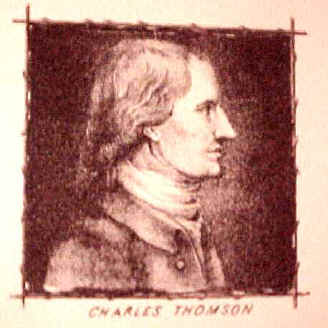
Charles Thomson, Secretary of the The United States 1781-1789,Secretary
of the Continental Congress - 1774 to 1781
Charles Thomson
Secretary of the The United States
in Congress Assembled 1781-1789
Secretary of the Continental Congress - 1774 to 1781
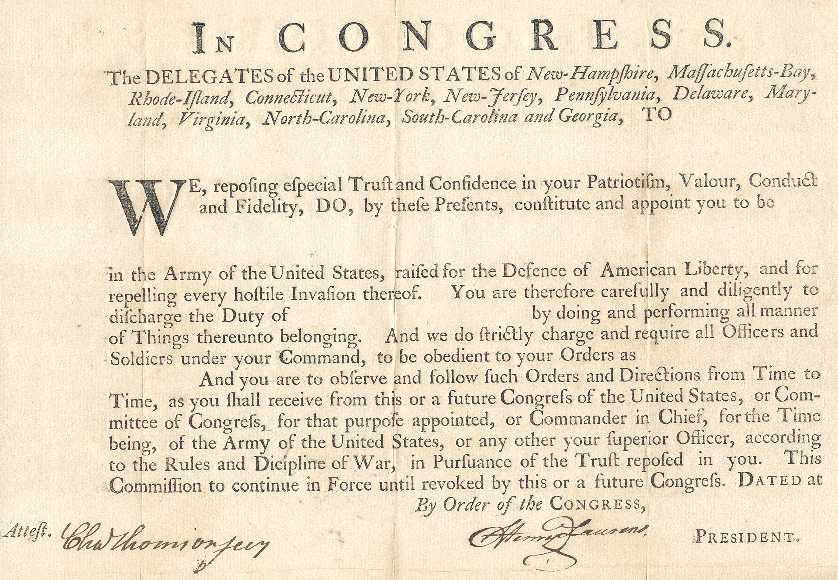
To View a Henry Laurens Signed Document
Click Here
CHARLES
THOMSON was active in colonial resistance against Britain for
decades. Although Pennsylvania conservatives kept him from being elected a
delegate to the Continental Congress, Thomson was chosen as its secretary in
1774, continuing until the federal government came to power in 1789. Thomson
faithfully recorded the decisions that shaped the government.
He was Secretary of the entire pre-constitutional Continental Congresses from
1774 to 1789. On July 4, 1776 the original declaration of Independence was
signed by only two people, Charles Thomson as Secretary and John Hancock as
President of the Continental Congress. The original signed Declaration of
Independence was then taken to John Dunlap, a Philadelphia printer. John Dunlap
printed 500 Hancock/Thomson "typed signed" Broadsides which were distributed to
the members of Congress and the King of England. The original Declaration of
Independence that was actually signed by Thomson and Hancock, however, was lost
in the fever of Freedom. On August 2, 1776 the delegates returned to
Philadelphia to sign a newly prepared Declaration of Independence and for some
known reason Thomson was not invited to sign.
For
fifteen years, from time of Revolution to the ratification of the New
Constitution, Congress would meet in Philadelphia and enact laws and issue
orders. The sessions ended with the delegates returning to their respective
States. Upon their departure one man was responsible for carrying on with the
Government of the United States and his name was Charles Thomson.
Among Thomson's many
accomplishments he is credited with creating the final design of the symbol of
America, the Great Seal of the United States. The seal was adopted by the
Continental Congress in July 20, 1782. Thomson's Great Seal of the United
States, with only minor modifications, remains in use today 218 years later. In
the center of the seal is an American eagle which holds in its beak a scroll
inscribed “E pluribus Unum”; in one talon is an olive branch; in the other, a
bundle of thirteen arrows. A shield with thirteen alternate red and white
stripes covers the eagle’s breast, and over its head a cloud surrounds a blue
field containing thirteen stars.
In 1808, after 19 years of work, he provided the first American translation from
Greek of the oldest version of the Old Testament of the Bible. Few now remain of
the original one thousand published editions of Thomson's four-volume 1808
translation. That same year, Thomson also published his translation of the New
Testament.
Appleton's Biography
THOMSON, Charles, patriot, born in Maghera,
County Derry, Ireland, 29 November, 1729; died in Lower Merion, Montgomery
County, Pennsylvania, 16 August, 1824. He was brought to this country with three
other brothers by his father in 1740. The father died just in sight of land, and
the young Thomsons were thrown on their own resources when they landed at New
Castle, Delaware An elder brother, who had emigrated before them, gave them such
aid as he could, and persuaded a countryman, Dr. Francis Allison, to take
Charles into his seminary in New London, Pennsylvania Here he made rapid
progress, and while yet little more than a boy he was chosen to conduct a
Friends' academy at New Castle.
He often visited Philadelphia, met Benjamin
Franklin there, and was brought to the notice of many other eminent men. His
reputation for veracity was spread even among the Indian tribes, and when the
Delawares adopted him into their nation in 1756 they , called him in their
tongue "man of truth." Reverend Ashbel Green, in his autobiography, says
that it was common to say that a statement was "as true as if Charles
Thomson's name was to it."
He was one of the first to take his stand with the colonists, and he
exercised immense influence, owing to the confidence of the people in his
ability and integrity. He travel led through the country ascertaining the wishes
of the farmers, and trying to learn whether they would be equal to the
approaching crisis. "He was the Sam Adams of
Philadelphia," said John Adams, "the life of
the cause of liberty." He had just come to Philadelphia in September, 1774,
with his bride, a sister of Benjamin Harrison,
the signer, when he learned that he had been unanimously chosen secretary of the
1st Continental congress. "He was the soul of that political body," says
Abbe Robin, the chaplain of Rochambeau. He would receive no pay for his first
year's services, and congress presented his wife with a silver urn, which is
still preserved in the family. He remained in this post under every congress up
to 1789, not only keeping the records but taking copious notes of its
proceedings and of the progress of the Revolution. When he retired into private
life he made these notes the basis of a history of the Revolution but he
destroyed the manuscript some time before his death, as he feared that a
description of the unpatriotic conduct of some of the colonists at that period
would give pain to their descendants.
Mr. Thomson wrote "An Enquiry into the Causes of the Alienation of the
Delaware and Shawaneese Indians, etc., with Notes by the Editor on Indian
Customs" (London, 1759), and "The Holy Bible, containing the Old and New
Covenant, commonly called the Old and New Testament; translated from the Greek
[the Old Covenant from the Septuagint]" (4 vols., Philadelphia, 1808). This
work is now very rare. It contained the first English version of the Septuagint
that had been published at the time, and was considered by biblical scholars in
Great Britain to have reflected high honor on American scholarship His own copy
of this translation, with his last manuscript corrections, is in the
Philadelphia library.
He also published "A Synopsis of the Four Evangelists, or a Regular
History of the Conception, Birth, Doctrine, Miracles, Death, Resurrection, and
Ascension of Jesus Christ, in the Words of the Evangelists" (Philadelphia,
1815), and left in manuscript "Critical Annotations on Gilbert Wakefield's
Works," which were presented in 1832 by John F. Watson to the Massachusetts
historical society.
-His relative, William Thomson, soldier, born in Pennsylvania in 1727; died
in Sweet Springs, Virginia, 22 November, 1796, is said in some Irish biographies
to be the brother of Charles, to have been born in Maghera, Ireland, about 1726,
and about fourteen years old when he arrived in this country. He was taken to
South Carolina by some friends of his family, was brought up as a frontiersman,
and became famous in the district for his skill with the rifle. He fought
against the Regulators in 1771, at the head of a regiment under Governor William
Tryon. He was sheriff of Orange-burg in 1772, and was elected a member of the
first provincial legislature, and the first state convention. He was appointed
colonel in 1775 of the 3d South Carolina regiment, which was known as the
Rangers. His soldiers were all skilful marksmen, and he dispersed the guerillas
of General Robert Cunningham, the Tory leader.
He fought at its head at Charleston in 1776, driving the English back from
the eastern side of Sullivan's island, and was formally thanked for this service
by Governor John Rutledge and congress. He also served with General Robert Howe
in Georgia, was engaged with his command in the attack on Savannah under Count
d'Estaing and General Benjamin Lincoln, and
was taken prisoner after the capture of Charleston. He served afterward under
the command of General Nathanael Greene. He
displayed the greatest bravery during the war, and at the end of it was broken
both in health and fortunes. He was elected sheriff of Orangeburg a second time,
and was a member of the State constitutional convention. Thomson was engaged in
the occupation of an indigo-planter until 1786, when, seeking to benefit his
declining health, he visited the mineral springs in Virginia, where he died.
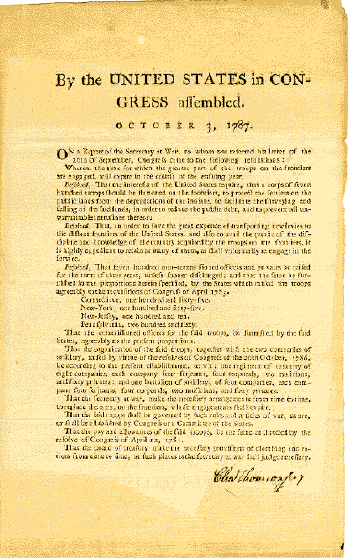
Printed broadside
document signed "Cha Thompson Secy", on a full sheet with the Brittania
watermark and countermark Crown G R, is a Congressional resolution to raise
a corps of 700 troops from the states of Connecticut, New York, New Jersey,
and Pennsylvania for the defense of the frontiers against Indian
hostilities. Dated October 3, 1787.
We invite you to read a
transcription of the complete text of the
Declaration as presented by the National Archives.
&
The article "The
Declaration of Independence: A History,"
which provides a detailed account of the Declaration, from its drafting
through its preservation today at the National Archives.
Virtualology welcomes the
addition of web pages with historical documents and/or scholarly papers on
this subject. To submit a web link to this page
CLICK HERE. Please be
sure to include the above name, your name, address, and any information you
deem appropriate with your submission.
Unauthorized Site:
This site and its contents are not affiliated, connected,
associated with or authorized by the individual, family,
friends, or trademarked entities utilizing any part or
the subject's entire name. Any official or affiliated
sites that are related to this subject will be hyper
linked below upon submission
and Evisum, Inc. review.
Please join us in our mission to incorporate The Congressional Evolution of the United States of America discovery-based curriculum into the classroom of every primary and secondary school in the United States of America by July 2, 2026, the nation’s 250th birthday. , the United States of America: We The
People. Click Here